NCVRD: How Olaolu Slawn created Odumodublvck’s ‘EZIOKWU’

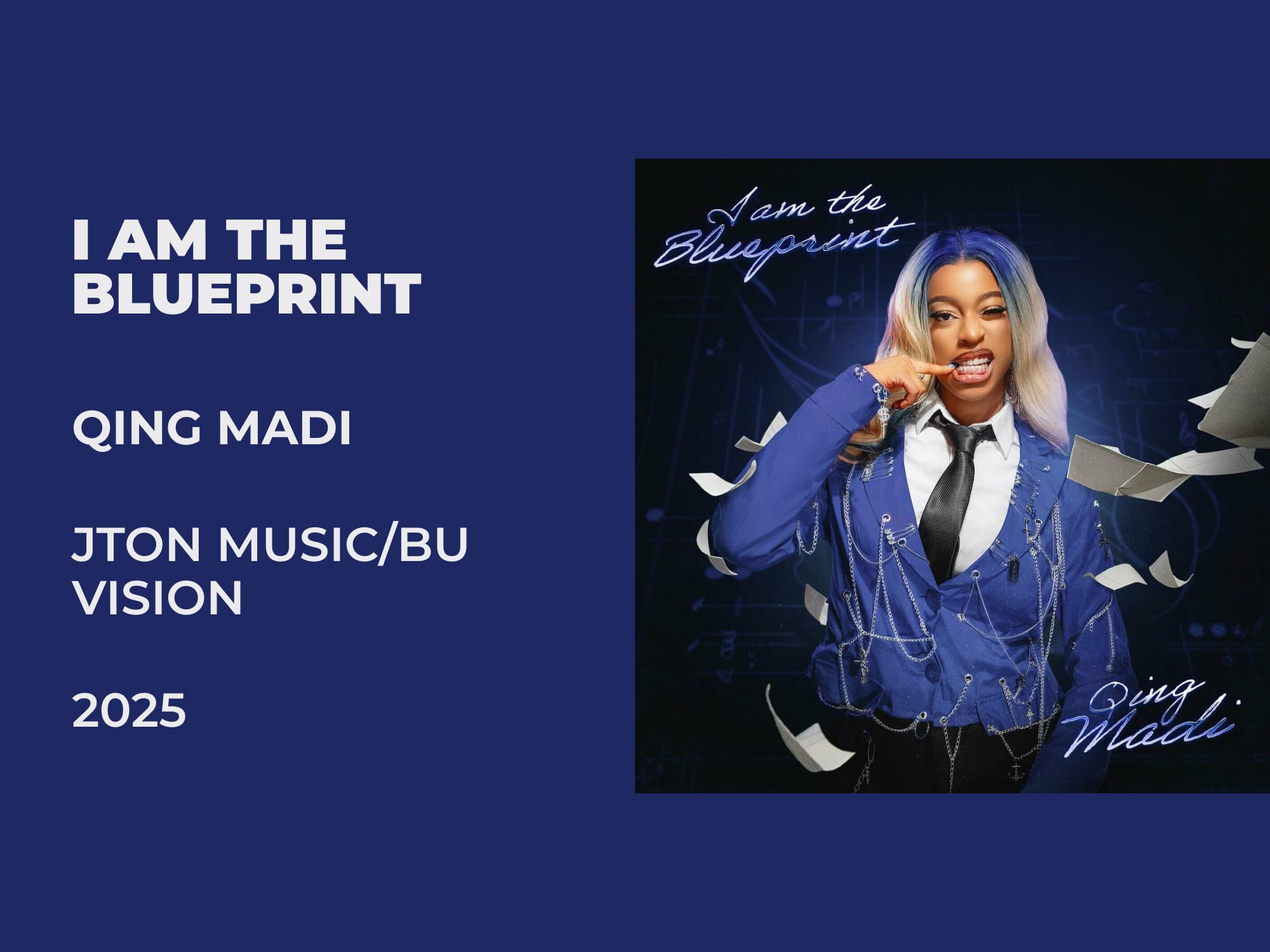
“So I went to his studio, and he just started painting it. He just drew two faces on each side. ODUMODU looking at ODUMODU. Based on ‘Omo, I don’t need to look to anybody to know that I’m the truth. I don’t need validation from anybody.'”

The business of music-making is a largely collaborative process. While it is one of the most essential elements, a number of other factors key into enhancing a listener’s experience beyond the artist’s chosen soundscape. In this post-digital wonderland, where every piece of music seeks attention, the value of a captivating cover art as introductory first impressions is as invaluable as ever. It preempts the sonic adventures across the album and sometimes hints at the themes explored across the album before the audience can hear the music. In some cases, it is also a reflection of an artist’s personality, taste and in this instance, background. 

Considering the level of intricacy adopted through the music curation process, it is only right that the choice of a visual collaborator to accompany all the sonic elements is chosen with utmost care. The artist must have full understanding of the project’s vision and thematic perspective, coupled with what is likely the most important aspect of collaboration —the creator’s personality. In light of this, it was almost a no-brainer that Olaolu Slawn was the chosen creative mind to translate ODUMODUBLVCK’s vision for ‘EZIOKWU’.


View this post on Instagram


A post shared by EZIOKWU (@odumodublvck)

“I think they represent similar things in terms of their rebellious spirits, always speaking the truth and fearlessness. That’s something I see in Slawn and ODUMODU. Being very close to both of them, I definitely get similar energies when I’m around them. I knew that making those two create something together would be extra special.”  – Teezee

NATIVE: How did you and ODUMODUBLVCK meet and when did your relationship bloom?

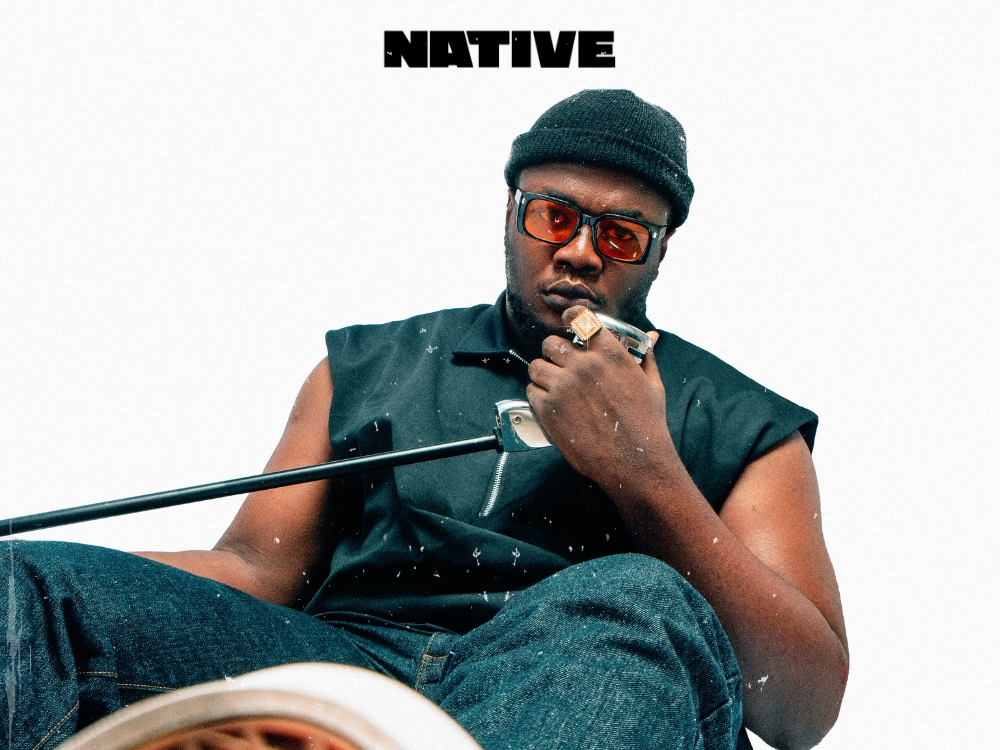
Slawn: I heard his verse on a song and I was impressed so I tapped in with him. It blossomed from there. I kept on tweeting about him and it turned into a whole relationship. I also spoke to Teezee about him. At that moment, there was a lot of controversy on the internet about his verse on a song. When we went to Ghana and  finally linked up, I felt like this was my person. Then it came down to making the artwork and he was very free flowing. I was making the art while speaking to him so the energy that was in the room transmitted easily onto the canvas. 

NATIVE: A major comparison many fans can draw between you and ODUMODU is your relentless attitude to make what you want to make, whether or not audiences may be in disagreement. How did you feel when he approached you to make the mixtape cover?

Slawn: I was gassed but I don’t even think I was approached. I told them I wanted to do it. I had listened to the tracks so I reached out to Teezee and was like “Yo, when is ‘EZIOKWU’ coming out? I want to make a cover for him.” If anything, controversy wise, his energy reminds me a lot of Kanye West. I’m also hugely inspired by Josh Condor and I wanted to create that same energy with reference to our relationship and friendship.

NATIVE: Artist collaborations and commissions can be tricky regarding creative differences. To what extent would you say you were granted creative freedom to bring the visions to life?

Slawn: Well if you don’t know the person, it’s tricky. But I know ODUMODU and I know Teezee. They’re my guys. They’re like my brothers so it’s very evident that it didn’t take a lot for us to produce what we did. The energy is there. It was natural and it was organic.

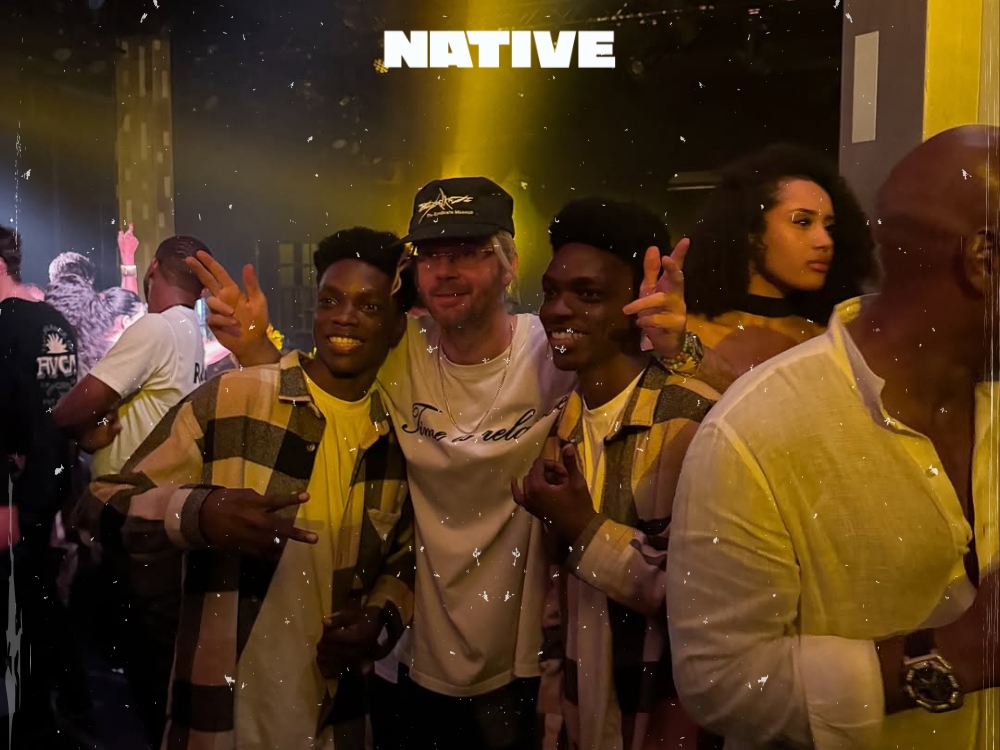
Teezee: We just went to Sloan’s studio and watched him make the artwork. We played the music in the background. Everybody was jonzing and he was doing his p.


View this post on Instagram


A post shared by slawn (@olaoluslawn)

At the nucleus of ODUMODUBLVCK’S mixtape, ‘EZIOKWU,’  Slawn inscribed a slew of symbols popularly known as Nsibidi. This symbolic system of writing, also known as Nsibiri, Nchibiddi or Nchibiddy, was common to the people of south eastern Nigeria. In an attempt to rewrite history, several texts have reinforced that prior to Western civilisation, Africans relied solely on verbal communication with little to no recorded languages. Speakingabout the inspiration behind the mixtape’s visual identity and utilising such key parts of Igbo’s ancestral heritage, ODUMODUBLVCK simply stated, “That’s my heritage. That’s the truth.” 

“When someone says the truth, it covers everything. E even cover reach poverty because for some people, na their life be that. From the time wey we dey suffer to the time way we dey happy, everything is inside the body of work. All those symbols have to be there for people to see that this is what we’re about for real.”

NATIVE: What does the title, ‘EZIOKWU’ mean to you and how did you channel that into creating the mixtape’s cover art?

Slawn: Eziokwu means hefty as far as I’m concerned. Undeniable, hefty and very unapologetic. Those are the best three words I can use to describe it. It’s big energy.

NATIVE: Let’s get into the details of the cover. At the centre, we have some Nsibidi symbols indigenous to Igbo culture. What inspired the choice of such symbols and how do they key into the vision for the mixtape?

Slawn: The white people at some point said we couldn’t read or write, which is clearly a lie. We definitely had some form of communication which is Nsibidi and the name of the album is EZIOKWU, truth, so it felt right to do that.

NATIVE: The most noticeable feature is the symbol of two heads between a crown, one of which we can assume is ODUMODU for the iconic red, black and white striped hat (Okpu Isi-agu). What do these figures facing each other represent?

Slawn: Who ODUMODU is in real life is kind of the same person he is online. So ‘EZIOKWU’ is like him against himself but they’re pretty much the same. One of them just wears the red cap and the other does not. When he goes home he’s going to take off the red cap so he’s not always wearing it.  It’s him against himself, but it’s still him regardless.

NATIVE: What informed this choice of a colour palette with red, black, white and yellow?

Slawn: So usually if I’m doing a painting like that for someone like ODUMODU, I want to make it powerful. I always cover up really good previous artworks of mine. I’ll cover it and then the artwork that’s under will seep through so you can see it. That’s how that base colour came about. It wasn’t a hard decision. I just covered up one of my favourite paintings. Red, white and black are also just his colours considering the hat he always wears. 

NATIVE: The release of this mixtape is a momentous occasion for ODUMODUBLVCK and the wider fabric of Drill music in Nigeria. What’s it been like being a part of the creative process?

SLAWN: I’m just happy to be working with a friend. All that hard stuff doesn’t really matter to me at the end of the day. I’m just happy to have been part of the whole process.


Interview by Chigoziri Ezeaku. 


ICYMI: WHAT TO EXPECT FROM ODUMODUBLVCK’S UPCOMING PROJECT ‘EZIOKWU’

Mohbad shines brighter from the afterlife—the charts have tangible proof

It’s been more than three weeks since Mohbad—born Ilerioluwa Oladimeji Aloba—passed away. The man, who before his death had rechristened him Imole, had left behind a wife and child, family relatives, distraught fans and music lovers, a fine discography of music etched with his life experiences. A candlelight procession held in his honour at Lekki, Lagos had attracted thousands of mourners, including fans and industry colleagues such as Davido, Zlatan and Falz. A thank-you note on X (previously known as Twitter) had, in part, read, “Your loyalty and love will keep him alive in our memories forever,” exemplifying the outpour of condolences that have trailed MohBad’s passing.


View this post on Instagram


A post shared by The NATIVE (@thenativemag)

On the other hand, the unclear circumstances of Mohbad’s death have alerted the Lagos State Police Command of the possibilities of foul play—heightened by the release of videos that showed the bullying and intimidation MohBad faced as well as his well-documented run-ins with previous label and its boss Naira Marley. An autopsy is being conducted by the police who have also recently taken Naira Marley and Sam Larry, a close associate of Marley, into custody for questioning. There is also confirmation by police that Primeboy, an associate of MohBad, is another person of interest in the investigation. While the case is still shrouded in a lot of mystery, it is hoped that the police will be able to unravel the details and circumstances that led to Mohbad’s untimely passing.

While death is a constant occurrence in the cycle of life, there’s usually unimaginable grief that follows the death of a person still in the early years of their life. Mohbad was 27 when he passed away, and in many places and cultures around the world, that age is far from deserving of meeting their end. Although MohBad isn’t here anymore, he’s left memories of himself in his music, and it’s this music that serves as a connector to his ideals and pains and wins and aspirations. This week, music data curator TurnTable Charts released their Official Nigeria Top 100, revealing MohBad in six spots on the Top 10, including No. 1. There’s “Ask About Me” leading the pack, “Beast & Peace” at No. 3, “Pariwo” with Bella Shmurda at No. 6, “Peace” at No. 7, “Sabi” at No. 8 and “Sorry” at No. 10.

“Like many street-pop artists, Mohbad didn’t try to be everything to everybody; he sang and rapped for himself, for his people—people raised in circumstances where you have to make shit happen because that was the only option,” Dennis Ade Peter wrote in his tribute to MohBad. Born and raised in Ikorodu, a suburb in Lagos State riddled with many challenges, ranging from poor infrastructure to pervading poverty, the singer’s music chronicled his path through life in plain and affecting detail. On “Sorry,” the opening track of MohBad’s 2020 EP ‘Light,’ the artist opened up about his difficult upbringing, singing, “Daddy no get salary/Ten years I no see money/Stepmother no care/Landlord e dey worry/My brothers are hungry/Daddy gather money make I go poly/I go poly but I no go class/Daddy, I am sorry/I don dey do Yahoo.”


Mohbad’s earliest efforts boasted sharp wit and attention to detail as he highlighted the occurrences in his immediate environs, addressing matters of cult violence, youth unemployment, desperate swings and finding hope. On 2019’s “Imole,” Mohbad poured years of frustrations and longing into the track as prayed for a change in his fortunes. “Take away my pain give me fame/Take away my weakness give me strength/Take away my korope give me Benz/Oh lord, this stress is not for me,” he raps. It’s this aspirational tone—relatable to millions of young Nigerians grappling with personal, economic and institutional setbacks—that endears listeners to MohBad’s music, as it is a reminder that they are not alone in the race to reach the top.

After Mohbad’s death and the suspense of its circumstances began to circulate, fans and colleagues in the Nigerian music industry took to social media to pay homage to the artist, sharing stories about him and the impact he had on their lives. It didn’t stop in Nigeria. American Hip-Hop stars Lil Durk, Kodak Black and Meek Mill also paid their respects to Imole, further highlighting the fact that music is a unifier of people and cultures. Mohbad’s most recent project ‘Blessed’ became the first EP to top Spotify Nigeria’s weekly albums chart and, according to TurnTable Charts, MohBad becomes the first artist to posthumously reach No. 1 on all the three major aggregate charts in Nigeria: The Official Nigeria Top 100, the Official Top 50 Albums Chart in Nigeria and Official Artist Top 100.

Globally, artists topping music charts posthumously isn’t a new occurrence. Juice WRLD’s 2020 album ‘Legends Never Die’ , which came one year after his death, debuted at No. 1 on the Billboard 200 albums, becoming the biggest posthumous debut in 23 years since Tupac and Notorious B.I.G. posthumously released albums in 1997. Lil Peep’s 2018 album, ‘Come Over When You’re Sober’, reached No. 4 on the Billboard 200 in its first week. “The overwhelming love that millions of music fans clearly have for Jarad reminds us how much his poetic words, creativity, and bright light continues to shine throughout the world,” Juice WRLD’s mother, Carmela Wallace, and record label Grade A said in a statement about ‘Legends Never Die’.


Although posthumous releases have offered fans and music lovers the opportunity to get new materials (sometimes unfinished) from their favourite artists, there is an argument that it is an exploitative act that disregards the privacy and creative rights of the artists. In her article for The Outline, which centres on Lil Peep and XXXXTentacion’s “Falling Down,” Rosemarie Ho questioned the ethics of pairing two artists who didn’t share the same ideals while alive, writing, “Had Peep ever liked X, or wanted to collaborate with him?…X was a well-known domestic abuser, who once bragged about beating up a gay cellmate in prison, who systematically brutalised his ex-girlfriend and admitted to it.” Other critics have also argued that most posthumous releases are families’ and labels’ way of earning quick cash from the sympathy and sour mood surrounding an artist’s demise

While it’s yet to be seen if there will be any posthumous Mohbad releases, his achievements on the charts point to the accessibility of his music, which offers insight into his person. A significant portion of his discography is built on introspective, lived-in musings and spiritually-indebted quips. “I open Bible chaptеr/I step on the Satan,” he sings on “Ask About Me”; and on the evergreen “Peace” (Marlian affiliation no less), the lyric sequence, “Wetin be this one like this?/Been through many things/Many many gists, though I still find my peace,” is one of the most resonant in Nigerian pop. Further highlighting the impact of MohBad’s music career is Ayox & Zlatan’s “Walking Dead (Tribute to Mohbad),” which is at No. 9 on the TurnTable Top 10. These songs are the avenues that fans connect with MohBad and ensure that his thoughts, fears, pains and proclamations are not lost to the winds of time.

“There’s no neat resolution to his life, he could’ve written so many more chapters if he had more time. However, his work is testament that he lived as best as he could,” Ade-Peter concludes. It’s this admittance of a life lived that fans and audiences around the world observe through Mohbad’s music. It’s this admittance that secures his voice in our airwaves, sharing his gospel of light.


ICYMI: The Bob Marley ‘Africa Unite’ Album Raises New Questions About Posthumous Projects

NATIVE Exclusive: R&B-rooted singer Kaien Cruz embraces sonic and emotive diversity

A spellbinding feature of the South African Music scene is its diversity. It’s a reflection of its societal make-up. “They call South Africa the rainbow nation because there’s so many different cultures, languages and people,” LA-based, South African artist, Kaien Cruz tells the NATIVE. “A lot of the world that isn’t aware of the diversity that Africa holds, is kind of surprised by the fact that there’s African artists that make pop songs or country songs for example. It’s always done in a way that still holds the essence of Africa as a whole, and all the different cultures.”

For Kaien, their music is rooted in R&B, a genre with a gamut of exciting talent in South Africa. In conversation with the singer, their ethos of diversity and providing a new perspective shines even clearer and if any artist understands the sheer power of staying true to oneself, it’s them. But it hadn’t always been this effortless. Growing up as a non-binary person in South Africa and relocating to Los Angeles so early on in their career and adulthood, amidst its challenges, the journey to self-discovery was understandably a tumultuous one.


View this post on Instagram


A post shared by Kaien Cruz ♾ (@kaiencruz)

This left Kaien Cruz only one choice: Music. Amidst life’s many obstacles, coupled with navigating the industry as an independent artist in a foreign country, they found solace in creating. Singles like “Fa111ing Angels” and their lead extended play, ‘Buffering…’, showcased Kaien on new levels of self-acceptance with music serving as a chosen vessel for expression. “The industry is getting more diverse and open to different types of people and people who aren’t fitting into standards or norms,” Kaien shares, relaying their gratitude for being able to hold that space.  

We get a well-rounded story-telling approach and heightened levels of vocal maturity on their recently released single, “I Lay,” along with a remix that features Kenyan songbird Xenia Manasseh. The pair stays true to their R&B roots, seamlessly gliding across the track’s smooth Pop-leaning soundscape while telling a story of timeless connection and love with their blue-eyed perspective on romance. For their debut album, over three years in the making, Kaien is set to unveil another layer of their artistry, delivering a summative report of their journey so far with a vivid collection of stories, memories and experiences all tied together by their buttery vocals and pristine production.

The album is my outlet and therapy for going through life’s challenges at the time. You can find themes of love, self, relationships, life, heartbreak, joy, betrayal, connection, and just the full spectrum of emotions,” they explain. Ahead of the release of ‘KAIEN’, slated for October 26, we caught up with Kaien Cruz to detail their creative processes for the debut album, the moments leading up to the momentous release and their early music journey leading up to this moment.


Our conversation, which follows below, has been lightly edited for clarity. 

NATIVE: You’re from Pietermaritzburg, have lived in Durban and have also moved to Los Angeles. How has this interaction with different places and people contributed to the art you make?

Kaien Cruz:  I grew up in a small town on the south side of Durban called Pietermaritzburg but I ended up going to uni in Durban for a while. There I met some really cool local producers and artists and that’s when I kind of began my music career.  I never really thought that music could be something that I actually did full-time. Music was always in the background  for me. I played the guitar in my room,  just for myself and I would write songs with therapy. I graduated high school and right at the end, I started posting  little 15-second clips on Instagram covers. Someone had reached out who was a rapper at the time inviting me for my first session in 2016. I recorded a couple of songs which ended up on the radio. One of them, [Sketchy Bongo’s] Love Me in the Dark,” I’d written on guitar and later produced as a Dance track.

That’s how I ended up being a top five in the country which led to us opening for Justin Bieber as part of this tour in Cape Town and Johannesburg. That opened so many doors by performing a lot and working with really cool artists like Nasty C. Which then led me to meeting these two producers who were from  Zimbabwe but lived in LA. They were the ones that introduced me to the concept of moving to LA and going down that path. I then worked on a visa for a while and at the end of 2019, I got a visa. I came to LA for a couple of months just to check it out and make music. I went back to South Africa and in 2020, I came again for just a couple of months. COVID hit and I was stuck in LA. I had to make the decision of either staying or going back home so I chose to stay.

When did you realise you wanted to pursue a music career and what sort of support did you receive on a familial level if any?

I think my family has always been mostly supportive. My parents just had the concern of, you know, me being taken care of  and having everything that I need. With me dropping off uni, they did have concerns at first but I think once they saw that I was having success in music and I was really doing what I love, they became  fully supportive. 

Who were your early music influences and how would you say they affected the sort of music you make?

It’s kind of a mixed bag for me since I grew up in South Africa. It’s so diverse and there’s a lot of genres and cultures. Growing up, my family was super religious so we didn’t really get to watch TV a lot or get exposed to different types of music other than what my dad would  play. My dad loves jazz music, the old school stuff like Earth, Wind and Fire and so that’s what I would listen to mostly. I think I was 13, or 14 when I started high school and that broadened my perspective because all of my friends at high school were listening to different types of music. That  opened my world. Also, listening to music on the radio because radio is really big in South Africa and music discovery. That’s how I got exposed to more hip hop and R&B etc. That is what bleeds into my music now and allows me to bounce between genres and do things that are not really in a box. That is my favourite way to create now so it definitely had a big impact.

How would you say your taste has evolved? Do you still listen and gravitate towards the same type of music and if not, what’s new? 

Getting older and developing myself as my own person outside of my family,  discovering who I am has evolved my taste naturally. When you’re younger, you’re more selective and kind of picky. And then things just grow on you so I feel the same way about music.


NATIVE: So far, you are an independent artist. What has been the most enjoyable thing about single-handedly taking charge of your career and what has been most challenging about that too?

Kaien Cruz:  It’s been a challenge, to say the least. But it’s definitely worth  the things that you go through as an independent artist. When you come up with whatever idea sparks the most joy and be able to see that idea through and not have to sacrifice any parts because someone else is in control, it’s rewarding. That’s definitely the biggest benefit. And also obviously, like financially as well,  I’m seeing most of the profits from my music. Mostly, it’s the creative freedom.

You featured on “Love Me In The Dark” which was nominated for the South African Music Awards (SAMA). That must’ve been a phenomenal moment. How did that feel and how would you say that moment has impacted you in the long run?

I think that definitely gave me a foot in the door, locally, especially. Then also opening for Justin Bieber as well. But mostly, personally, it just gave me a lot of lessons. I had no knowledge prior because no one in my family makes music. The question of What am I supposed to do? Is this the right decision? What are industry standards? Were largely unanswered. I was so young, with no management and the support of my family was great but they also didn’t understand how the industry worked. So being thrown in the deep end like that was a big experience that allowed me to take away a lot of lessons that I carry with me now.

South Africa is incredibly rich in music, how would you say being from this part of the world has influenced your style? 

They call South Africa the rainbow nation because there are so many different cultures, languages and people. Naturally, just growing up in that type of environment has given me a pretty broad perspective. I understand a broad spectrum of people and cultures and I think that does carry over to the music side because that environment was rich with different sounds and languages. Naturally, that has poured into my music influences and what I gravitate towards. 

How do you see your music contributing to or standing out within the broader South African music landscape?

My music shows that South Africa is diverse. A lot of the world that isn’t aware of the diversity that Africa holds, is kind of surprised by the fact that there are African artists that make pop songs or country songs for example. It’s always done in a way that still holds the essence of Africa as a whole and all the different cultures. For people listening to my music, they get a taste of all the nuances and the differences of the culture.


NATIVE: You have spoken about how applying for and being granted an artist visa to the United States was one of the most challenging obstacles you had to tackle to be able to pursue a career as an artist on a global scale. Why was the move necessary for you?

Kaien Cruz: It worked in multiple ways. I was 20 years old when I moved. Moving away from home at that age is always  a big step of growth, no matter what you’re doing. So moving to a whole new country especially comes with a lot of new challenges that you have to navigate on your own and that alone. LA is such a cool place where you can make up anything and people would be on board with it. You find people who are on the same journey as you and can provide support. The move for me in multiple ways was definitely something that allowed me to grow in the full sense of the word. Doing that away from family, in a new country and as an independent artist as well, I was very independent in all the ways. That has just given me all the tools that I need to take my music to the next level and I’m grateful for that experience.

What’s the story behind the remix of your latest single with Xenia Manasseh? How did that come about?

I worked with a producer Aus Young who actually produced a lot of the project that I’m releasing in October.  I had done a trip to Costa Rica for a couple of months to shoot the “I Lay” original music video. One day I called Aus and mentioned working with Xenia. I checked her stuff out and I had heard one of her songs before and she’s just so incredible. So I didn’t really think much of it at the time, I was just thinking maybe when I come back to LA, we could get into a session. Some months went by and I got back to LA. We were brainstorming ideas for the single I just dropped seeing as it was doing really well. We decided to get a feature on “I Lay” and for some reason, Xenia’s face just popped into my head. So I sent it to her and she loved it. I was patiently waiting and something like the next day, she sent it back with her verse. I played it for the first time on my speakers and by the first line she sang, I thought it was a done deal. 

You have worked with African artists like Tellaman, Nasty C, Lucasraps and now Xenia. Why is it important for you to keep your connection to the artists on the African continent alive?

I think naturally, those are the artists that I started with when I first got into music and so they will always hold a special place for me and my journey. They give me a sense of home and that nostalgic feeling is a grounding presence. That’s what it will always be for me. I always enjoy working with them.

With your debut album on the way, can you walk us through the inspiration behind the album and theme? 

This project is my first full body of work which is really exciting. It’s been three years in the making. This  project covers the journey of my moving to LA, navigating the pandemic away from family, trying to seek out life and music, personal growth and so much more. The album is my outlet and therapy for going through life’s challenges at the time. You can find themes of love, self, relationships, life, heartbreak, joy, betrayal, connection, and just the full spectrum of emotions. It sums up my experiences over the past couple of years. Genre-wise, I flow between R&B, Pop, and Afropop, which are my favourite genres right now. I’m excited for everyone to finally get a full body of work that really showcases the different styles that I love to work with and just my perspective of life so far. I collaborated with some really cool people on this project like Aus Young and Dan Faber, who’s worked with Kendrick and Lizzo. I also have one feature on the project and it’s unbelievable. I think people would be really shocked hearing that. Just a super cool project with something for everyone that encompasses my journey.

What did your creative process entail? 

It’s different every time. It depends on what first sparks the inspiration. If I go into a session and a producer plays me something that I like, then it starts with an instrumental first. Usually, I do lyrics before melodies but sometimes I do melodies and lyrics start coming out and I start freestyling and it evolves. Sometimes, I have a story in my head already that I want to write about or an experience that I want to get out. Music for me is like therapy. So sometimes things happen in life that weigh me in a way that I have to relieve myself of those emotions through music. It depends on the origin of inspiration but it’s different every time.

NATIVE: As we’re anticipating the album release, is there a particular message or feeling you hope listeners take away from the project? 

Kaien Cruz: With my music, I always want people to take away whatever it is that they need from it. If I have a lyric that has to do with heartbreak, whichever individual is listening  is going to think about their own experiences and that’s what I hope with the things I create—that people can take something for themselves or just feel less alone in the experiences. We all go through heartbreak, happy times, sad times and confusion but whatever it is, the truth is that we are not alone in our experiences. We can all relate to these things in different ways no matter the level you’re on. That’s what I hope my music does.

Representation and inclusivity are crucial points today. As a black queer person, how do you envision your music contributing to a more inclusive and diverse entertainment industry?

Being outside of the box comes with some sorts of difficulties, and challenging a lot of concepts that have been in place for ages. There needs to be a shift if we are going to have an environment that is more inclusive. I’m really proud to be able to hold space for that and be someone people can look up to and relate to. The industry is getting more diverse and open to different types of people and people who don’t fit into standards or norms. It’s really important to have that representation for kids growing up to see that it’s possible to achieve whatever it is you want no matter what you look like or where you come from. I am proud to hold that space. 

Reflecting on your musical journey, is there a piece of advice you’d give to your younger self when you were just starting? 

I think it’s just remaining pure in my intentions. In any industry, if you get really into it, it can get really overwhelming and can cloud your judgment. People can be really influential in your decision making and I think the advice I’d give to anyone is to hold your ‘why’ really close. Why are you doing what you’re doing? Hold that really close and be really clear on that. It has helped me to know if I’m on the right track and get back on the right track when I’m falling out of it. I remember that I’m doing this for the little kid who grew up with a huge dream  in a very small town and had no opportunities. So I remind myself and whoever needs it that anything is possible. 

[Featured Image Credits/The NATIVE]


ICYMI: XENIA MANASSEH BREAKS DOWN HER DEBUT ALBUM, ‘LOVE/HATE, PT. 1’

NATIVE Selects: New Music From Suté Iwar, Kabza De Small, Ayra Starr & More

It’s that time again. Every week, new music shows up, sweeping fans and music lovers off their feet while artists gauge reactions to know the effect of their creativity. At the NATIVE, we are committed to keeping our ears on the pulse of the music scene and bringing the best sounds to your doorstep. In our last edition, we brought you stellar new releases from Obongjayar, Bayanni, Kojo Cue and more. Today, we have songs that move from Afropop to Amapiano to R&B, with our select artists showcasing their unending talent and passion for creativity. Lock in!

SUTÉ IWAR & OGARANYA – “EARTH ANGEL (MIDNIGHT MANOEUVRES REMIX)” 

Suté Iwar’s Earth Angel” lies amongst the other 14 tracks which sums up his impressive body of work ‘ULTRALIGHT.’ featuring the electric Nigerian talent, Ogranya, “Earth Angel” is a rap song infused with Afropop rhythms and lyrics. With the success of Earth Angel,”  Midnight Manoeuvres decides to hop on and add his alternative flair introducing a dancehall alternative. 

LABDI – “TIKNI” 

Kenyan songstress, Labidi, with the help of Mozambique talent, Muhamgo, work together to deliver the earworm that is “Tikini.” From the very first note, Labidi does an excellent job of capturing every listener’s attention. Her voice gracefully rides on a traditional African rhythm with the help of traditional instruments such as the nyatiti and shakers. She comes armed with her mother tongue as she sings eagerly for her lover. 

NOON DAVE – “HILARY REMIX” FT. PABI COOPER 

Hilary” was Noon Dave’s first song of the year which followed after his debut single, Brunch” in 2022. With the massive success received on Brunch”, Hilary” was born. Collaborating with South African sensation, Pabi Cooper, both artists rub off each other’s voices perfectly as they try to dive into the complexities of toxic love. Noon takes us on a journey of a toxic love affair which he needs to escape from. 

Y’AKOTO – “DREAMBUG”

On her latest single “Dreambug,” Germany-based Ghaniann singer Y’akoto teams up with Grammy-nominated producer Nabeyin and Grammy-nominated engineer IRKO, who respectively have worked with Kanye West, Drake, Travis Scott, The Weeknd, Jay-Z and Sia, among others. “Dreambug” is a bubbly tune of perseverance during and victory over difficult conditions. “Living my life/Moving mountains till I die/Move to the side/I trip up but that’s alright,” Y’akoto sings. The song inspires as well as gets the listener up on their feet to dance.

DJ MAPHORISA & TMAN XPRESS KABZA DE SMALL – “WEH MAMA” 

The commitment to keeping Amapiano in the spotlight is real as it continues to climb up the ladder and defy all musical boundaries. Weh Mama” is part of a larger body of work, ‘Chukela,’  put together by South African vocalist, Tman Xpress and DJ Maphorisa. South African DJ and record producer, Kabza de hops on “Weh Mama” to produce an all round Amapiano feel. 

BIA – “CHATTY” FT. ODUMODUBLVCK & PA SALIEU

Off her international deluxe album, Really Her,’ BIA features Nigerian rapper, Odumodu and British rapper Pa Salieu on one of the 16 tracks, Chatty. The three artists bring on their A-game as they deliver verses with poignant lines and bars. Odumodu never fails to bring his authentic energy on every track he hops on and “Chatty” is no different. 

NOT3S & ODUMODUBLVCK – “HIGH FASHION” 

British artist, Not3s teams up with Nigerian Drill artist, Odumodublvck to release High Fashion” A song that appreciates the finer things in life. Bringing their unique styles and auras to the track, these artists are not afraid to create a vibrant fusion of Afropop and HipHop. Odumodu’s rap verses hitting hard against Not3s’ smooth vocals contrast in a rather good and infectious way.

NEIKED – “YOU’RE HIRED” FT ARYA STARR

Multi-talented artist, singer and songwriter Neiked locks in with Nigerian superstar Arya Starr to release “You’re Hired” Her last single, “Rhythm and Blues” is still making waves in the internet space and with “You’re Hired” out, she seems to be delivering back to back dope records. This pop-infused song showcases Arya’s vocal prowess as she sings about an unsure love towards a special someone. In the pre-chorus, she worries, “All this love/ I don’t know what to do/ All this love/ Can I show it to you?” But despite her worries, she believes that if he can try then she can too as she croons “If you’re tryna be my man, you’re hired.” 

KEVWE – “ME & YOU” 

Upcoming sensation, Kweve, known mostly for her freestyles and her podcast Kevwe & Cam, lets her vulnerability longer on her sleeve in this bittersweet single Me & You.” Being her first song of the year, it’s safe to eat she did a good job in exploring the complexities of lost love and heartbreak. She showcases her impactful lyrics with a soothing and soulful voice that convincingly pours out her emotions into this once-upon-a-time romance. 

JOEYTURKS – “LEANING”

Returning to the music scene, Joeyturks drops his first single of the year, “Leaning.” He features Boistory on the track and delivers a jazz feeling on the masterpiece. He professes love to his lover and emphasises her being the one he leans on. “Cuz you’re my one I’m leaning o, my one.”


Words By Chigoziri Ezeaku


[Featured Image Credits/The NATIVE]

How George Weah came to be known as Liberia’s man of the people

September 2023. Liberia. The West African  nation is in full election season mode. General polls are scheduled for early October 2023 and running for re-election as president is George Manneh Weah, erstwhile global football superstar and philanthropist. At a party rally President George Weah steps out to the podium, and the crowd goes wild: “Muyan! Muyan! Muyan!” In that crowd, shouting, is Jacob Kollie, a 27-year old bike rider in Monrovia.

“I am a cdcian (the name members of Weah’s party are called) to the core,” Kollie declares. “I love Weah, he is like me, he came from the streets. He doesn’t look down on us, the man is humble, and he employs youth in his government. I am just riding bike to hustle, but I want to play football, anywhere Weah goes I will follow him.”


From the Football Pitch to Public Office

Weah’s journey to the presidency started in Clara town, a low income area in Monrovia, where he was born and raised. Growing up in a low income household, Weah first learnt to play football using rags which were molded into a ball, building the skill-set of his generational powers through humble beginnings. Often lauded for his pace, stamina, technical ability, and brilliant attacking instincts, Weah started his football career playing for Mighty Barrolle and Invincible Eleven, the two clubs that dominated Liberia’s local footballing leagues.

After winning numerous trophies and writing his name in Liberia’s footballing circles, Weah moved to Cameroon where he played for Tonnerre Yaounde. It was at that club that Claude Le Roy, then coach of the Cameroon national team, noticed and recommended him to legendary football coach Arsene Wenger, who eventually signed George Weah to French club Monaco in 1988, after visiting cameroon to watch his then newest discovery.

In Europe, Weah shined even brighter, quickly becoming an even more skilled and productive attacker under Wenger’s guidance. In 1991, he won the Coupe de France with Monaco, and in 1989, he was named African Footballer of the Year. In 2018, George Weah, now president, awarded Wenger and Claude Leroy ‘Knight Grand High Commander of the Humane Order of African Redemption’, for their development of African Football.


George Weah had a successful stint in Monaco before moving to Paris Saint-Germain in 1992, where he would go on to win Ligue 1 in 1994 and lead the UEFA Champions League in scoring that same season. In 1995, he signed with Milan, where he would spend the next four seasons and win the Italian Serie A on two separate occasions. At the end of his career, he moved to England, returned to France and finally retired from the Emirati club Al Jazira in 2003

Weah also gave significant contributions to the growth of the national team in Liberia as he paid out of his own pocket for the national team’s kit, to give the players spending money, and for the national football team to travel to matches during the Liberian civil war. He also led the country’s “golden generation” of players, including Christopher Wreh, James Debbah, and others, to the CAF Africa Cup of Nations in 1996. Unfortunately, Liberia never went far in the competition.

As a footballer, George Weah earned legendary honors including African player of the year, the FIFA World Player of the Year and the prestigious Ballon D’Or. Till date, Weah remains the only African player to have won the Ballon D’Or. “When I started playing football, I never thought I would ever win the Ballon d’Or and emerge as the best player in the world,” Weah said of his seminal achievement. “I just had a passion for the game and I worked hard. Every day. I would rather train than eat or sleep.”

Asides his footballing exploits, Weah has also endeared himself to his supporters as a result of his work as philanthropist. During and after the Liberian civil war, Weah worked with UNICEF to provide relief for many Liberians. In 2005, when Liberia returned to democratic elections after its war, Weah emerged again, this time he was running for president. Despite winning the first round of the elections in 2005, Weah eventually lost the presidency to Ellen Johnson Sirleaf who became the continent’s first female president. During the elections, Weah lost out in part to voters saying he was unqualified as he didn’t have a university degree.


Not letting defeat get the best of him, Weah went back to school and obtained his high school diploma in 2006, aged 40. He then proceeded to DeVry University in Florida, obtaining a bachelor’s degree in business management in 2011 and a master’s degree in public administration two years later. In 2011, he ran for public office and lost again, this time as a vice presidential candidate. However, in 2011, Weah’s party, Congress of Democratic Change, boycotted the second round citing irregularities. In 2014, he ran and won a senate seat in Montserrado, a county that hosts the capital of Monrovia and is the most populated in Liberia. Building on that, he entered into a coalition with three other parties forming the Coalition of Democratic Change, and won the presidency in 2017, largely with the help of his youth base who stood with him.

Speaking on why Weah has been able to maintain his youth base, Joshua Kulah, a Liberian lawyer and political science lecturer says; “Weah has been able to garner and maintain his youth base because no other political actor in the country has been able to relate to young people as much. From his story from the streets of Monrovia to world fame, George Weah has been one of the silver linings in Liberia’s story. As a result, young people, a lot of whom are struggling and working to meet his heights, can relate and connect to him in a way they can’t relate with others.”

Free Education

In August 2018, President Weah declared that the University of Liberia and all other Public Universities in Liberia will now be tuition-free for all undergraduates. University students at the time had been protesting a recent rise in tuition fees—from an average of about $40 to $65 per semester—claiming it was unaffordable. Since resuming the presidency, Weah’s government has also paid the WASSCE exam fees for all 12th graders.

According to World Bank statistics, the gross national income per capita stood at just $570 in 2020, thus for many Liberians, mostly youth, education is expensive. As a result, Weah’s free tuition policy aimed to address this issue in order to lower dropout rates and enhance enrollment and retention. However, critics argue that, while the tuition-free policy has boosted access to education for many young people, it has also diminished quality by reducing university funding, as tuition fees were a key source of finance.

As a result, the university’s educational quality and educational infrastructure quality have declined. For instance, University students demonstrated against poor infrastructure to facilitate online learning during Covid lockdowns. Meanwhile, professors at the University of Liberia, the country’s largest public university, have gone on strike repeatedly over unpaid wages, infrastructure issues, and bad working conditions.


Weah and Music

Weah has also been able to connect to the youth through music. His relationship with music is a long one, in March 1998, in collaboration with the Italian Committee for UNICEF, Weah launched a CD called ‘Lively up Africa’ involving the singer Frisbie Omo Isibor and eight other African football stars. The proceeds went to children’s programs in the countries of origin of the soccer players involved.

At the height of the coronavirus in Liberia, President George Weah also recorded a song to inform Liberians about the coronavirus, which was then broadcasted throughout the country and was able to reach remote areas which led to sensitization on corona. In 2014, when Liberia was affected by the Ebola virus, he did the same to raise awareness. However, his music has not been restricted to just sensitization. Under the artistic name of “Rabi”, music has been ‘unofficially’ released covering various topics on happiness, betrayal, and he even did the theme song for a beauty pageant.

In February 2023, he released a song called “Talk Talk” where he allegedly shades top opposition figures Alexander Cummings and Joseph Boakai. While the song didn’t refer to the two men explicitly by name, lyrics throw jabs at a ‘Mr B’ and ‘Mr C’: “Mr. B wants to become president, Mr. C wants to be president, but all they do is just sit and talk the talk.


Despite his love for music, the structural problems of Liberia’s music industry still remain. Firstly, for artists, streaming is an unpredictable source of revenue due to the lack of internet and data service availability in many parts of rural Liberia. With 2.8GB available for $5 in areas with internet connectivity, it is well-known as one of the most costly data prices in the sub-region. As a result, music lovers turn to illicit downloads or free streaming services like Audiomack. The music industry also lacks proper infrastructure and distribution channels, which makes illegal downloads the norm


Liberian artists also can’t tour their cities and towns because the country’s roads aren’t very good. This makes it harder for them to make money. This bad transportation network has resulted in a concentration of shows in Monrovia, the nation’s capital city, which lacks proper show venues—for example, the biggest indoor venue can only accommodate about 700 people. Despite this, compared to the campaigns of other candidates, George Weah has had a greater level of support from Liberian artists, who have even organized concerts and written campaign songs to influence voters.

Man of the People

At age 51, George Weah made history as the first former professional footballer to become president of an African state. His feats lend to his consideration as an inspirational figure. For a man who followed his dream, rose through the slums of Monrovia to reach global football royalty status – earned on the streets of France – and is now the President of Liberia, it’s no surprise that he’s viewed through gilded lens by the youth populace, which also happens to be the main bloc that voted him into the highest public office in the country.


Even with the myriad criticisms he’s faced, from early concerns over leadership style to the (in)effectiveness of his economic policies and his recent long stay abroad, it’s clear that George Weah’s legend still has a massive sway over many Liberians. At age 56, he is hoping to replicate his 2017 victory. With Liberia’s population being majorly youth, Weah will be hoping that his largely youth base will stick with him and get him over the finish line. 

“I will vote for Weah,” Kollie says. “I have children. I will vote for him so my children know that they are on the street now, but they can be something one day. If Weah can do it, then they can do it too.”


ICYMI: How the latest presidential elections project a better future for Zambia

Best New Music: On “Sote,” DanDizzy & Falz Merge Their Colourful Vision for Rap

Nowadays, the conversation about the state of Nigerian rap is expected everyday. Never mind that these discussions hardly call upon the nuance required, the popular consensus is that rap has had better days in the country. While that might be true, especially when considered from a cultural standpoint, the possibilities for our rapping still taps from a rich well of influences, which is ostensibly derived from the “incredibly exciting and abysmally frustrating” (word to Chinua Achebe) nature of our collective experiences, living through this particular period. 

Emerging from the socially-conscious city of Port Harcourt, the rapper DanDizzy has been one to colour his music with expressive and realistic takes. He’s been around since 2017 and while his early music—the likes of “Egweji” and “Uncle Shuga Daddy”—flirted with touches of popular music, it was the verve behind DanDizzy’s bars which marked him out as a rapper to watch. Some few years ago, he entered into his second arc, utilising his freestyle skills to build an online fanbase and community around his music. He’s been in the popular conversation since then, mostly for his social commentary more than his rapping, but when he gets into his bag DanDizzy can leave a memorable impression. 

“Sote” belongs in the top tier of anything he’s created thus far. Oftentimes, the limiting factor behind DanDizzy is his lack of a sonic vision, which has seen him spit head-bumping bars but not enough musicality to demand repeated listens. Here those concerns are inexistent because DanDizzy enlists the masterful hands of Duktor Sett, a producer whose stellar work was announced on the Basketmouth cult classic ‘Yabasi’. His trademark style of Highlife-toned percussion are present here, creating the assured soundscape that DanDizzy and Falz floats over. 

Bars aside, one reason why “Sote” sounds so pristine is its interpolation of the Pulse classic of the same title. Peeling into the chorus, it’s a touch of affectation in a song suffused with humorous but heartfelt contemplation. The background vocals exacerbate the emotions of longing, while both artists come in from distinct lyrical angles. Starting off the rapping after DanDizzy’s brief but evocative intro, Falz uses his trademark charisma to follow up on the theme. “Sote dey go ask me whether na Jazz, Like say dem kidnap me/ I con dey scarce,” he raps towards the end of his verse, each lyric delivered with charming verve. 


View this post on Instagram


A post shared by Dandizzy (@idandizzy)

DanDizzy raps from the other side of Falz’s admission, rather than giving into love, he underlines the reasons why love isn’t the ideal situation for him. “Omo serious wahala for who dey plan love/Get the kind lines wey I no plan cross,” he raps in his opening lines, the language lean but quite distinct, the kind you’ll hear from around the urban areas of southern Nigeria. On a micro level, “Sote” might seem to fall into the category of Nigerian rap songs which push hot-button topics, but on further listen it’s actually a multilayered look at the currency of relationships, especially with contemporary society’s propensity for serving “breakfasts,” that popular term which was made even more popular by Burna Boy’s “Last Last”

It’s no surprise that DanDizzy and Burna Boy share Port-Harcourt as their origin. From Ajebo Hustlers to Omah Lay, artists who take the oil-rich city as touchstones for artistic inspiration seem to have a colourful grasp on language. On his part, Falz has long represented conscious ideals in Nigerian rap music, and by uniting his vision with that of DanDizzy, both rappers create a sterling record which ranks among the best realised Hip-Hop has witnessed this year. 


ICYMI: OUR FIRST IMPRESSIONS OF LADY DONLI’S ‘PAN AFRICAN ROCKSTAR’

TurnTable Top 100: MohBad’s “Ask About Me” Reaches No. 1

In death, Mohbad’s light continues to shine brighter than ever. “Ask About Me,” which has emerged as a huge crowd favourite, tallied 3.40 million on-demand streams (No. 1 on streaming) and 41.4 million in radio reach (No. 3 on radio). For the great street-pop bard, this is his first No. 1 song in Nigeria and the first No. 1 song off an EP in 2023—the first since Young Jonn’s “Xtra Cool” spent three weeks at No. 1 in October 2022.


With “Ask About Me” at No. 1, MohBad becomes the first artist to posthumously reach No. 1 on all the three major aggregate charts in Nigeria: the Official Nigeria Top 100, the Official Top 50 Albums Chart in Nigeria (‘Blessed’) and Official Artiste Top 100—MohBad topped the chart last week. “Ask About Me” also sets a new record for the longest climb to No. 1 in singles chart history in Nigeria, reaching the summit of the TurnTable Top 100 in its 22nd week on the chart. The late artist has received a massive increase in streaming and radio activity in Nigeria since his passing. 

Asake’s historic No. 1 song “Lonely At The Top” falls from No. 1 to No. 2 on this week’s Top 100, after an 11-week run that made it the joint longest No. 1 on the chart. The song tallied 55.5 million in radio reach (No. 1 on radio) and 2.26 million in radio reach (No. 3 on streaming). This marks the first time the song has had a downward movement on the chart since release, a new record of 14 weeks on the chart, including 11 weeks at No. 1. 

MohBad’s “Beast & Peace” holds at its No. 3 peak on the Top 100 – it tallied 3.18 million on-demand streams (No. 2 on streaming) and 12.6 million in radio reach (No. 48 on radio). Burna Boy’s “City Boys” rebounds from No. 6 to No. 4 on the Top 100 after peaking at No. 2 while Crayon and Ayra Starr’s “Ngozi” dips from No. 4 to No. 5. MohBad’s “Pariwo” with Bella Shmurda moves to a new peak of No. 6, while “Peace” dips two spots from last week to No. 7.


Rounding off this week’s top ten are MohBad’s “Sabi” holds at No. 8, while Ayox and Zlatan’s “Walking Dead (Tribute to MohBad)” peaks at No. 9, a 16-spot jump from No. 25. It is Ayox’s first top ten entry ever and Zlatan’s third. MohBad’s “Sorry” ascends two places to No. 9 on this week’s Top 100, reaching the top ten for the first time. It now holds the record for the longest period between release and top ten debut on the singles chart in Nigeria: Two years and 41 weeks.


ICYMI: IN MEMORY OF MOHBAD, THE STREET-POP ARTIST WHO ALWAYS SOUGHT THE LIGHT

Tracing Teni’s sonic evolution from “Fargin” to “Lanke”

Teni’s fairytale breakout run in 2018 heralded the entry of a self-accepting pop star with a larger-than-life presence. In that year, she delivered multiple smash hits, including “Askamaya”, “Case”, and “Uyo Meyo,” introducing herself to the scene with tracks that have come to define her prolific run.

The following year, she released her debut EP, ‘Billionaire,’ with its title track quickly rising to nationwide ubiquity. She followed up with ‘The Quarantine Playlist’, a joint EP with DJ Neptune in the thick of Nigeria’s nationwide lockdown and soon after, released her debut album ‘WONDALAND,’ a technicolour collection of tracks that teemed with truths about her life and artistry.


View this post on Instagram


A post shared by TENI OTG (@tenientertainer)

Since then, Teni has earmarked herself as one to watch with a consistent effort to best her previous output. As far as stars go, Teni is knocking it out the park: since her debut, she’s constantly reinventing herself and revealing new layers of her artistic mosaic which allows her to make generational music that cuts across a range of different age groups. Through her colourful music, she draws listeners deeper into her youthful world with youthful and vibrant visuals that add more depth to her character and endear her to her fans.

Recently, the Afropop singer released her 2023 offerings, “Lanke” and Genio Bambino-produced “No Days Off,” both bouncy club and radio-ready tracks which revealed Teni’s self-determined showcase to reinvent herself once again. “No Days Off,” was the first to arrive earlier this year to mixed reactions. For many who had been following Teni’s promising career since day one, it seemed like an effort to alienate the songs and melodies that had come to define the singer. However, core fans of the artist were well aware of her penchant for sonic evolution, allowing what sounds rudimentary on first listen to become catchy melodies that linger on the lips.

Right from the start, Teni has been reinventing herself with new styles and variations that widen the potency of her arsenal. Since her 2017 single “Askamaya”, she’s made a name for herself as the one going against the grain. Teni defies all the standard rules–she made a name for herself by giving more meaning and context to Askamaya, a popular nightclub in Lagos which attracts all characters to its doors. For a newcomer, hinging her debut moment on such a place, demystified the underworld with assertive and lucid storyteller and catchy melodies that were primed for radio and DJ sets.

Any millennial who grew up in Nigeria can tell you that the sparse collection of female musicians who have risen to high acclaim and tick boxes are all prescribed by the androcentric music industry. Artists who veered from the norm have, for the most part, been shunned or relegated to the side. But not for Teniola Apata who has carved a lane of her own making. Right from the jump, she has continued to act as an outlier who’s able to keep up with the changing times while offering a new template of authenticity. For much of her career, Teni has often found a way to navigate the existing reality that Nigeria remains bleak, by constructing her crowd-sized anthems with the people who are going through it in mind, using lurid lyricism that reminds one of places, emotions, and people they experience.

Teni represents a wanted evolution in Afropop. In her NATIVE 004 cover story with Joey Akan, Teni shared the weight of the responsibility of this evolution. “I feel like a whole generation is depending on me to break certain stereotypes and to open certain doors, especially for the female child, not only in this country, but the African mentality,” she shared at the time candidly. Since this time, she’s gone warp-speed on ensuring that these glass ceilings which once stood in her way are beaten down for the next generation of stars.


View this post on Instagram


A post shared by TENI OTG (@tenientertainer)

By the time her debut album came around, Teni was already operating as a master shapeshifter and world-builder. She crafted the world of ‘WONDALAND’ to be received like an amusement park experience presumably themed after the Disney Park in Orlando. From the VR-led experience she crafted in the album’s promotional run, to its masterful use of vibrant strokes of colour and design to represent her state of mind, nothing was left out of place. It was clear that Teni was operating from a place of vulnerability: crafting a world where she could be jovial and sincere and sound something like an intimate conversation with your girlfriends. This was already the workings of an artist committed to further storytelling and discovery, masterfully interrogating her own psyche and placing it on display for audiences to see and hear.

In the time since the release of her debut album, ‘WONDALAND,’ Teni has become a bright spot on an expanding canvas, experimenting and engaging with the parameters of her sound at a time when the Afropop genre is welcoming new tenants and rubbing shoulders with other genres each day. It’s clear for Teni that improving her skills is a great source of pride which she continues to champion while delivering aspirational lifestyle lyrics that are both relatable and welcoming.

Before the arrival of “No Days Off” earlier this year in May, Teni had already begun whetting fans’ appetite for the song with video teasers across her social media which showcased the singer donning a new style. In the first video to arrive, Teni recited the catchy lines to the song while walking around the streets of London in an all-denim ensemble and unseen shades from her Piece et Patch collection. The video which has now been played over 250K times on TikTok alone, is as much entertaining as it is revealing of Teni’s latest disposition. She’s done negotiating her space in the industry and is making music that truly represents her current state of mind: one of unflappable chill.

For music listeners in the age of streaming, it can be alienating when your favourite artist starts playing a new tune and trying on new genres to stretch their capabilities. Odunsi The Engine once said in a NATIVE Exclusive that he knew his newer works might not bode well with the fans he started with. “A certain set of people will live and die by that album, and there’s nothing else I am going to make after it that they will like because they love that album for a particular reason. But people that know me, and follow my social media, every project I have dropped, they already know how different I am, how polarising I am, and how my mind works. I do stuff based on my instincts and I have lots of sides to show,” he shared at the time. For decades immemorial, it has always been an interesting conundrum in the fan-artist relationship in modern times: you think you know everything, but as with anyone, you only really know what they share.

If Teni is bothered about alienating any fans on her journey to self-discovery: she’s shown no palpable signs of breaking a sweat. Instead, this year, she’s only continued to double down on this experimentation with new singles that are currently in rotation on the airwaves and push the envelope once again on where she’s able to go sonically and personally. With a tightly honed method of approaching her craft and a deft conceptual eye for crafting her visual world, it’s clear that Teni is an artist keen on adding an element of the unexpected to each new release.

As she continues to whet fans’ appetite for her new album, which is already in the works, Teni continues to solidify herself as a considerable talent laying the groundwork for constant experimentation. We’re watching this space closely.


View this post on Instagram


A post shared by TENI OTG (@tenientertainer)

Featured image credits/NATIVE

NATIVE Exclusive: Nobuhle’s Music is a Conduit for the Physical & the Spiritual

A trip through Nobuhle’s music uncovers a deep sense of place and reverence for heritage and spirituality. The singer, songwriter and performer has spent years chiselling her ideas and views as a South African woman through the hearts of her audiences. There’s the bible scripture-inspired invocations on “Eloyi” with Black Motion, the musings of perseverance on “Wela” or the recalling of memories about home on  “Emakhaya.” Across her two albums—2021’s ‘IMVULA’  and 2022’s ‘Indlela’—and a slew of singles and guest appearances, Nobuhle ensures that she’s a conduit for her listeners’ spirit, soul and body. 


“I think the most important thing my grandmother said when I was six years old is you can never go anywhere and not remember home. Home is where the heart is, even when you are tired of being everywhere. Home will always remain,” Nobuhle tells the NATIVE. “[My music] is me paying homage to roots, to the blood, to the songs, to the dance that was given to me at a very young age. And now, I’m able to use that and share it with the world. Not only am I known for just my voice but people can realize that something is coming from somewhere and that is important because there’s a root in what I write; it has to accommodate listeners but also I want people to feel like this is taking them somewhere. That is always the aim with me.”

Born in Nkandla in KwaZulu-Natal, Nobuhle was raised by her late grandmother who was a spiritual healer. Her childhood is filled with memories of trips to the river to fetch water, sharing songs about the rain with her siblings and the dances showcased during cultural ceremonies. In fifth grade, Nobuhle’s teachers noticed her talent for singing and put her in a choir of older people. Later, she became the lead singer for her school’s choir and when she moved with her family to Durban for high school, she was a part of a poetry group that ran awareness campaigns in communities about drug abuse and teenage pregnancy. For Nobuhle, her path as a creative was possible due to the mentoring of her grandmother.

“There were certain ceremonies that were done at home almost every week, which included dance and basically celebrating our culture and tradition,” she says. “It was a way to remember our ancestral bloodline and also to enhance the spirit of healing within our community and our family. It would be the sounds of drums and the clapping hands and the music and the singing, and the drinking of African beer, Umqombothi, and it kind of instilled [in me] that music is how we remember who we are.”


Nobuhle’s debut on the South African music scene was on Sun-El Musician’s “Never Never,” which she reveals resulted from memories of her grandmother. “I would ask her why she gets so emotional when she sings and she will say that whenever she sings, she remembers a place that is unknown to us, the living,” Nobuhle says. “[That] she travels to another world where she’s free, a place where all her dreams are coming true.” It was that influence from her grandmother that convinced Nobuhle that she wanted to pursue music professionally so she went to study music at the University of KwaZulu-Natal (UKZN) and then returned for a second degree in dramatic arts, with a specialisation in directing.

Nobuhle prides herself as a musical descendant of a generation of impactful South African women. She grew up listening to the music of Busi Mhlongo, a legendary performer who Nobuhle says carried an ancestral aura whenever she went on stage; there was Thandiswa Mazwai, whose flawless delivery awed a young Nobuhle; Simphiwe Dana was an intriguing figure who Nobuhle believes carried an “ancestral Xhosa spirit within her, her voice, her tone, everything.” There were also Brenda Fassie and Izingane Zoma who left indelible marks on Nobuhle’s artistry.

All the years Nobuhle spent at UKZN were fundamental to shaping her into the artist that she is today. Her time in school taught her to be confident in herself, to be comfortable with being vulnerable as an artist and to master the configurations of the music business. “I went out during those university years and did some shows around the city and met other artists and saw what they were doing and learnt different instruments,” she says. Her persistence paid off when she got invited to Johannesburg, where she snagged a deal with Redbox Entertainment, a sub-label of Sun-El Musician’s El World Music.

Nobuhle was in Johannesburg working with Nduduzo Makhathini on a project when she reached out to Sun-El Musician on Instagram, requesting that they work together. Sun-El Musician agreed and the next day, he and Nobuhle were in the studio together where they worked on “Never Never.” Nobuhle describes the experience as a spiritual one ordained by the gods. She and Sun-El Musician would work extensively on her debut album ‘IMVULA,’ which was inspired by Nobuhle’s grandmother. “He’s just an easy producer to work with,” Nobuhle says about Sun-El Musician. “He’s really able to teach you what to do if you don’t know what to do because I came in not knowing what to do. So he has patience and he has a very easy heart with new talent. He loves new talent, he works very well with new talent. And that is very interesting to anybody who’s looking to make it into this industry.”


For Nobuhle, music transcends the physical realm. It’s why she usually needs to hear the beat before penning words to it; the instruments and the sounds they create are what evoke the feelings that give birth to the words. On her second album ‘Indlela’, Nobuhle deepens her grasp of her spirit-led sonics with rumbling African drums and percussions with dashes of elements from pop to electro. It also signalled a rise in her profile as she worked with established names in the likes of Kabza De Small, De Mthuda, Josiah De Disciple and Mpumi Mzobe, among others. Both ‘Indlela’ and ‘IMVULA,’ which Nobuhle delivers in IsiZulu and smatterings of Xhosa and English, hold a special place in the singer’s heart.

“I think every time I look at them, they are reminders that everything has led to this point,” she says. “And that my prayers are valid and my dreams are valid and there is still a long journey to go. For a person who’s coming from a very far, rural area, there’s nobody who has done what I’ve been able to do, which is to really fly and be that person who is doing something nobody has ever done in your community. I think that it makes me feel very proud that I have been able to stand on my ground and trust that I’m on the right path.”

The South African music space is a huge industry dominating its airwaves as well as those of other countries around the world. From Kwaito to Gqom to the current sensation of Amapiano, South African artists have found expressions in these sounds as a means to document and share their personal and cultural viewpoints. Nobuhle is one of the artists utilising House music and its variants. With her branding, she portrays an unapologetically African image with fashion choices—clothing, hairstyle and jewellery. It’s a deliberate act from Nobuhle to distinguish herself in the crowd of superstars and ensure that identity and purpose are communicated from a glance before she even opens her mouth to speak or sing. She also derives an advantage from her inclination to seek what is underneath the surface of her listeners’ minds.

“I’m bringing House to Africa. I am bringing House to home. I am bringing House to healing. Those are my three points,” she reveals. “And mostly I would always say I’m bringing House to healing. I want people to dance but to [also] have that space of healing within the dance because we are always going through a lot. I take House to spirit and I take House to my roots.”


While Nobuhle understands the need to differentiate herself from the competition, she also acknowledges the talent currently working that inspires her to be a better version of herself. Ami Faku, Bongeziwe Mabandla and Makhadzi are some of the names she mentions. Outside South Africa, she has taken note of the impacts of Tiwa Savage, Aṣa, Yemi Alade, Ayra Starr, and Angélique Kidjo, who Nobuhle says reminds her of her grandmother because of her grace and the way that she moves on stage. “She moves like she has hundreds of ancestors carrying her and when she opens her voice, there’s just this easiness and this proudness of being African and it’s something that I always pray for, to be alive until when I’m at her age, to be able to stand until that time and be remembered.”

Nobuhle’s latest single “Imali” features Master KG and Casswell P.  A similarly titled song dropped in 2020, which Nobuhle and her team had missed until the release of the current “Imali.” The earlier one was Nobuhle’s prayer to her ancestors, soliciting their assistance in providing money for a better, comfortable lifestyle. The latest one is broader, tackling social and political issues in South Africa while urging listeners anywhere in the world to go out and create the lives they dream about. Nobuhle revealed that she had reached out to Master KG on Instagram and that it was an example of her certainty in her craft to move with intention and determination. It’s this mode of operation that Nobuhle carries in the present and hopes to replicate in the future.

‘Imali’ is my last release for the year. I’m going home to relax and spend time with my family,” she says. “Next year, I’m going to do a live album project, hopefully; if it doesn’t turn into a live album, it’s going to be a very different type of album, which I’m hoping to feature Samthing Soweto.” In all, Nobuhle’s music is an assemblage of home, family, memories and experiences. “I am just a woman now who is living to narrate stories of my childhood and where I come from and where I could be going with my craft.”


ICYMI: BEST NEW MUSIC: NOBUHLE OFFERS STIRRING PRAYERS ON “IMALI”


Featured image credits/NATIVE

New Music Friday: New Projects from Not3s, DJ Maphorisa, Gigi Lamayne & more

It’s another Friday and time for a roundup of music projects from African acts to check out. Throughout the week, music has poured in from all over the continent and sometimes unmissable projects can slip through the cracks, unheard. This column serves to bring those projects to your ears as you wind down to the weekend. We’ve compiled a typically spellbinding list today, a vast terrain in the African music soundscape covered. In addition to new projects from Not3s, DJ Maphorisa and Gigi Lamayne, here are some more projects that deserve your ears.

Not3s – ‘Son of the Soil’

Over the past 5-plus years, Not3s has strengthened his standing as a distinct and forward-facing persona in Afroswing. On his new EP, ‘Son of the Soil’, the UK-raised rap artist embraces his Nigerian heritage on explicit terms. Conceptualised during a trip to Lagos, where he visited the grave site of Afrobeat pioneer Fela Kuti and spent some time with local industry bigwigs like Bankulli, the EP is steeped in the Nigerian culture that defined his upbringing, even as he grew up in Hackney. On the 7-song EP, he’s joined by ODUMODUBLVCK, Mayorkun and Hamzaa.


Abigail Chams – ‘5’

For a recent breakout talent, Abigail Chams has already lived more than one life as an artist. The Tanzanian singer was previously a gospel songbird, before transitioning into a nascent pop star, even signing a major label deal with Sony Music Africa to make things more proper. Newly released, ‘5’ is her debut EP, and it’s colourful offering that fuses Bongo Flava, Amapiano and Abigail Chams’ chiming  voice. It features the pre-released hit with Marioo, “Nani?”, along with five newer tracks.


DJ Maphorisa & Tman Xpress – ‘Chukela’

DJ Maphorisa is arguably the biggest co-signer in South Africa’s Amapiano scene. Part of that is his openness to working with a slew of talented producers and artists across generations. His latest drop is a joint project with vocalist Tman Xpress, who’s been growing into ubiquity over the last year-plus. ‘Chukela’, released  under Phori’s New Money Gang label, comprises eight breezy slappers that spotlight Tman’s sweetly scented, grizzled voice, with big name assists from Kabza De Small, Daliwonga, Mellow & Sleazy, and more.


Paybac Ibroro – ‘West African Goat (Deluxe)’

As one of the most prolific indie rap artists in Africa, it’s evident that Paybac Iboro approaches his music within the framework of full-length releases. It’s fitting for an artist who renders portraiture in gripping, intimate detail. Earlier this year, ‘West African Goat’ continued that streak of purposeful project drops, and he’s now added six new songs to the set, along with a rearranged tracklist that injects a sense of thoughtfulness to the deluxe endeavour.


Gigi Lamayne – ‘Vision’

Gigi Lamayne is so deep into the game that it’s more than apt to refer to her as a veteran. Over the course of four albums, she’s proved her mettle as a rapper, both from a technical standpoint and as a musically dynamic artist. For her fifth LP, ‘Vision’, she expands her range into varying styles of dance and pop forms across African music, while recruiting a cast of collaborators from across the continent. Nigerian producer Masterkraft, Zimbabwean rapper Holy Ten, Zambian rapper Natasha Chansa, and more grace an album where scalding raps meets booming beats.


Muthaka – ‘Love Bite’

Muthaka is one of the brightest shining women in East African pop/R&B, evidenced by her AFRIMA Award win for Best Female Artist in East Africa. Earlier this year, she joined Sol Generation, the powerhouse music label and collective founded by Sauti Sol, and the Kenyan singer has gone about consolidating her star power with new, stronger structural support. ‘Love Bite’ is the follow-up to 2021’s ‘Sunshine’, and the new 5-song set includes the Bien-assisted “Secret Lover” and the upbeat jam, “Touching on my Baby” with Emma Cheruto.


Kiing Lu – ‘Militant Mindset’

From older cats like Larry Gaaga and Basketmouth to younger guys like Savage and Sheye Banks, more executives and music industry affiliates are curating full-length projects, recruiting an army of rappers, singers, songwriters, and producers to serve a unified vision. Well-known in Nigerian music as an A&R and general industry guy, Kiing Lu has  just dropped his debut album, ‘MILITANT MINDSET’. Rooted in the booming rap subgenres of trap and drill, the project is loaded with energetic performances from ODUMODUBLVCK, Alpha P, Dremo, Odunsi (the Engine), Vector, and more.


TRACK-BY-TRACK: RAYTHEBOFFIN BREAKS DOWN HIS NEW EP, ‘FRECKLES’

In conversation with Fu’ad Lawal, who’s intent on digitising Nigerian history

On December 31st, 2016, a young bright creative pitched an idea to his boss about traveling round the 36 states of Nigeria. Today, he is envisioning a future where Nigerian newspapers can be digitized and history can be forever preserved. Fu’ad Lawal is the man behind these applaudable feats. The archivi.ng founder was once a young boy searching for jobs as a chemistry student. “I was barely finding anything and then I remembered my friends said I could write,” he tells The NATIVE as he recounts getting into journalism. After facing rejection from his first choice of employment, he got into Pulse NG and things skyrocketed from there on.

It was at Pulse that he took the decision to embark on the impressive journey round Nigeria across 80 days. “It was a thing where the business had never done it before so they had to learn,” Fu’ad recounts of the intense venture for him and his supporting team. Not too long after this journey, Fu’ad was on a new journey and this time, to travel round the whole of West Africa. At this time, he was the editor-in-chief at Zikoko and, alongside his travel team, opened Jollof Road, an online diary where supporters and spectators could keep track of his everyday movements and encounters, either through words by Fu’ad himself or a vlog – most times both. 

After working at Pulse, Zikoko and its parent company Big Cabal Media, Fu’ad found himself in the dilemma of ‘what next?’. “One of my problems is that I have many interests and so I didn’t know exactly what to do,” he says. Curiosity always brings out a new side of us and that was Fuad’s story as well. Despite all his many interests, tech was the one he “knew nothing about but had the most curiosity for.” This interest and curiosity for the tech industry landed him a spot at Eden Life, the food and home services company.

Around the same time, Fu’ad started his personal publication, Vistanium, a kaleidoscopic outlet for varying types of stories and pieces, including fiction, personal experiences, life updates and more. It’s via Vistanium that he’s announced and shared the scope of Archivi.ng, an archival publication that will give easy access to old Nigerian newspapers from past decades. A creative nomad who understands the impact of the past on the present, and how history influences culture, Archivi.ng is a critical undertaking with potentially sweeping value. “I don’t see the impact in a journalistic context. I see the impact of it in the context of everything and how it seeps across everything,” he tells The NATIVE.

With the steady progress of Archivi.ng, Fu’ad Lawal discusses his career path so far and his vision for cultural and historical preservation.


View this post on Instagram


A post shared by The Fu’ad (@fuadxiv)

NATIVE: How did you get into writing?

Fu’ad Lawal: To give you a sense, I was studying chemistry. And I remember one Saturday night where I checked all the job sites for chemistry jobs and I remember putting “Chem” so that I don’t miss out on chemists, chemists, or chemical anything. I was barely finding anything and then I was like, “Oh, my friends said I can write.” So I put in writer and all sorts of jobs came up. And I was like wow. People actually get paid for this?

Somehow I got a job interview at Anakle and I got rejected, but someone on the interview panel liked me so he followed me. His name is Chydee. One day he tagged me on a tweet and was like “I think you should apply for this. I think you’re going to be a good fit.” So I applied for the job, sent the email that was requested of me and next thing you know I was being interviewed at Pulse. Next thing you know I was resuming work the next Wednesday and that was it.

I joined because I was terrified of unemployment. There was also this period where I was like, you know what? Over the next four months I’m going to try and cast two nets. If it catches HSC and that entire safety net, I’ll go for it. If it catches writing, I’ll go for it. It also did help that I had a lot of friends who were designers. I had two friends who were designers who always needed copy support and that gave me reassurance that there’s something out there for me.

What was the progression from there?

Pulse first, then Party Jollof. I spent 8 months at Party Jollof and then went back to Pulse. I joined Big Cabal, from there I was not sure what I wanted to do next. One of my big problems is that I have many interests and so I didn’t know exactly where I was going to go. I had spoken to a radio station to come lead content at the radio station, I had spoken to a very, very massive studio to come lead content at this massive studio. I had even spoken to a major music label even though I don’t really like music that much. But you just reach a point in life where everyone believes in your sauce. So I had many interesting choices.

It sounds ridiculous but the one I knew nothing about but had the most curiosity for naturally was the tech company which was Eden. The joke I used to make then was that I was the highest paid intern. It’s a very interesting thing where every time we’re doing a new thing, we’re basically rising to a new level of incompetence. It’s really wild because the only way to become competent is to just embrace the incompetence with humility but not accept it. So you continue to chase how to get better. I don’t think I’ve had a job that wasn’t extremely intense. Pulse was intense but Eden was a new level of intensity that I had never seen or experienced before and naturally what tends to happen is if you don’t break, you grow a lot and that happened.


NATIVE: Between Pulse and Zikoko, you pioneered a couple of important projects. Why did you decide it was important to capture Nigeria and West Africa for digital documentation?

Fu’ad Lawal: I just wanted something for myself. It started as a selfish decision first. Now that I say this, I sound like a selfish person but I guess it doesn’t really hurt to be selfish. When I travelled around Nigeria, I did it with Pulse. Anakle’s team had travelled to Bauchi and they were like the coolest. That was like one of the popping places from a creative standpoint. I texted the WhatsApp group which has my brother and some of my friends and I said, “You guys start saving now, we’re going to Bauchi in December.” I wasn’t at Pulse then, and when I returned to Pulse, I knew that it was not going to happen because Pulse is very intense in December and so I just started nursing this weird obsession that I was going to travel around the entire country. I first posted it on my Instagram. When I was asked why you would want to travel, I validated it with my pitch to Osagie by saying travel for the stories but I really just wanted to enter the street and see everything.

It was a thing where the business had never done something like that before so they had to learn how to do something like that, how to sell it and how to approach the situation. it was just generally intense. I left in July even though I was supposed to leave in March. Things just take time you know. So, I came back in September and the week I came back I downloaded the map of West Africa and drew a line from Lagos to Dakar. Then drew a line back through the Sahel by Sokoto. The line was ridiculous because it cost us days of wandering around in the wilderness when we did travel around West Africa in 2019. So, I just drew a line first and the reason came second. The thing that’s interesting about this line is Jollof rice. The origin is Senegal. So how did it travel along this line down to Lagos, Nigeria. Why is it so popular even though it is from so far away? And so, I started to craft a myth around that.

I met a friend after I travelled around Nigeria. I was telling her how it’s so crazy how I wanted to do this thing and now I’ve done it. She was like “Dude you’ve been making noise about travelling Nigeria since 2015.” I was like, “I have? I have no memory of it.” We did West Africa. It’s funny because I don’t think that’s the most interesting thing that happened at Zikoko. The most interesting thing that happened at Zikoko was that it transformed how, in a sense, a new generation of publications wrote about Nigeria and Nigerians. You can literally see the trace of things Zikoko was doing then in almost everything. It was and still is an incredible team, but the 2019/2020 team was the dream team.

What informed the decision to start Archiving?

Like I said, it started as a selfish interest. I used to work in a newsroom and naturally you want to write about stuff but you just don’t have context. You can’t find anything before the internet became mainstream. What was Maiduguri like in 1995? You don’t know. So, if you want to write about it today, the only material you have is all the Boko Haram coverage and nothing else. So, it’s like, why is Nigerian history inaccessible? The actual original ground zero was, what would it look like to collect all the university projects ever written by students and store this academic body of knowledge. I remember talking about it casually on Twitter. Someone responded saying that it’s a needle in a haystack kind of thing because most projects are bad. I don’t entirely agree but I get it, perception is probably just as important as facts. And then I started thinking about another body of knowledge that we have a consensus on and it became newspapers. So, the new question became, “Oh, Nigerians we don’t keep anything, how are we going to find newspapers?”

When I was traveling around West Africa, Jollof Road, when we got to Sokoto we went to the National Archives and I saw old newspapers from 1983 and I was like, “You people keep old newspapers.” They told me that every national library keeps old newspapers, and that was interesting. The next thing for me became to conduct an experiment. I picked a pilot period of 1960 to 2010. The experiment was, if we go looking for one newspaper per day from that timeline, are we going to find it? It’s 18,647 days. And we found newspapers across the days that we were travelling for, it suddenly became possible. These papers exist. The next thing became, how can we make it accessible? Accessible meaning, figuring out how we’re going to digitise it. And I didn’t know anything about these things. So, I started reading up about digitization and scanning. It was obvious that regular scanners weren’t going to scan the newspapers because they’re large formats. So, I did more research on scanners and I was seeing ridiculous prices.

Second issue was we can’t scan without permission and no one would take us seriously because we’re not a legal entity. And that’s how the process started, registering and raising money for a scanner. When the wave of curiosity started to build, I saw the importance and then we started the work.

NATIVE: How do you envision Archiving contributing to modern Nigerian journalism?

Fu’ad Lawal: It cuts across many things. Journalists have the duty to build, but inevitably what they’re doing is to build the narrative of any nation. The collective narrative of a people and a place at a certain time. And so the problems I had as a journalist where I didn’t have that context suddenly surfaced. But when I think about the ways that it would actually deeply affect us, I think about it currently in five buckets. The first bucket is how we understand democracy and human rights generally, and the effects of having access to how we have engaged with this topic over let’s say over the past 100 years and how they’ve affected us. The second one is policy and governance. What kind of choices did they make fifty years ago that are affecting us today? How did we arrive at those choices?

A third thing is the economy and entrepreneurships. How do you understand the economy? Think about the prices of fuel and Indomie and using them to calculate inflation. There’s also culture and identity. This sounds philosophical. A thing is only as sentient as the awareness of itself and awareness is rooted in knowledge. So, if we don’t know anything about who we are, and we know next to nothing, how aware are we really of why we are here? So it feels like building the identity of the country. The last thing is AI, which is the buzzing thing right now. And so, the thing is how represented is Nigeria in these language models? Because we have nothing to offer. You go to Wikipedia about some historical Nigerian stuff and you’re met with only 15 lines and you can’t blame them because they have nothing to work with.

So, I don’t see the impact in just a journalistic context. I see the impact of it in the context of everything and how it seeps across everything. The vision for Archivi.ng is to become the most dependable resource. One inevitable consequence of this is that it is going to extend all over the continent. We’re going to have to gather some momentum to be able to go past the borders of Nigeria. Because it’s not only a Nigerian problem, it’s a continental problem. It’s fundamentally the purpose is to make Nigerian history accessible, what are the other places that find information that makes Nigerian history accessible? 

Is there a category of newspapers you guys are including? is there a criteria for the selection of newspapers?

For the first phase, our priority is just to find one newspaper a day right. Just one a day, and we’re doing one a day because it helps us show everyone what’s possible. This is what happens when you have just 18,647 newspapers. Now, we’re archiving everything eventually. Over the next three to five years we want to have archived one major newspaper from every region. So, the work is a lot.

Apart from copyright issues and resources, what are the other challenges you’re facing with the digitalization of these newspapers?

Storage, that’s a resource problem too to be honest. Storage is expensive, especially when you’re considering the volume of the files that we’re trying to digitise. Few days ago I uploaded four or five months of 1994 PM News to the cloud and it was like 250 GB. So we’re going to be guzzling a lot of storage, I think that’s going to be our biggest expense for a very long time. Then, it’s really just publishers and money. Those are our only two problems. On the talent side, we have serious talents. Our talent pool is divided into volunteers and our full timers. Our full-timers are mostly associates. Our biggest problem is cooperation from publishers and money, we need a shit ton of money.

How have you been navigating copyrights with these publishers?

So it’s literally going to pitch them, right? Currently we’ve closed only two publishers. We’ve closed PM News and a newspaper that was running until the early 90’s I think; The Republic. That’s the hard part for publishers: It’s convincing them that what we’re doing is for them too. Like, our pitch to them has been, we will help you digitise at zero cost to you, just give us permission to redistribute. By redistributing, I mean make it accessible to everyone. It’s been one of the toughest parts to be honest because there’s a suspicion that, “Who’s giving you people money for all these things?” They can’t fathom that we’ve raised over $10,000 from the general public.

NATIVE: You’ve also announced ‘Sun and Country’, a storytelling project centred on the civil war. What informed that?

Fu’ad Lawal: I think ‘Sun and Country’ is one of the few things that is truly rooted in a very moral mission, because that’s the most pivotal event in Nigerian history since independence.

Given the ever-evolving media landscape, how do you plan to adapt? People are tilting more to videos and audio formats like podcasts. So, how do you stay relevant?

Yeah, so, video is not a new format to me. Personally, I think of writing as a critical first draft of format development. Do you understand? And so even when I say ‘Sun and Country’, like we literally have a roadmap that starts at text and ends with a feature release, whether as a limited series or as a movie.I don’t think in one format, I think that’s one of the things that Big Cabal did for me. Big Cabal are very content agnostic. You have an idea and you ask yourself, ‘What’s the best format to interpret this idea?’ For me, staying relevant is actually just challenging yourself to make stuff that you’re not gonna be bored by. I try not to bore myself so that’s a good pace to start. I also try to not approach it in a way I’ve done in the past, and so that helps it to stay interesting and exciting for me. I also consume a lot of really, really good stuff. I consume everything. I watch Korty, I watch Shank, I watch Tayo Aina, I watch Fisayo Fosudo. I watch Mr Beast. So I watch everything, and I read so much.

How can social media help the work Archivi.ng is doing?

To be honest, it’s retweeting. I am a student of media and I understand the power of media, because the current media debate that Archivi.ng is having, is because of a media story right? So just spreading the word is going to help a lot. One of the things we really need to get better at is actually just talking about it. I have a serious problem with sharing when I’m not asked, I need to fix that. I just feel like I’m extremely lazy and irresponsible and I have zero follow through. So I’m like, will talking about it provide some satisfaction on having done it if you don’t follow through?

But you’re actually doing very great work. It takes a lot of energy to say you want to digitise thousands of newspapers from 1960. At some point you’re going to be like, ‘Oh, what is the essence of this?’ and many Nigerians have short attention spans, that’s why scandals in this country last only 24 hours.

Here’s the thing, when i think of the newspaper i don’t believe that the newspapers are for people to go and read. I don’t expect most of the people to go and read, that’s not what i expect. I expect knowledge workers to be the ones to take the stories to people.

Like academics?

Not just academics. For example, there is no definitive story of Festac ‘77 on the internet. Like that’s NATIVE territory. People don’t need to go to the archives to read the weeks long coverage, they just need to go to NATIVE and read NATIVE’s story about it, and go to Wikipedia and read a richer article about Festac ‘77. Do you get? They don’t need to go to the newspapers and look for the price of a bag of rice in 1989. They just need to go to the calculator Stears has built to calculate these things and track these things, see how the price of a bag of rice has gone from maybe 2 naira to 60,000 naira, and the source is Archivi.ng. I think of Archivi.ng as a public well with unlimited utility. For example, the world building of [the film] ‘76 was most likely done with like two weeks worth of newspapers. And that’s fourteen days; we’re trying to archive 18,627 days.


IN CONVERSATION WITH COODIE & CHIKE, THE DIRECTORS OF ‘JEEN YUHS: A KANYE TRILOGY’

NATIVE Selects: New Music From Victony, Kojo Cue, Obongjayar & More

It’s that time again. Every week, new music shows up, sweeping fans and music lovers off their feet while artists gauge reactions to know the effect of their creativity. At the NATIVE, we are committed to keeping our ears on the pulse of the music scene and bringing the best sounds to your doorstep. In our last edition, we brought you stellar new releases from Ami Faku, NSG, Victor AD and more. Today, we have songs that move from Afropop to Amapiano to R&B, with our select artists showcasing their unending talent and passion for creativity. Lock in!

VICTONY FT. BABYBOY AV – “JAGA JAGA”

In recent months, Victony has been leading towards the release of a new project, ‘Ebelebe Vol. 1’, and his sound has been taking a fresh, electrifying turn. On this new song, he connects with Babyboy AV, another artist whose artistry flows around similar ebbs as him. Evocative strings and a mid-tempo drum pattern enlivens the record, as both artists coolly unfurl tales about their life. In typical Victony style, it’s a moment of reflection which offers a sweet melodic tease. 


KOJO CUE FT. JOEY B – “FREE THROW”

Known for his incinerating, spirited bars, the Ghanaian rapper Kojo Cue has been leading towards a comeback. On this bouncy trap number, he unites with his countryman Joey B, and the both of them lace affirmative bars with heated precision. Like many things Joey B, the song manages to lean towards social commentary while maintaining a quirky outlook, and it’s a fun they both relish during the duration of the song. It’s one for the outdoors and triumphant moments. 


BAYANNI – “LOW WAIST”

A tropical base enlivens this new record from Bayanni. It’s a quintessential afropop song, teasing imagery from the circuitry of romantic relationships, and Bayanni’s language is particularly exciting. “Baby, see your waist/ Me, I no dey shake, shebi na wetin man dey face?” he sings in the hook, suggesting a level of impending danger he just can’t turn away from. A sweet tease of a song, its assured energy gives the listener enough to return to. 


OBONGJAYAR – “WHO LET HIM IN”

Since releasing his groundbreaking debut album ‘Some Nights I Dream of Doors’, the artist Obongjayar has followed up with a trickling stream of funky, light hearted songs. On “Who Let Him In,” he addresses his outsider position across industries, while establishing the reasons why he’s so heralded; his versatility, but also his grit, and the song reflects that sense. Although carried by an earthy percussive base, the utilisation is novel, and Obongjayar bares his several selves with assured mastery. 


GOOD NATION, LOJAY & JOE DWET FILE – “ROUTINE LOVER”

On this debut record by Good Nation, there’s an atmospheric candour which allows Lojay the space to shine. Usually, the Nigerian singer is able to find impeccable pockets in the most challenging of beats, but here the movement is attuned to his strengths. Along with a stirring French-sung verse from Joe Dwet, the sense of fatalism which trails the brooding percussions of the song is delivered on. 


RAYBEKAH – “MY WORK”

One of the most impressive vocalists operating today, Raybekah has been steadily inching towards her breakout moment. She’s put out a collection of stirring, socially-driven records, and “My Work” follows in that direction. The title references her persona’s loyalty for their lover, with sweet inflections meeting the mellow guitar-tinged production. It’s a hearty embrace of sentimental proportions, and Raybekah deserves all the credit for bringing the idea into life. 


DANDIZZY & FALZ – “SOTE” 

In recent times, rappers have been becoming more comfortable with blending the pristine stuff of bars over conventions from other movements, most often Nigerian pop. Being a native of the artistically-amorphous Port Harcourt city, DanDizzy does know how to create pop-friendly rap songs, whether through his choice of beats or his conversationalist language. On “Sote,” both are on display as he and his guest Falz unfurl hilarious but narrative-driven lyrics over the warm, palmwine music-evoking production. A really purposeful collaboration, this one. 


KING KRUFF FT. STONEBWOY & JAG.HUGLIN – “SHEDOENEED”

On this banging afro-dancehall record, the Jamaican artist connects with the Ghanaian veteran Stonebwoy and vocalist Jag.Huglin. A love interest is the focus of the song, as the artists croon lovingly about her desires and their willingness to provide them for her. The production is a feel-good capsule, with twangy guitars and the bouncy drum progression working to incredible effect. Stonebwoy has always been big on establishing artistic and cultural links with the Caribbean, and on the musical front, this is one of his most accomplished collaborations so far. 


NATIVE EXCLUSIVE: BALLORANKING IS ALL ABOUT PREACHING THE GHETTO GOSPEL

Track-By-Track: RayTheBoffin Breaks Down His New EP, ‘Freckles’

RayTheBoffin’s music is primarily driven by personal experiences as well as those of close associates. For his recent EP ‘Freckles’, his time studying at a university in Ukraine, as well as the tumultuous event of the Russian invasion of Ukraine in 2022, contribute to the bedrock of the project. “I like to think of myself as somebody that listens well so my friends like to tell me stuff and all those things inspired the making of the songs,” he reveals to the NATIVE.

‘Freckles’ is RayTheBoffin’s second project under Outer South, with the first one being 2020’s ‘Run Boy, Run’.  His sound is a mixture of R&B and Hip-Hop, with elements sought from other genres. A native of Jos, Plateau State, RayTheBoffin is keen on collaborating with other artists and finding common creative grounds with them. He’s one-half of the duo Riverays (with Iver Rivers) and a member of the quarter Dancing in the Desert (with Iver Rivers, Jess ETA and 3kene).

On ‘Freckles’, RayTheBoffin features Iver Rivers, 3kene, Tim Lyre, Twelve XII, Yimeeka and BUSA. All the songs are produced, mixed and mastered by RayTheBoffin, who also layers his vocals alongside the guest appearances to develop a complete experience. In this track-by-track breakdown, RayTheBoffin speaks on each song on the six-track EP, offering insight into the song’s genesis and creation process. 


View this post on Instagram


A post shared by ray, the boffin (@raytheboffin)

“OKAY” FT. TWELVE XII & BUSA

Before I send out a song, I usually have a part, maybe just a hook and the beat or a verse and the beat. So, Adam [Tiran] actually connected me with BUSA, he’s from South Africa. And I was like, “Okay, what can we work on?” And at this period, I was working on my ‘Freckles’ and I sent him “Okay,” and he immediately liked that one and he wanted to jump on it and he gave me that verse. and then it was like a complete song With just the two of us.

But over time, I got to know Twelve XII personally and we were just in contact. I can’t remember the name but there was a song of his that I had, and I felt like he could have a unique perspective on this story. And I sent it to him and he was like, yeah, he would love to [be on the song] and that’s how I got him on the song. 


“ALIVE” FT. YIMEEKA

This was also a song that I had completed, and Lanre—shoutout to Lanre Shonubi—connected me and Yimeeka and you can see that she’s the only female in this [project]. I didn’t want to just be talking about relationships without having a female perspective. So I took one verse out and we sent [the song] to Yimeeka and she sent me back that beautiful verse that I really love. So, yeah that’s how we got “Alive.”


“NEW EMOTIONS”

“New Emotions” is one of my favourite [tracks]. It’s one of the most unique In the tape. I actually recorded this one back in Ukraine on my own. I think I’ve written different verses on it. With this one, it was very personal to me because I was going through some personal hurdles. That’s why there are no features in it. It was just me And my thoughts.


“LIFELINE” FT. 3KENE & TIM LYRE

It’s actually inspired by one of my friends. With this song, 3kene was with me in Ukraine just last year. So, I had this song recorded after the story my friend told me on a long-ass phone call. And I already had this beat from a long time ago, so I was playing different beats and it just resonated back in that moment. And I recorded it And the next day, 3kene came to my apartment and I played it to him. I was like, “What do you think about this?” And he immediately had something to say and I was like, “Yeah, take a hook.” And as he took the hook, we needed somebody on it, And to be honest, I always wanted to work with Tim But I didn’t know what to send to him.

3kene was one of the first people to tell me about Tim—this was years ago. There was a song that I produced for 3kene a long time ago and he sent it to Tim. and he was like, “Yo, Tim tells me that this is fire,” and that’s when I even got introduced to Tim’s music. Now I have access to Tim because of Outer South and 3kene was like, “Let’s get Tim on this,” and I was like, “Let me try and see if he fucks with it.” And I sent it to him—I DM-ed him on Instagram. He heard it and was like, “Yeah, I fuck with this man. I’d like to be on it.” I was like, “Damn, let’s get it,” and yeah, that was how we got Tim on it.


“BRAIN” FT. IVER RIVERS

Me and Iver have a million songs, bruh. And “Brain” was one of the songs that we had for a while. Like I told you, I wanted to do this ‘Purple Lens’ idea and he was part of it. And [the song] was still valid because ‘Freckles’ is just ‘Purple Lens’ growing into becoming ‘Freckles.’ So “Brain” was able to come from that.


“BAAADDIE”

“Baaaddie” is the last track to be in the EP and actually the latest one that I did among all the songs in the EP. I actually did it last year When I was alone in Ukraine in my apartment. I respect women a lot. I’d say that I don’t have a bad ex; I don’t have a situation where I fought with my ex – it was always just a mutual understanding because I do treat women right. I believe that I do and I have this idea that if I’m with somebody, I’d do everything to please you. That is really really how I am and I just expressed that in the song.


ICYMI: RAYTHEBOFFIN, LIFESIZE TEDDY & MORE BEST NEW ARTISTS (AUGUST 2023)

AV Club: Exploring The Humane, Cinematic Excellence of CJ Obasi’s ‘Mami Wata’

As a child growing up in the small, vibrant town of Owerri, CJ Obasi watched a lot of films. These films were mostly black and white, and their gripping narratives etched into his memory. In 2016, when the filmmaker got the vision to create a movie inspired by the West African water spirit, he knew he wanted it to take that colour tone. Story-wise, its moving parts hadn’t come together, not yet. But Obasi had read Stephen King and his 2014-released debut film ‘Ojuju’ was a spiritualist fable with echoes of the horror master George Romero. Surely he had the background to chisel a transcendental narrative from the poignant stories of the seas, and in his latest movie ‘Mami Wata’, he presents the results of his seven year search for cinematic precision. 

‘Mami Wata’ went to local cinemas for the first time this September. Expectedly, it was a major moment for hipster viewers, the sort me and my two writer friends perhaps belonged to. We had sauntered into the cinema in Asaba with palpable anticipation, finally about to watch this movie which was rocking the global film industry. Its historic showing as the first Nigerian feature at the Sundance film festival, where it won the Special Jury Award for Cinematography, along with the avowed praises of those who had seen the film, established a quite high bar. And for the most part ‘Mami Wata’ does reach those elevated metrics, making the strong argument that it belongs among the canon of modern Nigerian cinema. 


View this post on Instagram


A post shared by C.J. “Fiery” Obasi (@fierycj)

The film follows the activities of a society led by the mami wata priestess, Mama Efe. Played by Rita Edochie, she must maintain the political and spiritual life of the Iyi community, whose lingual and anthropological make-up most closely resembles the Efik of southern Nigeria. She’s also the guardian of two of the film’s most impressive characters, the young women, Prisca and Zinwe, respectively played by Evelyne Ily Juhen and Uzoamaka Aniunoh. With the arrival of Emeka Amakaeze’s character of Jasper, ‘Mami Wata’ ultimately spirals into a political allegory with subtle touches of water spiritualism. 

When the praises of ‘Mami Wata’ are sung, the beauty of its picture often comes first. Lilis Soares, in her role as cinematographer, ensures every frame is purposefully curated. Because the colour white is utilised as an atmospheric counter to the more often-seen black, the coastal setting imbibes a feeling of coldness to the film. This choice enables a certain timelessness to the movie, as though it could have happened in any era. As such films demand, there’s a lot of responsibility placed on the body, which must become more than just a conduit of humanity and rather viewed through the prism of colour and comfortability. Obasi recognises this, especially with the cerebral choices he allows his co-creators to make. 

Reminding the viewer that artistry can be inherently political, the aesthetic refuses to succumb to simplicity. From the body art of the characters to their movement on-screen, especially as the tensions in thickens, the vision remains uncompromising. Light offers a poignant plot device, teasing emotions from the characters and seductively offering them to the viewer. Some scenes in the film directly references this feeling; the brief love arc between Prisca and Jasper, which peaks with a skimmed through but nevertheless heated sex scene. Even the costumes contribute to the movie’s breathtaking cinematography, with the grand outfits of Mama Efe particularly delightful. 


View this post on Instagram


A post shared by Lílis Soares (@soares.lilis)

In movies where setting acts as an important plot device, that vision should ideally align with other sensorial markers. That means sight, while being the highest in that hierarchy, has to be complemented by sound (there’s also touch, but taste and smell are senses which the limited form of cinema cannot evoke). ‘Mami Wata’ achieves the purpose of sound as a signifier of geographical nuances. Shot around the splendour of the villages and waters of Benin, the sound of crashing sea waves and the heavy tunes of the wind are recurrent devices, used to propel the abstract form of the movie’s messaging. 

The most understated contributor to the film’s sonic excellence comes from its language, however. Beyond the epic broodiness of the soundtrack, and the mystical allure of its water stirring, particular credit is owed to the dialogue and the metres of sound they’re delivered in. The former is unarguably owed to the mastery of the actors, their stepping up to the ingenuity of the script at hand. Per dialogue, Obasi’s script doesn’t allow for conversational fluff, even when taking the colourful dance of the Nigerian Pidgin. This is especially obvious in the early scenes, where the tension arises from the characters’ implicit desire not to express themselves to each other. In one scene, after Zinwe watches a youngster lose his life, she queries Mama Efe, whose unconvincing explanation becomes noted for its novelty; until then, nobody had offered the parameters for her powers. She was just another character moving to the film’s motivations. 

If the execution of ‘Mami Wata’ was assured, and its actors delectable in their performances, then why was I conflicted as we exited that Asaba cinema? My friends were convinced it was a masterpiece; Chimezie likened the camera to a character of its own, finding a parallel showcase in ‘City of God’. Chiedoziem thought it was an instant classic which would spur conversations many years after. Perhaps I was still tussling with the storyline, because I was uncharacteristically quiet, even though I had opinions of my own. It is a masterpiece, to be sure, but I can’t help but feel the writing could have benefited from more complications. Stories of this kind are inherently complex, in that the filmmaker has viewed sociopolitical concerns through a spiritual, and almost mystical, prism. It’s a presentation of opposing ideals and the resolution, therefore, should ideally tussle both ideals with equal intensity. 

Through a political lens, the script of ‘Mami Wata’ is almost flawless. The movie begins with the representation of the traditional belief system; the rituals, the offerings, the level of reverence that’s accorded to Mama Efe—these  are poignantly drawn into the movie, with an astute dedication that evokes the films of Tunde Kelani. Then comes the focal character of Jasper, whose quick ascendance into political power reveals the sly ways of contemporary lifestyle. Where there was faith in the unseen, now even the beholden doesn’t confer loyalty. The move to take power from Mama Efe reflects the friction between the old and new; from ‘Things Fall Apart’ to ‘Living in Bondage’, it’s a classic theme in Nigerian storytelling, but Obasi makes it poignant enough for modern filmmaking. The scene where Jasper acquires guns, and he and his cohorts shoot them into the air, is rendered just so the viewer knows the depth of disruption that has happened. 

When a confrontation occurs between both parties, Prisca makes sure to point out the undelivered promises of Jasper and his men. It’s a charged portrayal of one of the film’s most important messages; that politicians claim to have solutions for everything, but ultimately, they reveal themselves to be after their own interests. Closely related to that idea is that the modern idea of democracy might not always be the solution, especially in Africa where historic links of governance are interlinked with spiritual forces. Considering the poignance of its sociopolitical arc, I felt its reflection of spiritualism wasn’t done enough justice to. 


At the end of the movie, we do not know how influential the mami wata goddess has been, and there are few pointers. There’s that undoubtedly moving scene where a figure that seems to be the goddess appears on the water, casting an awesome light and smiling radiantly on those who behold her. At that point, there’s been a resolution to the conflict but its means aren’t clearly arrived at. The sighting of mami water thus suggests she’s played a role, and the actions of Prisca might suggest divine possession, but aside from these permutations the matter of faith isn’t given enough scenic detail to enable the viewer to solve its tensions within the context of the film. 

It was nine years ago when CJ Obasi said that he didn’t consider himself a Nollywood filmmaker. For him, the choice was more political than artistic; in the nineties a New Yorker journalist had ascribed the name to the Nigerian film industry, largely for its prolific nature, and it had stuck. A commercially-minded term which bolstered the scene’s economic prospects. His indie-centric work wasn’t nodding to those motivations and while it was a divisive choice, the richness in his creativity has earned his position in the scene. It’s one he shares with the directors Abba Makama and Michael Omonua, with whom he co-founded the Surreal16 collective, whose artistic vision is tied to the filmmakers’ love for the alternative genre and the mystical elements found across African cultural beliefs and practices. 

A believer in maintaining high standards, Obasi has always leaned into the artsy potential of filmmaking and through this has created a fine oeuvre for himself. His ‘Hello, Rain’ adaptation of the short story ‘Hello Moto’ by the acclaimed Nigerian-American author Nnedi Okorafor put him on the stage of the International Short Film Festival Oberhausen in Germany. Movies like ‘O Town’ and his work on S16’s ‘Juju Stories’ also contributed to Obasi’s renown down the years, as one of Nigeria’s most dedicated filmmakers. 

‘Mami Wata’ takes Obasi from the circuit of alternative filmmakers to an established presence in Nigerian film. His next movie will definitely be attended by a lot more attention, and the current run of this feature is the kind that forever elevates one’s career. His greatest achievement remains the film’s forward-facing artistic vision however; while Old Nollywood films have had scenes which reflected the mami water terrain, they were mostly presented as an exotic choice, and had little depth going for them. ‘Mami Wata’ is the first we’ve seen the internal circuitry of its practitioners reflected. Shimmering with cinematic brilliance, evocative in its Africanness, it’s a film that carries the unarguable stamp of greatness. 


ICYMI: ‘JAGUN JAGUN’ RAISES THE CEILING FOR YORUBA EPIC FILMS

TurnTable Top 100: Asake’s “Lonely At The Top” Becomes the Joint Longest No. 1 Song

On this week’s TurnTable Top 100, Asake’s “Lonely At The Top” equals the long-standing record of Omah Lay’s “Godly” as the longest-running No. 1 song in singles chart history. It rules the Official Nigeria Top 100 for a record-tying eleventh week – the joint longest run at No. 1 since music tracking began in 2020. “Lonely At The Top” tallied 2.50 million on-demand streams (No. 3 on streaming) and 83.2 million in radio reach (No. 1 on radio for ten weeks). The song extends its record as the longest No. 1 song of 2023 in Nigeria. “Lonely At The Top” will be looking to outrightly hold the record by spending an unprecedented 12 weeks at No. 1. 


“Lonely At The Top” began its record-breaking run in the chart week of July 7 – 13 when it became Asake’s record-padding 11th No. 1 song in Nigeria. It has since topped the chart for another ten weeks seeing off the challenge of multiple songs. During the 11-week run, a record six songs peaked at No. 2 behind “Lonely At The Top.” Joining that pack is “Ask About Me” by Mohbad, which has just peaked at No. 2 after a full week of tracking, the singer’s music sealing his immortality in the weeks since his death and during its controversy-riddled aftermath

Mohbad’s “Ask About Me” rises from No. 22 to No. 2 on the TurnTable Top 100, becoming Mohbad’s highest charting single ever in Nigeria. It surpasses the No. 3 peak of “KPK (Ko Por Ke)” with Rexxie (2021). “Ask About Me” tallied 3.45 million on-demand streams (No. 2 on streaming) and 49.5 million in radio reach (No. 4 on radio). Also, MohBad’s “Beast & Peace” moves from No. 32 to No. 3 on the Top 100. It tallied 4.05 million on-demand streams (No. 1 on streaming) and 9 million in radio reach (No. 113 on radio, it is yet to chart on the weekly 100-title radio chart). 


Crayon & Ayra Starr’s “Ngozi” dips from No. 2 to No. 4 while MohBad’s “Peace” moves from No. 28 to No. 5. “Peace” previously peaked at No. 21 on the Top 100 in 2022. Burna Boy’s “City Boys” falls from No. 3 to No. 6 while MohBad occupies No. 7 to No. 9 with three entries: “Pariwo” featuring Bella Shmurda at No. 7, “Sabi” at No. 8 and “Feel Good” at No. 9 (it peaked at No. 7 on the singles chart in 2021). Khaid’s “Anabella” drops to No. 10 after peaking at No. 2 on the chart.

Outside the top ten, MohBad has 11 entries on the chart in addition to his six entries in the top ten. With 17 entries on this week’s Top 100, this is the third most entries by any artist on the chart in a week (tied with Davido). Only Davido with 18 entries in 2020 during the debut week of ‘A Better Time’ and Burna Boy with 19 entries in 2022 during the debut week of ‘Love, Damini’ have more.


ICYMI: ASAKE, WIZKID & THE INFLUENCING POWER OF LISTENERS ON ARTISTS’ CREATIVITY

Everything we know about the #OccupyJulorbiHouse protests

Back in 2009, John Evans Atta Mills, assigned September 21st a statutory holiday in Ghana. The now late president designated the day to celebrate Kwame Nkrumah, one of the nations founding fathers. Amidst a series of long-standing economical and social challenges in the nation, the civil activist group Democracy Hub slated this year’s date for nationwide protests against high cost of living crisis, abuse of power and serial allegations of brazen corruption by government officials, as well as recurring issues regarding press freedom violations.

As hundreds of Ghanian’s took to the streets, others utilised their social media presence to spread the word of the protests and raise awareness against the countries callous governance with #OccupyJulorBiHouse. Ghanaian sports Journalist, Gary Al-Smith shares, “The hashtag is a play on Occupy and Jubilee House (Ghana’s seat of government). Julor Bi is a Ga (language of the people of Accra, Ghana’s capital) phrase meaning ‘Child of a Thief’, a loose reference to the ruling Executive, who the people believe have negligently driven the country into a mess.”

On Tuesday, September 19, Democracy Hub held a press conference to inform members of the public the necessary measures being adopted to ensure their safety and success of the demonstration. The protest schedule planned to hold for a three-day period at Jubilee House and the organisers all logistical arrangements had been made for any protesters who planned on camping outside the government office. The following day, the police made attempts to foil all plans made towards the peaceful protest with an issued statement claiming they received a court order to cancel the demonstration.

Signed by the Juliana Obeng, the press release read, “As we wait for the court to determine the matter, we wish to urge the public to take note and disregard any calls from any individuals or groups encouraging them to assemble for demonstration at the Jubilee House.” The statement concluded with a direct address to Democracy Hub, “We equally wish to urge the organisers to respect the due process in the interest of public order and public safety.”


Nonetheless, protesters gathered peacefully at the seat of government the next day in a bid to hold the government accountable for their actions, only to be met by aggressive police resistance. As participants voiced their grievances regarding several injustices and the hardships faced by Ghanaians on a daily basis, reports share that the police arrested 49 protesters to be held at the Accra Regional Command Barracks. The arrested parties include any onlookers dressed in black and red—colours associated with anti-government—whether or not they’re participating in the protest. Several journalists, including two from BBC were also detained and have since been discharged. 

A new police report titled ‘POLICE ARREST 49 SUSPECTS FOR UNLAWFUL ASSEMBLY AND VIOLATION OF PUBLIC ORDER ACT’ claimed the arrested protesters were guilty of “the flagrant disregard of a court process.” As a result, many participants took to social media to flag the arrest as an infringement of several constitutional human rights. To this, the Ghanaian police service explain that they’re not opposed to any peaceful demonstration however, “The exception, in this case, is the Police disagreement with the organisers on the venue, the Jubilee house, being a security zone.”

According to NPR, spokespersons of President Akufo-Addo claimed the country’s economic woes are a consequence of the COVID-19 pandemic and Russia’s invasion of Ukraine. They explain that the aforementioned has contributed to rising inflation in several countries around the world. However, the protests have been a long time coming since the government’s mismanagement of fund. Many protesters sight the 17th financial rescue from the International Monetary Fund after signing a $3 billion bailout loan back in may. Other share their dissatisfaction with unpopular and widely irrelevant expenses as the new, 5,000-capacity national cathedral, commissioned by the government with a cost of over $400 million.

RAISE AWARENESS

You can share this news post or any other related information about the protests on your social media accounts with the #OccupyJulorBiHouse. Also, share any resources that may be helpful to concerned parties.

[Featured Image Credits/The NATIVE]

NATIVE Selects: New music from Ami Faku, Rema, Lady Donli & more

It’s that time again. Every week, new music shows up, sweeping fans and music lovers off their feet while artists gauge reactions to know the effect of their creativity. At the NATIVE, we are committed to keeping our ears on the pulse of the music scene and bringing the best sounds to your doorstep. In our last edition, we brought you stellar new releases from Diamond Platinumz, Khaid, Zlatan and more. Today, we have songs that move from Afropop to Amapiano to R&B, with our select artists showcasing their unending talent and passion for creativity. Lock in!

MR MSOLO & AMI FAKU – “NEEDED ME” 

Through the past couple of months, South African singer, Ami Faku has been expanding the scope of her artistry and SA’s mainstay genre, Afro-House, through a series of remarkable collaborations. She joined Ghanaian DJ, Juls, earlier this year for a heart-warming rendition of “Terrified” and Nasty C’s “This Time” off his recently released album, ‘I Love it Here.’ Now she enters her producer bag, joined Mr Msolo for an Amapiano remix of Rihanna’s “Needed Me.” The pair retain her first verse and pre-hook layered over a glassy drum-led production and brooding piano keys. After the hook rolls around, some dingy keys accompany Rihanna’s looped adlibs.


SPYRO – “ONLY FINE GIRL”

Headies award winner, Spyro, emerges with a new single, “Only Fine Girl.” The song starts with a catchy piano melody before syncing up with the African rhythm. He showcases his impressive focal prowess as he assures his lover that she is the only fine girl around, “You’re the only fine girl I know/ Only fine girl in my zone. Spyro’s voice perfectly delivers the lyrics with notable conviction and passion. 


NSG – “NELLA ROSE”

Ahead of their debut album ‘AREA BOYZ,’ East London group NSG unveils a new single in “NELLA ROSE.” Set on an Amapiano-inflected production, “NELLA ROSE” celebrates the group members’ experiences in chasing success. The Don Prod-directed music video features the group and members of their Hackney in jubilant moods and enjoying the pleasures of life.


VECTOR – “GBEDU”

Gbedu” is Vector’s return to the music scene after a lengthy hiatus. The multi-award-winning rapper and singer/songwriter delivers a groovy song which features English, Yoruba, Nigerian Pidgin, House music and African rhythms which solidify his versatility as an artist and as one of Nigeria’s foremost Hip-hop artists. 


SEFA – “VIBRATION” FT MEIWAY 

Coming strong from Maposa” and Acid Fairy” Ghanaian singer and songwriter, Sefa, releases Vibration” with the help of the talented Ivorian singer, Meiway. This collaboration witnesses a captivating bridge between two cultures and genres which brings the music to life. Both artists deliver raw and authentic energy in their verses, especially Meiway in his first verse. His verse sets you straight for the song. The Afropop rhythm and Amapiano feel create a must-dance atmosphere.


LADY DONLI – “THE BAD ONES”

Lady Donli is at work again with “The Bad Ones” coming off of her fresh new album ‘Pan African Rockstar.’ This 12-track album features songs like “Hello Lady” and “My Ability” and holds Impress features. Truly a Plan African Rockstar, she introduces us to “The Bad Ones” with a deep bass guitar and a truly exceptional voice as she carries and delivers the lyrics. “I’m a real ass motherfucker” An undeniable line. 


VICTOR AD – “MIDF (NA MONEY I DEY FIND)”

Following his last track release, Normal” Victor bounces back with a Kullboy-produced single, “MIDF (Na Money I Dey Find)” The song title already gives us a clue of the message Victor plans to pass across. The hustle and grind never stops which he encapsulates in the second verse as he sings, “You see this hustle no get days off/ Once you don land you no fit take off” With a choir-like essence, he delivers a line that we all can relate to, “Na money I dey find oh.” 


KAIEN CRUZ – “I LAY” FT XENIA MANESSAH 

Anticipating the release of her debut album, South African singer, Kaien Cruz brings back their Afropop anthem, “I Lay,” giving us an alternative version with the talented Kenyan crooner Xenia Manessah. Xenia does justice on the track as she syncs perfectly with Kaien as well as carries her part of the song. 


FIED & REMA – “BUBALU”

Emerging as the Best Male Artist of the Year at the The Headies, Rema joins forces with Columbian superstar, Fied, on his new single “Bubalu.” It stands as one of the songs from his upcoming album “Mor, No Le Temus A La Oscundad ” Rema singing Spanish alongside Fied is both impressive and commendable as it rides on the African rhythm. Both artists sing about a special romance that feels just like paradise with Rema singing, “If e no be her then me no want am” in his verse. 


M.ANIFEST – “50 YEARS FREESTYLE”

Following his last release, “Reap,” Ghanaian rapper and entrepreneur, M.anifest releases his much-awaited track, “50 Years Freestyle” – a celebration of fifty years of the genreHe showcases his powerful lyrical abilities accompanied by a trumpet and drums which give off the vibe of a marching band alongside the rhythm flow of his sleek bars. The song speaks volumes about his success and contribution to the growth of Africa’s Hip-Hop scene as he proudly spits, “50 years in my guy none of this is random.” 


Words By Chigoziri Ezeaku


[Featured Image Credits/The NATIVE]


ICYMI: OUR FIRST IMPRESSIONS OF LADY DONLI’S ‘PAN AFRICAN ROCKSTAR’

Our first impressions of Lady Donli’s ‘Pan African Rockstar’

There are more than a  handful of words to describe Lady Donli, but arguably the most apt is maverick. In about a decade since she started recording music, the Nigerian singer has matched to the beat of her own drum with a self-assured candour. After years cycling around Neo-Soul, R&B and glittery pop, she masterfully realigned her artistry with her 2019 debut album, ‘Enjoy Your Life’. Partly inspired by nostalgia, without being overly beholden to her influences, the project landed as a dazzling statement of unique, yet easily accessible, excellence.

In the years since, she’s cycled through another period of growing pains, partly triggered by the global pandemic. The EP, ‘W I L D’, emerged from all of that and its part-ruminative, part-invincible is testament to how Lady Donli coped and emerged from those times. For the last two years, she’s been clearing out space for her sophomore album, the newly-released ‘Pan African Rockstar’. In typical Donli manner, the title is  a statement on its own, which already creates a high bar of expectations. If the  lead singles, “Hello Lady” and “My Ability,” show anything, though, it’s that Donli is more self-assured than she’s ever been.

After our first listens, here are The NATIVE’s team of writers sharing their early thoughts on ‘Pan African Rockstar.’

Did you have any expectations of Lady Donli going into this album?

Uzoma: The only expectation I had going into this was good music—what direction Lady Donli would take, I did not know. “My Ability” got me hyped for the album because I liked the attitude she brought to the track and I sensed that the title ‘Pan African Rockstar’ replicated that energy. So yeah, I just expected to be treated to good music because Lady Donli is known for that.

Nwanneamaka: When I put ‘Pan African Rockstar’ on for the first spin, I was looking to see how well the synergy with her band, Lagos Panic, was reflected. In addition, I had hoped the album’s title would come into play on the track. So genre fusions from different parts all strung together by Rock elements. Finally, I was looking out for how this would contrast ‘Enjoy Your Life,’ especially considering how emphatic she is about thinking outside the box. After a first listen, I can say she ticked all those boxes effortlessly. There’s so much attention to detail with layering the vocals alongside the instrumentals. The pianist, drummer and most especially the guitarist are given so much room to shine. I also get several twinkles of Afropop, Highlife and Jazz so as far as genre fusion goes, this hits the mark. Finally, this sophomore effort starkly contrasts her debut. While she took on a lot of romance centred themes then, Donli is evidently focusing on herself here.


What song(s) stood out to you on first listen?

Emmanuel: Ah, a lot of the records did, especially because the sonics were so progressive. Sometimes you’d enter a new song and wouldn’t know, except you checked the track list. That said, the album is really a string of fantastic moments coming together to create something special. A standout record for me would be “Nothing2Something,” just because Lady Donli uses a lot of the sounds I know Obongjayar for. ‘PAR’ is like a less experimental extension of ‘Some Nights I Dream of Doors’, and I’d like to see more artists tinker with this punk-tinged sound. “The Bad Ones” is a pretty good record too; it’s a fine turning point towards the final movement of the album. 

Uzoma: “Your Fantasy” with Kah-Lo and “Nothing2Something” with Obongjayar. Kah-Lo entered the track with cockiness and I like the lyrics “You wan contest?/Oya, come test/Dis your wahala no know say I come first.” And I like how she and Lady Donli flowed on the track, complementing each other. On his part, Obongjayar didn’t disappoint on “Nothing2Something”—his voice is instantly arresting and the lyric “I’m not lucky, I’m working” resonated with me. I think both songs are true standouts.


What are your immediate thoughts on the musical choices?

Nwanneamaka: I can’t fault this. She does immense justice to the soundscapes she taps into all the while adding unique touches to make it her own. Not bombarding the album with so many features not only allows us to appreciate the ones that are there but leaves room for Lagos Panic to set the scene and for Lady Donli to talk her shit. A track list of 12 songs couldn’t be more perfect as well considering my ever dwindling attention span. She is able to cover so many themes in such little time and I appreciate her song titles and lyricism as well, very witty. It’s safe to say that Lady Donli has beat the sophomore slump. 

Dennis: At the risk of hyperbole, ‘Pan African Rockstar’ is the best produced Nigerian pop album I’ve heard this year. Change my mind, I dare you. Even the scope of Nigerian pop might be limiting, considering how truly pan-African its musical sources are, from Highlife and Soukous to Afrobeat and Konto. Most importantly, the sonic tapestry is greater than the sum of its parts; ‘Pan African Rockstar’ has a stunningly executed identity. None of it surprising, considering the quality of her great debut album, but it’s nothing short of awe-inspiring how she expands her purview—assisted by her band and several producers of course—without losing a step. There’s no doubt whose vision this is.


How well did the guest appearances enhance your first listen?

Uzoma: The guest appearances show intentionality on the part of Lady Donli. They all add different spices to the songs, making for a well-rounded project. As I mentioned earlier, Kah-Lo and Obongjayar do great work on their respective songs. So also Pierre Kwenders on “SAID,” with his combination of English and Lingala. Overall, the album has an eclectic taste of different genres and rhythms that Lady Donli handles very well.

Dennis: Four for four. Lady Donli doesn’t just share guest spots like they’re party packs, that much was instantly evident on ‘EYL’. The streak continues here, four perfect features. Kah-Lo is the baddest in the room, Obongjayar’s gritty soul is as warm as scotch hitting your belly, Pierre Kwenders sounds as vibrant as ever, and the Lagos Panic, at the risk of hyperbole again, could’ve been Africa ‘70 in another lifetime. Like I said, 4 over 4.


What’s the potential significance of ‘Pan African Rockstar’ to the ever-evolving artistry of Lady Donli?

Nwanneamaka: Throughout her career, Donli has emphatically expressed her rejection to be placed into a box. Every artist, at least the dedicated ones, are constantly striving to out-do themselves but Lady Donli’s effort is particularly admirable because you can tell she embraces experimentation even at the risk of failure. It’s natural for fans that fell in love with a particular facet of your artistry to have certain expectations. And when that facet is as commercially successful as ‘Enjoy Your Life,’ I can only imagine how difficult it is to stray away from that path. Having listened to ‘Pan African Rockstar,’ Amidst the ruckus in Nigeria’s music scene, a theme running strong through the 12-track course, it’s refreshing to see talents willing to stay true to themselves. 

Emmanuel: A band-generated sound has always been important to Lady Donli. On ‘Enjoy Your Life,’ it’s the amazing duo of The Cavemen. who provide its retro Highlife direction. It’s a miracle of evolution that ‘Pan African Rockstar’ embraces even more fullness in its direction, by adapting percussive patterns from other African countries while also expressing neo-punk sensibilities. In an era which celebrated more of pristine artistry, Lady Donli would be one of its champions. Sonically, visually, and philosophically, she’s made her music align, and this album signifies her expanding vision. Moving first from the familiar and now embracing a bit of the unknown, whatever she chooses to do next would benefit from the practicality of experience, and that’s a good place to be. Wait—that’s actually a great place to be.


ICYMI: How Lady Donli’s Collaborators Are Enjoying Their Lives

New Music Friday: New Projects From Lady Donli, Kemena, Makhadzi & More

It’s another Friday and time for a roundup of music projects from African acts to check out. Throughout the week, music has poured in from all over the continent and sometimes unmissable projects can slip through the cracks, unheard. This column serves to bring those projects to your ears as you wind down to the weekend. We’ve compiled a typically spellbinding list today, a vast terrain in the African music soundscape covered. In addition to new projects from D-Truce and MaWhoo, here are some more projects that deserve your ears.

LADY DONLI – ‘PAN AFRICAN ROCKSTAR’

In terms of artistry, few musicians are as deliberate as Lady Donli. Debuting as a rapper and then going on to contribute some of the most rootsy, Highlife-influenced sonics to the alte repertoire, Ms Donli’s ear for sound has been impressive. Her sophomore album ‘Pan African Rockstar’ arrives to much anticipation, as it follows up on her cult classic, ‘Enjoy Your Life’. As the title suggests, ‘PAR’ is a freewheeling album, incorporating influences that range from punk to soukous, jazz, and even the electrifying guitar-playing of Highlife. A distinct project with encompassing features like Obongjayar and the Congolese icon Pierre Kwenders, it’s a reaffirming showcase from a true Pan African rockstar.


MAKHADZI – ‘MBOFHOLOWO’

At the age of twelve, Makhadzi was already familiar with the frenetic pace of entertainment. She worked as a dancer, but as time went on, the Limpopo-bred artist leaned more towards her music and by the mid 2010s was set for a prolific career. She’s just released her twelfth studio album, which comes after her departure from Open Mic Production. Floating her own record label Makhadzi Entertainment, ‘Mbofholowo’ reinforces her place among the global appeal of South African pop music. As her projects tend to be, the new project is a sprawling body of work, totalling ninety-six minutes, and featuring a roll-call of diverse voices which include Kabza De Small, Lioness Ratang and MaWhoo.


D-TRUCE – ‘SMOKE BREAK VOL. 2’ 

Forget the occasional tantrums about the death of the genre—Nigerian Hip-Hop is in a good place. Quality wise, there’s seldom been a period where rappers haven’t cut singular narratives from the fabric of their life, and D-Truce has always been one such rapper. A project artist who takes the time to immerse rich detail into his music, he’s followed up on the indie scope of the ‘Smoke Break’ series. This Vol. 2 incorporates even more voices in his consideration of the contemporary Nigerian existence, as the likes of frequent collaborator Bigfootinyourface, Jess ETA, Deena Ade and LOTI feature. It’s a colourful project with a purposeful gaze.


IDRIS ACKAMOOR & THE PYRAMIDS – ‘AFRO FUTURISTIC DREAMS’ 

Inspired by the afrofuturism movement of writers like Octavia Butler and Samuel R. Delaney, ‘Afro Futuristic Dreams’ invokes the black experience into the infinite possibilities of sound. Idris Ackamoor & The Pyramids band have long created from the seams of purposeful genre-bending, with the core element of spiritual jazz turning to meet favourable conventions in other sounds. This new album marks the collective’s first album since 2000’s ‘Shaman!’ and coincides with the fiftieth anniversary of their debut album, the seminal ‘Lalibela’. Entirely produced alongside drummer and record producer Malcolm Catto, ‘AFD’ promises to be a groundbreaking moment for Black music this year.


MAWHOO – ‘THE CHOSEN’

Over the years, MaWhoo has become one of the most recognisable performers in the South African music scene. Her distinct vocals and acute sense of self has given her an edge in a highly competitive space, while she hasn’t failed to continue to burnish her reputation through the release of projects. Titled ‘The Chosen,’ her latest album calls upon a vast list of musicians, both established and rising, who colour the album with a communal, positive energy. These include DJ Maphorisa, Master KG, Kabza De Small, and Makhadzi, among others.


KEMENA – ‘GUITARS & MALARIA’ 

A distinct presence in the Nigerian pop scene, Kemena has had a good year. He’s been featured on a record by Joeboy, and co-wrote one of his most enduring records, all the while creating solo material to follow up on his transcendental 2020-released project, ‘Bond’. That’s the primary motivation behind ‘Guitars & Malaria’, the artist’s new six track EP. Suffused in the intimate, playful songwriting he’s mastered, the project continues to reveal the artistic preferences of Kemena, as one which stays close to home while honing into universal themes such as love, loss, and the search for happiness in the midst of so much trouble.

DEELA – ‘IS THIS ON..?’

It’s admirable to watch how much Nigerian rapper, DEELA, has grown in such little time. Since her debut album, ‘DONE DEEL’ hit streaming platforms in 2021, DEELA has consistently reaffirmed her penchant for feel-good music through a series of sleek bars and her loveable personality. She recently released a remix to breakup anthem, “Take it Up” with the assistance of American rapper, Flo Milli. That served as the lead promotional release for her 7-track extended play, ‘Is This On..?,’ a self-affirming release that sees DEELA more braggadocios then ever.


ICYMI: READ OUR REVIEW OF BURNA BOY’S ‘I TOLD THEM…’

NATIVE Exclusive: Balloranking Is All About Preaching the Ghetto Gospel

Growing up in the Lagos mainland, Balloranking was always familiar with stories. His family lived within the bubbling intersection between Ajegunle and Surulere, and the realities were heavy but instructive, and went into his professional music. Balloranking listened to the likes of Fela Kuti and Burna Boy, “but that was before I found my own voice,” the artist who just released his debut album ‘Ghetto Gospel’, told The NATIVE one recent weekday. “I started with the street freestyles”. 

One can surmise that in the period it took the man born Balogun Olamilekan from being a music lover to being an artist himself, he went deeper into the wells of his own inspiration. That means being a youngster raised in the streets, seeing the things he’s seen, and trying to make sense of it. He wasn’t the only artist with those motivations, especially those who lived in Lagos hoods which echoed similar realities. The likes of Bella Shmurda and T.I Blaze were some of the street poets whose vision aligned with Balloranking’s, and like many artists of the present generation, he turned to social media as a promotional tool. 


There he garnered the appreciation of an excited fan base. This was just before the pandemic and through it all, Balloranking released singles which revealed his energised, wizened grasp on Street Pop. A spate of singles in 2020 which included the aspirational gems “Never Die Poor” and “Never Stop Trying” first came out. Then came “Time No Dey,” a poignant collaboration with Seyi Vibez. If the soundscape of Street Hop was intrinsically hinged on close-by narratives, then Balloranking was focused on the least-told of those stories, especially how religious beliefs play a formative role in the shaping of one’s trajectory. 

“I’ve always wanted to create good music,” he tells me now. “Although there are a lot of different genres here, I just want to like, have my own sound, which I already do. I’m very grateful; any song I drop, my people already know this is my sound, my voice”.

But there were challenges at the start. Prior to when his career started to take off, his parents doubted the feasibility of creating music full time. Like many Nigerian artists have revealed over the years, the familial insistence on a white-collar job was a considerable weight on their dreamy flights, but through persistence the likes of Balloranking were able to stick their neck out for what they love. He relates this story now with a triumphant smile on his face, as his white designer clothes glistens on my laptop monitor. 

The telling moment for Balloranking came two years ago, when the breakout song “Based on Believe” preceded the release of his debut project, ‘Zero Panic’. An audacious body of work, its assurance was evident from its first song “Supernova”. Over the mellow production, he sings, “Might not be popping yet, but I know that I’m a rockstar/ Believe in my confidence, I know Lord is my shepherd”. It’s a life-affirming statement which, more or less, is the ethos of Balloranking’s music. “Dayemo” and “Gangster,” which features the late Dablixx Oshaa, further showcase the enjoyable minimalism of Balloranking’s sound; with poignant, almost muted percussions, the music allows his striking vocals to come through unencumbered, relaying distinct stories from far-off memories and recent experiences. 


As the years went on, so did Balloranking’s sound evolve. His deal with Dvpper Music was increasingly proving effective, as it opened Balloranking to wider audience streams, and through the music those markets became home. You’d hear the glossy lining behind “Feeling You”, an affectionate love record where the artist stretches his vocals into fresh sonic plains. With the feature of Bad Boy Timz, the NATIVE uNder alum stood by his ambitions to soundtrack the contemporary experience. No where would have been more evident than on ‘Trench Kid’, the sophomore project which arrived in May 2022. 

It’s a direct precursor to ‘Ghetto Gospel’, particularly in terms of its lyrical vision. A successful attempt to turn localised events into details of myth creation, its titular record picks akara over samosa and speaks about rocking okrika when “raba no dey to buy original”. It’s a stark reminder of where Balloranking is coming from; on the remix of “Elevate,” that grass-to-grace narrative is again reiterated, this time with one of the most introspective offerings from Bella Shmurda. But it’s Balloranking who takes the song past the finish line, his awareness for the unassuming metaphor yet palpable. He combines the duo of Majeeed and S1mba on the sweet breeze of “Fine Girl,” while the seven track EP ends with the Lyta-featured “Omo Ogbon”, a reiteration of the musicians’ wisdom as gleaned from the streets. 

“As a musician, I want to talk about life experiences,” he says about the overriding ethos in his songs. “I want to talk about others that I know about, my friends or my family. I really want to talk deeply about reality; I just don’t believe in going to the studio and saying all sorts of things that’s not meaningful. I calm down, I write my lyrics, and make it perfect. I don’t believe in telling false stories.”

That dedication to relaying intrinsically valuable stories poured into the making of ‘Ghetto Gospel’. Coming from a religious family, although both Balloranking’s parents were Muslims, his dad would often listen to Christian messages and loved to buy its scriptural CDs. “It gave me more view and perspectives about singing the reality I am singing,” says Balloranking, “It says more about me. There are a lot of albums, and people name their albums the way they want, but I feel I should be in this religious way because my music is not all about lifestyle and enjoying. And I really want to put people on the right path; I don’t wanna lead people astray”. 

The album was put together this year, but on there, you’ll find songs that were created as far back as 2021, thus establishing the idea of a sprawling, sonically progressive body of work. “It’s just like bringing the old vibe and the new vibe together,” he affirms. On the sombre, sparse “XXL,” he features Oshaa, who was a beacon of street-influenced Trap until his unfortunate passing in November last year. Bella Shmurda features on “Healer,” a similarly evocative record whose late-night appeal is evident from the tone of its drums, and the reserved vocalism of both artists. Interpolating his flow on “New Born Fela”, the feature is one of the many which strategically improves their associative songs. 

Yet while the album undoubtedly pleasures in the revelry of new and better stories, Balloranking isn’t divorced from the realities of many coming from where he’s from. “Bode Thomas” is one of the most profound album openers you’ll hear this year. Its soundscape resides in the atmospheric church zone, spurring the therapeutic gaze Balloranking adopts throughout its two-minutes runtime. Carrying the heft of an autobiographical performance, it begins with the poetic admission: “In my head, I’ve been trying to put things together…” 


‘Ghetto Gospel’ witnesses the range of Balloranking, especially the structural strength of his songs. Its sprawling vision already places great expectations on the artist, but he’s mastered his presentation, some seven years after he began exploring his sound. Other standouts on the project include the amapiano-flirting “Aye,” the Dancehall-coloured “Dinah,” and the breezy “Backwoods,” but seriously, there’s gems littered over the soil of this fifteen track album. Like he reiterates throughout our conversation, Balloranking’s grasp on narrative conventions purposefully informs his music, making this one of the most assured debut albums to have emerged from the Street Hop tradition. 

He’s instantly reflective when I pose the question about the merits of this album, and his music, being a stretch of collective moments reaching for the sun. “Whenever you listen to Balloranking, I just want you to have belief in yourself,” he says now, touching his chest. “Whatever you have in mind, just keep doing it”. By way of final comments, Balloranking imagines a blooming effervescence in his musical journey. “More is still coming,” he affirms. “As long as I’m still growing, exploring more, I think you can’t get enough of Balloranking.”


ICYMI: CHECK OUT BALLORANKING ON THE AUGUST 2022 EDITION OF NATIVE’S UNDER

Nigerian Artists & Music Labels: A Love-Hate Relationship

Although art is its primary commodity, the music industry is intrinsically a business. It is a marketplace where both the producers and the distributors of the art hope to make an income from the interest of the consumers—whether they are paying attention through the TV or the radio, through their smartphones, or in a physical space in a gathering of like-minded people. The situation is no different in any place around the world, much in Nigeria.

Nigerian music, as it is today, is no small fry. The artists have become renowned superstars across the world, recognised for their sounds—collectively termed Afrobeats—of joy, pain,  excitement and frustration. From the earlier times of Fela Kuti to King Sunny Adé to Oliver De Coque to William Onyeabor to Onyeka Onwenu to Ras Kimono to Trybesmen to 2Baba to D’banj to present times of Wizkid, Davido, Burna Boy, Flavour, Tiwa Savage, Rema, Fireboy DML, Tems, Ayra Starr and Omah Lay, Nigerian music has taken on different complexions but what is constant is that the music has crossed the country’s borders into other parts of the world.

In this conveyor belt of art-consumer, artists and music labels are two peas in a pod. The Times of India notes that “labels have a major role in terms of funding; they assist budding and young artists, and singers by facilitating funds at the time of creation, distribution, and marketing of the releases. This gives a strong hold to artists and those who want to go ahead in their music careers.” In the Nigerian music scene, whether the labels are based in Nigeria or outside the country, they are a fundamental part of the careers of many artists. Think King Sunny Adé and Island Records, or Afrodisia and The Lijadu Sisters and Christy Essien-Igbokwe, or Kennis Music and The Remedies and 2Baba, or Chocolate City and M.I Abaga and Ice Prince, or YBNL and Fireboy DML and Asake, or Mavin Records and Rema and Ayra Starr.

In 2004, the three-man group of 2Baba, Faze and Blackface (Plantashun Boiz) disbanded with 2Baba choosing the solo route. In an interview, he spoke about why he joined Kennis Music, the Nigerian music label led by Kehinde “Kenny” Ogungbe and  Dayo “D1” Adeneye. “There were a couple of labels then, but I went with Kennis Music. Because Kennis Music was the biggest in terms of everything,” he said. “So I went with Kennis music and I spoke with Mr Kenny Ogungbe, we came to an agreement and you know, the album came out and it was a huge success…” 2Baba’s two albums under Kennis Music—2004’s ‘Face 2 Face’ and 2006’s ‘Grace 2 Grace’—transformed him into a sensation, and he lent credit to the label, saying, “…Kennis Music had done the work of promoting the music properly, like taking it across the whole corners of Nigeria and Ghana and South Africa.”

M.I Abaga’s 13-year stay in Chocolate City Music is also an example of the impact that a record label has on the career of an artist. From his studio albums to his mixtapes and collaborative projects, Chocolate City Music had been the home of M.I, guiding his entrance into the music scene with 2008’s ‘Talk About It,’  firing up Nigerian Hip-Hop with his ‘Illegal Music’ series and signposting his evolution as an entertainer. So woven was M.I into Chocolate City Music that he, Ice Prince and Jesse Jagz were fondly known as Choc Boiz. M.I also served as the label’s CEO between 2015 and 2019, overseeing a joint partnership deal with Warner Music Group. After leaving Chocolate City Music in 2020, M.I still respects his time at the label, saying, “We are family for life.”

While Nigerian artists and record labels have mostly mutually beneficial relationships, there is a part of the conversation that spills anguish and courtroom drama. In 1974, King Sunny Adé was sued by Chief Bolarinwa Abioro, owner of African Songs Limited and Take Your Choice Records Stores Limited. Adé had signed a five-year contract with Abioro and trouble began when the former demanded improved royalties for his music, which the latter firmly turned down. Adé went on to release new music under his outfit Sigma Disc Records and it annoyed Abioro who considered it a breach of contract. In 1975, a court ruled in Adé’s favour, stating that his contract with Abioro expired and ordered Abioro to return Adé’s master tapes but that didn’t happen. In 1997, one year after Abioro’s death, Adé sued both companies for his master tapes in a federal high court in Lagos; it wasn’t until 2015 that he won the case—with 500 million naira as damages. 

The cases have tripled since then—from Kiss Daniel (now Kizz Daniel) and G-Worldwide Entertainment to Runtown and Eric Manny Entertainment to Cynthia Morgan (now Madrina) and Northside Music to Iyanya and Made Men Music Group. These situations, in most cases, wrought life out of the artists, damaging their enthusiasm to make music; for the labels, it gave them a bad reputation, ultimately tainting their credibility. In a three-part special investigation for the NATIVE, Nigerian journalist Joey Akan reported the situations that sullied the relationships between Made Men Music Group’s CEO Ubi Franklin and the label’s artists, including Iyanya and Emma Nyra. The report offered the perspectives of Iyanya and Ubi Franklin, on a case of contractual violations.  See ehn, instead make I work with Ubi again ehn, I’d go and start farming. That one na suicide wey you just go carry,” Iyanya had said. In 2021, Iyanya and Ubi Franklin reconciled, trashing their differences, with Iyanya releasing his latest projects under Made Men Music Group.

The matter of artist-label feuds is not a Nigerian phenomenon. In South Africa, there’s the Kgosi Mahumapelo-owned Ambitiouz Entertainment whose disputes with several acts are public knowledge. The exits of Amanda Black, A-Reece, Fifi Cooper, B3nchMarQ, Emtee and Priddy Ugly from the label sparked controversy in the SA music scene over disagreements over finance and other contractual obligations. In June, Ambitiouz Entertainment was barred from taking down Blaq Diamond’s YouTube channel and music from all other digital streaming platforms over copyright/ownership disputes. In 2018, rapper Gigi Lamayne left Ambitiouz Entertainment, and in an interview, she cited financial disparities as one of the reasons she left. 

“So, 50% went to the label and 50% went to me. And I only found out that it wasn’t even 50 afterwards when I was talking to promoters,” she said. “It was like, ‘Oh, you got paid [this much]?’ ‘How much did you get paid?’ [and I’m like,] ‘I got [that much].’ That means they kind of chopped the rest. So, it wasn’t really even a 50. But, you know, those are questions you can’t even really ask now when you’re in the record label and you’re stuck.”

In the US alone, countless stories abound of artists and their music labels being at loggerheads over the contracts, sometimes going to court or settling for out-of-court settlements. There’s the story of Prince who, due to his contractual dispute with Warner Bros. Records, wrote ‘SLAVE’ on the side of his face during performances and changed his name to a symbol and often went by The Artist Formerly Known as Prince. There’s Dr. Dre whose legal battle against Death Row Records for the rights to his 1992 debut album ‘The Chronic’ ended in 2015 when the court ruled in his favour. Most recently, Taylor Swift, after failing to secure the rights to her music from Scooter Braun’s Big Machine Records, has vowed to re-record all her old songs dating back to her 2006 self-titled debut album.

In recent weeks, the death of MohBad has engulfed the media in Nigeria, with tributes pouring in and calls being made to unravel the circumstances of his death. MohBad signed to the Naira Marley-owned Marlian Music in 2019 alongside Zinoleesky, C Blvck and Fabian Blu. MohBad’s time with the label birthed the well-received tracks “KPK (Ko Por Ke)” with Rexxie, “Feel Good,” “Peace” and the 2020 EP ‘Light.’  In October 2022, MohBad took to social media to call out the victimisation he suffered at the hands of his label boss Naira Marley and his associates. MohBad went on to sever ties with Marlian Music and float his outfit Imolenization. After the passing of MohBad on September 12,  stories have emerged—with video evidence—of MohBad being physically assaulted and bullied by entities associated with Naira Marley. The Lagos State Police Command has also set up a 13-man committee to investigate the circumstances surrounding the death of MohBad.

MohBad’s situation is an extreme case that highlights the tensions that arise between artists and their labels. Many Nigerian artists have countered unpleasant situations of this kind by launching their labels as independent artists or signing distribution deals with other outfits. EMPIRE, an American distribution corporation and record label, has been pivotal in assisting artists like BNXN, Wande Coal and Kizz Daniel with the wherewithal to play major roles in steering their careers in their preferred directions. Beyond artists, EMPIRE also ensured that other professionals in the industry get proper representation, with Titilope Adesanya, Director Of Operations EMPIRE Africa, saying, “We’re in a place where people understand the importance of producers and instrumentalists for the studio session. You have producers being listed—not only for split sheets or somebody’s computer, but they’re also been listed on the DSPs [digital service providers]. There is a similar thing happening with photographers.”

Nigerian Hip-Hop duo Show Dem Camp is also another example of independent artists who have curated their music themselves and built an organic following, resulting in their annual Palmwine Festival. “We started the Palmwine Festival. I think that has been the quickest thing to help us get our brand global,” Tec, one-half of the duo explained.  The festival takes the duo to Lagos, Abuja, Accra, London and New York, where they connect directly with their fans as well as boost their financial earnings. “We were able to activate our followers and have them pay money and support what we were doing. They bought into the music and us as artists. Your core following holds you to the standards you have set. I always say it is more important to have fans than followers,” Tec added.

A marriage of artists and record labels, in whatever form, will remain a constant. Artists will always seek the outfits that can empower them with the right opportunities to create and amplify their music, and labels will always be on the lookout for musical talents to spotlight and invest in with the hope that the support yields financial dividends. What must change is for the parties involved to ensure that they play their roles adequately for the marriage to not turn sour. In the Nigerian music scene, as in every other music industry in the world, artists and music labels owe it to themselves not to ruin a good thing.

[Featured image credits/NATIVE]


FOR THE GIRLS: XENIA MANASSEH IS A POLISHED CREATOR ON ‘LOVE / HATE PT. 1’