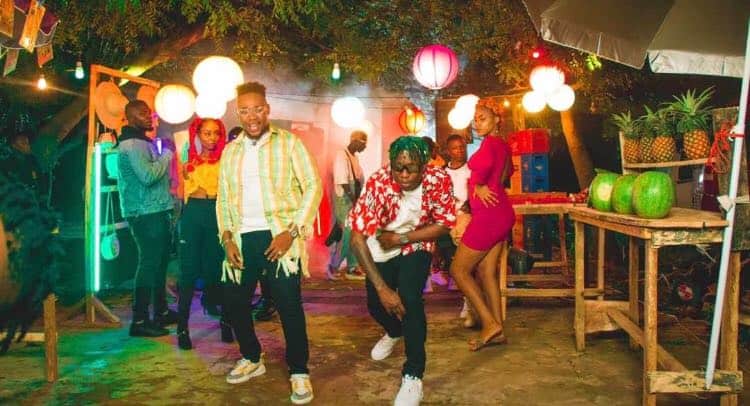
Peruzzi has spent the last few weeks building up to his debut album, ‘Huncho Vibes’, and last Friday, he dropped “Only One” as the album’s second single. With only a week to go until we get the full album, he’s just given us another taste of what to expect from “Sunshine”, featuring label boss Davido, the only featured artist on the 10-song project.
Produced by Vstix, the lively beat for “Sunshine”, with piano synths, guitar harmonies and gently knocking drums act as the perfect match for Peruzzi and Davido’s upbeat performance. Both singers perform a charming set aimed at their love interests, with heartfelt lyrics that could easily pass for wedding vows. “You’ve got me dancing in the rain, ‘cos I love you”, Peruzzi proclaims on the song’s pre-chorus.
Listen to “Sunshine” below.
Featured Image Credits: YouTube/Davido
[mc4wp_form id=”26074″]
Dennis is not an interesting person. Tweet Your Favourite Playboi Carti Songs at him @dennisadepeter
WurlD and Sarz are finally making good on their promises for a joint EP, which we’ve been anticipating for a very long time. Two weeks ago, they announced its title, ‘I Love Girls With Trobul’, and have now followed up previously on released singles, “Trobul” and “Ego”, with a new song off the project, “Mad”;
Similar to preceding singles, “Mad” tows the line of romantic tension, as it finds WurlD describing a relationship where sex is used to shield their love from external pressures, like work stress and issues with friends. “Say you want and you need me, when you call I dey busy, make we take am dey easy”, he sings over the buzzing synths and thumping percussions Sarz produces.
With WurlD’s evocative writing and Sarz’s delightful production, “Mad” strengthens the case for the duo’s synergy, which we will fully gauge when the EP drops next Friday.
Pre-add ‘I Love Girls With Trobul’ and stream “Mad” here.
Featured Image Credits: Instagram/only1sarz
[mc4wp_form id=”26074″]
Dennis is not an interesting person. Tweet Your Favourite Playboi Carti Songs at him @dennisadepeter
Over the past year, Bella Alubo has been teasing the release of her latest project with a handful of singles including “Unavailable” with Lady Donli, and the Zlatan-assisted single “Agbani (Remix). Now fans finally can stream the highly anticipated project, ‘Summer’s Over’ which cements Bella as one of the most promising Afropop acts working today.
Upon first listen, Bella’s undeniable growth is made abundantly clear, with her sound, message and execution being further than a step’s throw away from the Bella we saw on her last project ‘Re-Bella’.‘Summer’s Over’ is a crisp 10-track offering, which presents the theme of heartbreak with catchy bops laced with memorable lyrics, and there’s definitely something for everyone on it.
The opening track, “Don’t trust Geminis” features, Ezi Emela, where they sing: ‘Many men don play the girl don do the girl something’. The song gives insight into the hurt she’s had to deal with in past relationships with Geminis. People of this star sign get a really bad rep for being one of the worst signs to deal with in the zodiac, and both artists explore this, with their voices intermingling for a down-to-earth, relatable record.
Elsewhere on “Fire”, Bella is more optimistic about love, singing “Call me on the phone I’m available” and openly inviting love into her life. On “Summer’s Over” the project’s titular track, she enlists Ajebutter 22 and Mavin rapper, Ladipoe for a breezy lighthearted track which traces a relationship from its early stages before the summer until it dies out towards the end of the year. Produced by Quebeat, the song truly reflects things ending; ‘Really loved you September…maybe I’ll see you December’ Bella sings, mirroring how fickle feelings are in Lagos, as they always seem to always die down before the crazy December period.
Mr Eazi joins Bella on “Kolombi” for a catchy sex positive track, which explores having a partner who wants you just as much as you want them. Fresh L & Ghanaian artist, Ko-jo Cue also feature on “4 Am” where Bella praises her love interest who stays by her side even in the madness of Lagos city. ‘Na me go out with you when the popo dey for road’ she sings, providing relatable lyrics for anyone who’s lived in Lagos and given love a chance.
On “Follow Me” Bella turns her subject matter to social media and the importance our generation places on it. “Wanna be your favourite girl on the timeline” she sings, imitating a rhyming trance-like tone. She sings about how baseless she thinks social media relationships can be and how efforts placed to maintain them are futile.
The closing track is a French remix to the project’s pre-released single “Agbani” which earlier also picked up a feature from everyone’s go-to feature guy, Zlatan. On the French remix, Tengo John sing-raps in French about how different his life has been since his love interest walked away.
While women certainly do not need men telling them how beautiful they are, sometimes when it’s not cloaked in misogyny and as a shot at another woman, it can be nice to hear man lending his voice to the self love movement without coming off as condescending. This is a feat Mayorkun manages to pull off with his latest single, “Up To Something”.
We are beyond tired of being men ‘mansplaining’ everything from our bodies to what we wear, with most comments only prepping women for desirability for the male gaze, and given that this is the status quo in the music industry, songs like this are a breath of fresh air.
Sampling a classic track “Faze” from veteran rap group, Plantashun Boiz, Mayorkun presents words of affirmation to women in his usual melodious form. On the Speroach-produced song, Mayorkun touches on body shaming and lack of self love in black women. “But you don’t really understand, that you’re beautiful just the way you are” he sings, with the accompanying music video showing various clips of women of different ages and skin tones feeling beautiful in their skin.
Lakin Ogunbanwo debuted his latest photography collection, “E Wá Wo Mi (Come Look at Me)” with Niki Cryan Gallery last month. Women wearing veils are the subject of the new photographs, seemingly contrasting his previous “Are We Good Enough” which captured men wearing different hats. While both portrait collections carry Lakin’s signature bold and vivid tones, “E Wá Wo Mi” explores the Nigerian wedding ceremony culture through the bridal direction of the costumes.
He’s able to create a striking impression with the silky fabrics while also balancing bright colours with dark shadow in the portrait pictures of his brides. To achieve the punchy images, he tells me he was very hands-on and involved with every aspect of what went into each frame. “From the models to the clothes, to the lighting to the makeup, I pick very specifically to what I think fits the narrative I’m trying to put out.”
Having started out commercially as a fashion photographer, it’s no surprise that he’s so adept at picking appropriate costumes to express his art. However, it wasn’t till 2012 when he began shooting the “Are We Good Enough” hat collection that his artistic vision and the ideology he wants to put out crystallized. “I realized I wanted to capture my culture and document it as best as I can but also put a contemporary world view on it.”
Lakin Ogunbanwo has gotten international recognition for his works, using photography to expand the contemporary African visual art archive. He has featured on magazines like Times, New Yorker, British GQ and making it on “British Journal of Photography”‘s Top 25 Photographers of 2015 in their annual ‘Ones to Watch’ list. But Lakin tells me Nigeria is his favourite place to display his work because he doesn’t have to answer overly philosophical questions about the cultural significance of every little detail in his work. “Everyone just gets that the concept is a bridal ceremony.”
Though the media attention has certainly helped the trajectory of his career, Lakin explains that it’s the days where he shares his art with people who appreciate it that means the most to him. “To be able to show the work that is very inspired by my culture to people who are part of that culture and understand it and its layers and nuisances.” He describes his audience at the Niki Cryan Gallery with a fondness that suggests he knows most people present by name. With everyone around expressing pleasant thoughts about his work, he tells me it’s very humbling to be described as an inspiration but ultimately, it doesn’t affect what he creates. “I choose not to define my work based on who is affected by it or who are inspired by it. I don’t do it cause I want an audience to like it. I do it cause I want to put it out.”
https://www.instagram.com/p/BwEchjmB1bV/
As a result of his unapologetic self-expression, he has become a sort of ambassador for Africa, using his works to challenge the monolithic narratives of Africa. His “Are We Good Enough” series, for instance, used traditional Nigerian hats to explore the individuality within the Nigerian culture. “I don’t like when people speak of Africa as just this one body of people. There are many ways to be African.” Now he’s looking to expand his artistic expression to film-making as he’s expected to release a short film later this year. Though he prefered to remain mysterious about the themes the film would explore, snippets from the viewing of his “E Wá Wo Mi (Come Look at Me)” hints at an expansion on the wedding ceremony photographs.
[mc4wp_form id=”26074″]
You are meeting Debola at a strange time in his life. He wandered into a dream and lost his way back. Tweet at him@debola_abimbolu
Since she made her way into mainstream with Sarz-produced “Maradona” in 2017, Niniola continuously proves that the pair are a match made in heaven. Clearly, if it’s not broken, don’t fix it, as she has stuck to her frequent collaborator, Sarz for her third release this year, “Omo Rapala”, which we’re expecting to make the rounds much like her other releases.
Niniola’s Yoruba lyrics build on the pulse of the drums, percussions, horns and sensual moan samples Sarz places amidst the groovy instrumentals. Singing “Oya gbondi titi ale (Shake your booty till the night time)”, she describes the seduction of the dancefloor with gentle and caressing vocals and inventive Yoruba rhymes that are as exciting as dancing. “Omo Rapala” is coming out ahead of her “The Human Radio Concert” scheduled for the 8th of November at the Balmoral Hall in Victoria Island, Lagos.
Stream Niniola’s “Omo Rapala” below.
Featured Image Credits: Instagram/officialniniola
[mc4wp_form id=”26074″]
You are meeting Debola at a strange time in his life. He wandered into a dream and lost his way back. Tweet at him@debola_abimbolu
The Mr Eazi-led emPawa initiative has made commendable strides in about one year of existence, and has successfully broken Joeboy – one of the key players in the music industry today- into mainstream
While the initiative is currently sorting through entries for its next batch of applicants, emPawa is putting together a compilation project, and has officially started its rollout. “Call Waiting”, featuring vocals from Mr Eazi, and Ghanaian artists King Promise and Joey B, serves as the project’s lead single, and it also comes with a fitting music video.
Over the sunny, mid-tempo beat E-Kelly produces, all three artists trade lyrics yearning for affection, while also pledging their undying love to their love interests. Mr Eazi and King Promise deliver a verse each, while Joey B adds a recurring bridge. Set at the beach, the music video sees Mr Eazi and King Promise perform their set in the company of models who act their muse, while Joey B moves around in agitation, waiting for a lover to pick his phone call.
Watch “Call Waiting” here.
Featured Image Credits: YouTube/emPawa Africa
[mc4wp_form id=”26074″]
Dennis is not an interesting person. Tweet Your Favourite Playboi Carti Songs at him @dennisadepeter
British-Nigerian rapper, Skepta is currently on tour in support of his latest studio album, ‘Ignorance Is Bliss’, and he’s brought AJ along for the ride as a supporting act. The pair have now also just linked up for their first collab, “Kiss And Tell”, a boisterous cut that could become a fan favourite at their coming shows.
Over the eerie bells and rumbling bass produced by Skepta, both rappers tout their ability to easily pull women without revealing intimate specifics.Throughout the song, they use their brag-filled raps to highlight how real and affluent they are, in comparison to their weaker competition.In the Kritical-directed accompanying video for “Kiss And Tell”, we see grainy shots of Skepta and AJ rapping their lines with a frenetic energy, as well as footage from their tour performances.
Watch “Kiss And Tell” here.
Featured Image Credit: YouTube/Skepta
[mc4wp_form id=”26074″]
Dennis is not an interesting person. Tweet Your Favourite Playboi Carti Songs at him @dennisadepeter
Every week for the last six weeks, DAP the Contract has rolled out new music as part of his ‘Contract Thursdays’ series. The latest entry is “Signs/Bryn’s Interlude”, another strong indicator that listening to DAP is always a good idea.
“Signs” continues from the last release, “Mind Control”, opening with a woman’s voice singing about her affections for a lover. DAP follows suite, professing his undying love for her and assuring that the feelings between them are mutual.
The gentle beat produced by Bryn Bliska, combines hypnotic piano keys and hip-hop drums for DAP to float over. Displaying his lyrical virtuosity, DAP delivers a self-assured rapped verse, bolstered by clever references and his deft delivery. “I’m good with words, I’m like a lexicon/Money slide and green around me like leprechaun”, he confidently raps.
In the accompanying music video for “Bryn’s Interlude”, DAP is captured riding around on a bike while performing his lyrics, capturing the cruise-like aura the song exudes.
If you view Buju’s 2019 run in a single snapshot—from “Energy” to “L’enu”—you get the picture of an artist coming out of his own shell to embrace his newfound fame as the life of the party.
Two years before “Energy” became one of our earliest Best New Music picks of 2019, Buju was going through the familiar motions of a reluctant pop-star in the making. His closest friends had already marked him a superstar, but doing the work was another story entirely. All of that changed this year after “Energy” became a fan favourite, allowing Buju to step into his brightening spotlight.
The first mark of his come-up was with “Spiritual”, his pop-fused second single of the year, featuring street-hop rebel, Zlatan. In that time, he’s landed a handful of collaborations, a Headies nomination, as well as a performance slot at Art X Live!, an interactive music show hosted by West Africa’s biggest art fair.
His latest ingle, “L’enu”, is a self-attestation of his own limitless potential. Set on electronic synths and Afropop drums, Buju returns all the attention to his ear-warming vocals, delivering Fuji-inflected lyrics as he basks in the comfort of his superstar trajectory.
Like Tems, Teni, Lady Donli and Santi, Buju is also having a phenomenal 2019. “L’enu” is a remarkable telling of how quickly Nigeria’s DIY-musicians are coming to their own mainstream voice, and on his Steph-produced new single, it’s clear he has come a long way from being the microphone-shy singer he used to be.
At the moment, it’s almost impossible to imagine a Lagos Christmas where DJs don’t keep “L’enu” on turntables till year-end.
Stream “L’enu” by Buju via Apple Music below:
Toye is Editor-at-Large at NATIVE Nigeria. Tweet at him@ToyeSokunbi
As you’ve probably heard more times than you care to, “we live in a digital age now”. Traditional media, such as the Television, are now fading into oblivion, being replaced by the flexible, accessible and individually tailored digital technologies into which they evolved.
Sitting down in front of the distant screen, plugging in the digits to your preferred channel, being assaulted with whatever content is playing before your desired show comes on is, quite frankly, the ghetto. TV is old-school.
But, in reality, its presence in Nigeria is not that old at all.
It was only 60 years ago today, October 31 1959, that Nigeria launched her first ever indigenous television station, the Western Nigerian Television (WNTV), marking, not only the advent of Television Broadcasting into Nigeria, but also into sub-Saharan Africa. In fact, Morocco had established a television service in 1954, but stopped broadcasting in ’55, so by 1959 Nigeria was the only country with television services in the whole of Africa.
Commissioned by the Premier of the Western Region, Chief Obafemi Awolowo, supported by the Minister of Information at the time, Anthony Enahoro, the primary objective for the WNTV was to provide a medium by which the general public could attain important information. Essentially, the WNTV was to furnish the Western Region with a democratising means of education, working closely with The Ministry to produce shows such as News and You, a current affairs show, and Careers, which documented different professionals in their various occupations.
Of course, beyond its educative function, WNTV also offered entertainment value, serving as a disseminator of both Nigerian and Western cultures. Children’s shows, such as Adventures of Robin Hood, cohabited with WNTV news programs and even taped recording of Yoruba theatre productions. In fact, the WNTV was one of the instrumental drivers behind the rise in popularity of the Yoruba travelling theatre, promoting the principal figures inYoruba theatre, Baba Sala (aka Moses Olaiya, founder of the Alawada Group), Duro Ladipo and Hubert Ogunde.
Fondly reminiscing “those days”, one of Chief Obafemi Awolowo’s grandchildren recalls the station’s schedule to The NATIVE saying:
“There was only one television channel at the time [WNTV]. If I remember correctly, broadcasting started at 4pm. Children’s shows were from 4-6pm, then we had some comedy/drama shows till 9pm. News was at 9pm and I think the station closed at 10 or 10:30pm.”
In 1977, the WNTV merged with its regional counterparts Benue-Plateau Television Corporation, Radio Kaduna Television and others, and is now known as the National Television Authority (NTA). Though it’s a history which is often ignored, especially as the medium is hardly used any longer, the Western Nigeria Television Station boasts a significant historic impact in the production and circulation of culture in 1960s and 70s Nigeria. Even today, as theatrical Nollywood memes infect every corner of the internet, the lasting effects of Nigeria’s first TV station are still felt.
So, to commemorate the 60-year anniversary of the advent of television to sub-Saharan Africa, a few of our readers share their favourite Nigerian Broadcast TV shows, from back in the day right up to the present.
F, 23 – Tinsel
Tinsel is one soap opera I can actually relate with on a deeper level because it actually represents Nigerian society. The characters feel familiar, in the sense that I can see those characters in day to day life in Nigeria. You’ll have one guy that reminds you of that your uncle, and one ridiculous aunty that reminds you of your real life aunt. Tinsel is lit and funny! It’s almost like the Nigerian Eastenders.
W, 22 – Bisi Olatilo Show
I grew up in England and my mum used to make us watch a lot of AIT and NTA. I particularly remember the Bisi Olatilo Show. At the time I used to complain, but I really did enjoy his documentation of all the seemingly high-profile events in Nigeria. It was an avenue for me to connect to my culture and also a good laugh at times.
Mrs S, 54 – Hotel Majestic
I really enjoyed Hotel Majestic. It reminded me of Village Headmasters, an old, probably the first, soap on Nigerian TV. The script was realistic and the acting was excellent. It was also relatively ‘clean’ in terms of morality.
D, 25 – Jenifa’s Diary
I really love Jenifa’s Diary because it’s hilarious and it has staying power. It’s mindless TV which makes you laugh and gives you perspective into the average Nigeria’s psyche. I’ll watch absolutely anything from that franchise TBH.
B, 34 – Yanpon Yanrin
Yanpon Yanrin is a classic Yoruba movie which showcases the Yoruba culture almost in its entirety – food, depth of language, attire and bravery etc. The most important takeaway of the movie for me was in shaping my moral compass, as it portrays the struggle between good and evil and the triumph of uprightness over evil.
D, 22 – Papa Ajasco
I know it’s cliché but I quite enjoyed Papa Ajasco. I mean I only stumbled upon it a couple of times, but I think it was funny with (what appeared to me to be) well-thought characters. Super Story was also pretty good. Both these storylines were always quite interesting and captivating.
Mrs A, 55– Baba Sala
In those days, I enjoyed a Yoruba comedy called Baba Sala, and two pidgin ones, Village Headmaster and Masquerade. The shows were very funny and and refreshing. They were family shows enjoyed by everyone. We watched them with our grandfather whenever we were with him – it was sort of a bonding time. I wish they could be produced as DVDs. I would buy them and watch them with my own grandchildren.
Featured Image Credits: University of Wisconsin-Milwaukee/Harrison Forman
Nollywood offerings today are nothing like they used to be, and unlike before, newer flicks are shot with better quality and (a bit) more expansive storylines. It’s common to see rich socialites squandering their fortunes (Bling Lagosians), women fighting to be taken seriously in the workplace (King Of Boys, Lionheart) and other tame subject matters unlike it used to be.
Everyone knows OG Nollywood was scary AF, due to the subject matter mirroring rife happenings in real life, which take the message ‘by all means necessary’ very literally! From hungry businessmen sacrificing their newborns for money to mermaids taking human form to turn men into their zombies, it’s fair to say a Nollywood film in the 90’s and 00’s caused many of our nightmares.
Any Nigerian will automatically recognise the comparison of Halloween to witchcraft – a massive taboo in our society. Well, as millennials grow up and out of learned societal ideals, we’re embracing mindless holidays such as this, and creating our own halloween culture.
So since we know we can’t go treat or tricking, lest we be doused in holy water and anointing oil by our nosy neighbours, we’ve put together a list of some of the scariest Nollywood films to watch in the spirit of Halloween!
Witches, 1998
Starring Zack Orji & Liz Benson and directed by Fred Amata, Witches follows the story of Princess, who was born into witchcraft and had been initiated when she was very young. As she grows up, she falls in love with Desmond, when she learns that she must remain celibate all her life, and has to face the music when she doesn’t.
Living In Bondage, 1992
Well, you should be watching this anyway as the sequel will be released in cinemas later on this year. Considered the first Nollywood film, the classic film tells a story about a down and out business man, who engages in rituals and blood money to get ahead and secure his future.
Nneka The Pretty Serpent, 1992
Now, all women and feminists out there shouldn’t be too afraid of this story, as it’s a cautionary tale we should all be inspired by. The 1992 classic tells the story of Nneka, a mermaid who takes human form in a bid to captivate any man she fancied, and turn him into her zombie. A queen.
Magun (Thunderbolt), 2001
Directed by the legendary Tunde Kelani, this film follows the story of a woman whose husband puts a hex on her in order to stop her from sleeping with other men. Struck with an illness as a result, she must find a way to fix it before it claims her life!
Married To A Witch, 2001
After leaving the church behind (a sentiment which should resonate with most millennials), a man is targeted by a coven of witches, and send their best player out to seduce him.
Karishika, 1996
This absolute nightmare of a film follows the titular character, “Karishika” who has been sent by the devil from the underworld to kill, destroy and tempt people in order to increase the population in hell. Falz, no bets.
Blood Money, 1997
Once you see Kanayo O. Kanayo in a film, just prepare yourself for nightmares. This flick follows him as the lead character, who loses his job at a bank, and as a result chooses to use everyone he knows as sacrifice, in order to get his money up.
Billionaire’s Club
Patience Ozokwor and Pete Edochie all in one? Whew. Directed by Afam Okereke, Billionaire’s Club follows a group of men who operate in a secret society, with super powers which allow them manipulate people to make a quick buck.
Sylvia
Sylvia follows the life of Richard (Chris Attoh), who divides his time between his real life and his imaginary life. In real life, he meets and falls in love with Mimi (Ini Dima-Okojie), which enrages his imaginary lover, Sylvia (Zainab Balogun)
Featured image credits/Instagram/Living In Bondage
Slimcase became a nationwide sensation with his feature on Idowest’s street-hop smash, “Shepeteri”. Although he’s dropped a few singles, he has mostly flexed his muscles on features with the some biggest names in afropop, including Wizkid, Mr Eazi and D’banj.
Following up his hit single from earlier this year, “Azaman” featuring 2Baba, Peruzzi and DJ Neptune, he has now shared a follow-up, “Lambaxtra”, and it continues to carry the same zany sense of humour that shot him to mainstream prominence. With rolling synths and jangling talking drums, the fast-paced beat from Crackermallo, while Slimcase maintains his usual form, matching the song’s energy.
Throughout the song, Slimcase bounces between street-wise sayings and praise of close friends, which is definitely his modus operandi on every song. The twist on “Lambaxtra” is that he gets quite explicit, pushing his Yoruba-delivered quips into crass territory, which will definitely appeal to the inner city audiences he primarily caters to.
Listen to “Lambaxtra” below.
Featured Image Credits: Instagram/iam_slimcase
[mc4wp_form id=”26074″]
Dennis is not an interesting person. Tweet Your Favourite Playboi Carti Songs at him @dennisadepeter
Nigerian-American Keep Cool signees, Vanjess broke well into the Nigerian music scene this year with their additional vocals on Lady Donli’s standout single “Corner”. Since then, they have been on our radar, even gaining a spot on our 6 videos you should watch this week column with the Xavier Omär and Sangö-assisted music video for “Just Get Here”.
Now the duo have landed a stunning verse from R&B Dreamville artist, Ari Lennox on their 2018 interlude “Cool Off the Rain” which was one of the standout tracks on their last album ‘Silk Canvas’.
“Cool Off the Rain” is everything we could have expected from each artist– a smooth feel-good listen offering which is developed further by Ari adding her frustrated, lovelorn lines “there’s been so much I can take baby cool down and off the rain” to the already soothing track.
Stream “Cool Off the Rain” featuring Ari Lennox below.
Featured image credits/VICE/ShaughnCooper
Tami is a lover of astrology, music and women. Tweet your fave female artistes at her @tamimak_
It kinda goes without saying that having the right music producer can have a huge impact on how well the song does, as they quite literally lay the sonic foundation. This is why in functional societies, music production copyright operates such that everyone involved earns royalties; including artists, labels, writers, producers, A&R and publishers.
The Nigerian music industry, however, doesn’t quite function as such, as the market has been structured in a way where a song & artists’ ‘blow’ factor is based on ability to move a large crowd. This structure can sometimes create turbulence between those involved in the process as we’ve seen many times.
Disputes between those in power and those under their thumb have been a mainstay and artists such as Iyanya, Runtown, and most recently Ycee have spoken up about it. With streaming services allowing artists have more control over their careers, record labels and distribution companies no longer hold as much leverage over artists’ careers as they once did and this seems to be spreading into the artist/producer relationship,
Earlier this month, Northboi, who broke out in 2018 with Starboy’s “Soco” took to social media to air out his grievances against his longtime collaborator, with claims that he hadn’t been paid for some production work. Following the release of “Joro”, Killertunez was credited as producer in lieu of Northboi, and he did not seem to like it.
this is madness. Joro was produced by me Not killertunes. i have the data. This is just madness. am done with this. so shameful pic.twitter.com/NCUbgSqEbU
Given the industry’s infrastructure, which sees producers leaning towards big one-off payments for their beats, as opposed to banking on royalties, Northboi’s frustrations are understandable on that front. Although music distribution has moved into the streaming era, it’s still not a particularly viable system in Nigeria, as the current performance based market only leaves room for bragging rights for everyone who isn’t the performing artist.
Take for instance, R. Kelly, who at this point, is done out here following his reputation as a sexual predator for 3 decades. In 2019, we would assume that nobody is actively and intentionally streaming R.Kelly’s music, however, he will continue to make money from his involvement in songs he has written, produced and mastered for other artists like B2k, Destiny Child, Michael Jackson, Celine Dion, P Diddy – to name a few.
If our society functioned as it should, producers will never really fall into pickles such as Northboi’s alleged one, and it’s things like this which point to the importance of building up lasting structures, to ensure symbiosis and that everyone eats good together.
Wizkid is one of the biggest stars out of Africa at the moment, and he’s set to release his third studio album very soon. It’s a no brainer that he’ll be cashing out from performances all over the world, especially in the run up to the busiest time in Nigeria and West Africa in general – Christmas.
Northboi, however, is also gaining tremendous international recognition, and having worked on a beat for Beyoncé’s ‘Lion King: The Gift‘, and being paid $5000 for it outside of streaming royalties, he’s clearly done with the imbalance that exists in our industry and is speaking up to rectify it.
What the ongoing saga between Wizkid and Northboi teaches us about the music industry is invaluable – the current infrastructure isn’t quite up to par, and it would be best to create a system where everyone involved in a body of work is fully credited and benefits in the long term.
To achieve this, the onus doesn’t only fall on music execs and those within the industry. We as fans and listeners must also properly support musicians by acquiring their music legally, instead of downloading off the internet.
Producers are invaluable to the music process, and deserve just as much accreditation as the recording artist, because everyone knows that no matter how good an artist is, the beat of a song makes it what it is.
Featured image credits/Instagram/TSE
Tami is a lover of astrology, music and women. Tweet your fave female artists at her @tamimak_
Last year, Fresh L raised his middle finger in the face of naysayers when he featured one of the hottest musicians out right now, on the undeniable hit,”Firewood“. Now, in the run up to his upcoming EP, SUNS 2, he has given us a further taste into his ability with his latest single “Head Dey” featuring DMW rapper, Dremo.
Throughout the song, Fresh L raps assertively over the catchy and bolshy beat, while Dremo handles the heat and a closing verse. While Fresh L makes his growth as a rapper and artist in general clear with his verses, where he brags about his ability and what he brings to the table, Dremo does a fantastic job with the hook and should probably lean towards that more often.
It’s clear that Fresh L has something to prove and he continuously proves it with each new feature and release. If this is what we should expect from his upcoming project, we’re definitely keeping an eye out.
Earlier this year, Dice Ailes caught our attention with his steal scening hook on “Alakori” in collaboration with Falz. The fact that he did the heavy lifting on the song and could have carried the entire track on his own, seemed to foreshadow a solid year for the Chocolate City singer, and he’s clearly ready to begin, with his first solo single of the year, “Ginika”.
Produced by frequent Burna Boy producer, Kel P, it’s clear that he was aiming for a hit with anenergetic beat, which merges airy piano strings and boisterous house music drums. Embellishing the song’s feel-good candour, Dice sings a jovial set that will appeal to dancefloor audiences, with his lust-filled lyrics describing the attractive backside of his eponymous love interest. “Sister Ginika, I want to throw this dollar upon your waist”, he sings with a nasally melody, portraying the hold her voluptuous body has on him.
Listen to “Ginika” below.
Featured Image Credits: YouTube/MI Abaga
[mc4wp_form id=”26074″]
Dennis is not an interesting person. Tweet Your Favourite Playboi Carti Songs at him @dennisadepeter
Last week, Joeboy announced his debut EP ‘Love and Light’ which contained two of his hits this year including breakout single “Baby” and “Beginning” which landed him a Best New Music pick from us. He also shared one of the pre-released singles from his upcoming EP titled “Don’t Call Me Back” which featured him and Mayorkun airing out their grievances for lovers who take them for granted.
Now the rising star shares the music video for “Don’t Call Me Back” which follows the vindictive mood of the song. In the music video directed by Prodigeezy, Joeboy shows a real life relationship gone sour as we learn that both Joeboy and Mayorkun are being played by the same girl. When both artists learn of this, they stop answering her calls and move on to other women mirroring what Joeboy sings about on the hook, ‘When you see say I don dey with another person don’t call me back’.
Watch the music video for “Don’t Call Me Back” below.
Featured image credits/GodwinMoore
Tami is a lover of astrology, music and women. Tweet your fave female artistes at her @tamimak_
Imitation might be the best form of flattery, however, in the contemporary Nigerian music space, which inherits a lot from hip-hop, imitation raises a bunch of cynical questions. Over the weekend, more listeners became hip to the fact that Burna Boy’s smash hit song, “Anybody” was clearly inspired by Angelique Kidjo’s 1991 hit “We We”. In typical Nigerian fashion, the discovery prompted conversations about musical authenticity, with the worst takes citing copycat syndrome on Burna’s path.
In his storied career, Burna has always been one to publicly pay homage to his influences, and in his latest album African Giant, he not only sampled Angelique Kidjo, but also featured her on one of the project’s standouts.
We first caught wind of his admiration for Angelique Kidjo on “Wombolombo Something”, a deep cut off his debut LP, ‘L.I.F.E’, which referenced and sampled her 1996 hit of the same pseudo-title. His recent return to her catalogue for another banger is a testament to the amount of stunning music Ms. Kidjo has delivered over the last three decades.
I been trying to work with Angelique Kidjo for ages too.
“We We” is one of several hit songs off the Beninese maverick’s major label debut, ‘Logozo’, released in 1991. While its grungy fusion of groovy congas, thrashing guitars and shiny synth riffs aptly reflects the post-Disco era of dance music, it’s Ms. Kidjo’s shrill voice, carrying a radiant melody, that solidifies “We We” as a classic. It’s the same catchy melody progression that informs “Anybody”, and it exemplifies one of the trait of truly timeless art: the ability to inspire subsequent generations.
Bolstering the idea that no idea is original, sampling puts the past in conversation with the present, and there would be no conversation if the past wasn’t remarkable. By virtue of being on a record widely regarded as one of the best dance albums of all time, “We We” is beyond remarkable, and it is quite refreshing that it has direct ties with one of the biggest Nigerian songs of the year.
Last week, prolific rapper, Psycho YP announced the release date for ‘YPSZN 2’, the sequel to his debut full-length project, ‘YPSZN’. He also shared a 16-song tracklist, with none of his numeroussingles in the last few months making the cut. Well, to whet our appetites even more, he has just dropped three songs off the project, giving listeners a taste of what to expect.
Backed by blaring horns and grand drum-rolls, intro track “City of Kings” sets the bar high for what to expect from the project, as it finds YP in his usual exuberant form, proclaiming himself royalty with a barrage of self-assured raps. Elsewhere, “Elevate” and the Terri-assisted “No chaser” are groovy cuts suited for club-ready playlists, with YP bragging about his steady come-up over afropop-leaning piano and guitar riffs, underpinned by blown-out 808 bass.
Pre-add ‘YPSZN’ and listen to all three singles here.
Featured Image Credits: Instagram/psychoyp
[mc4wp_form id=”26074″]
Dennis is not an interesting person. Tweet Your Favourite Playboi Carti Songs at him @dennisadepeter
Since Tosin Igho made his Nollywood debut with his 2018 film ‘The Eve’, starring Nollywood veteran John Okafor and Beverly Naya, it became clear that he was one to watch, and we’re definitely watching.
This year, he’s been working on a new film titled ‘Seven’ and given what we know so far, we’re excited for what’s to come. Popular webseries, ‘The Men’s Club’ & ‘Rumour Has It’ star, Efa Iwara plays Kolade, the wealthy irresponsible son of a businessman who following his father’s death, is given seven days to survive in Ajegunle. This task is given to him by his late father as a prerequisite for gaining access to his inheritance and his late father’s estate.
The trailer also shows us the arduous encounters Kolade faces while living in Ajegunle, a world filled with thugs, guns and violence. Other cast members also include Richard Mofe Damijo, Bimbo Manuel, Daddy Showkey and Orezi. The film is set for release on November 29.