Get To Know The New PocketApp by PiggyVest, A Socio-Commerce Platform

If you haven’t noticed from the deluge of tweets popping up on your Twitter timeline, Big Brother Naija is back for its seventh season. Kicking off barely a month ago, the Level Up season has arrived with its fair share of drama, gossip, stan wars, and all round wholesome entertainment.

As a mainstay in Nigerian popular culture, Big Brother is known to dominate conversations throughout its months-long airing on Showmax and DSTV. While a lot of these conversations typically revolve around topics such as the housemates, the different ships in the house, this year, there’s also a lot of talk about ‘Pocket by Piggyvest,’ the official sponsor’s of this season’s show.


View this post on Instagram


A post shared by Pocket App (@getpocketapp)

Formerly known as Abeg app, Pocket by Piggyvest app, is a social commerce and payments app targeted at young savers and tech-savvy business owners. The app was originally founded by Muheez Akanni and Dare Adekoya in 2019 as a social payment app which provides a peer-to-peer social payments platform where users can easily transfer money, partake in giveaways and request money from their contact list of friends.

Barely a year after its launch into the market through BB Naija Season 6, Abeg has now rebranded its name and user functionality. Now flaunted as Pocket app, the social and business payment platform introduces new and familiar features to appeal to a wider consumer pool. It was granted an approval in principle (AIP) by the Central Bank of Nigeria (CBN) to operate as a Mobile Money Operator (MMO), becoming Nigeria’s first social commerce platform to acquire this. In a bid to show off its advancement and growth, Abeg has reintroduced itself as Pocket by Piggyvest. So what’s changed exactly?

How exactly does it work?

The new Pocket app allows sending and receiving money to be a lot easier. Almost all possible transactions can be completed within the app. Similar to the Abeg app, payments can be made between two Pocket app accounts as well as any other with commercial bank account. Your Pocket app maybe funded from any commercial or local bank and vice versa as long as you have your 4-digit pin.

The platform also offers an avenue for trading. As an e-commerce app, it offers unique services to buyers and sellers. While business owners can create a virtual shop to display their products for free on the app, these items are available for purchase by customers through the app and these items are placed in the user’s shopping cart until the user is ready to place the order. Just like Mobile commerce apps, the delivery fees vary according to location.


View this post on Instagram


A post shared by Pocket App (@getpocketapp)

New features

The most standout feature on the app is that it offers an escrow service — a contract that outline the terms and conditions between parties involved and the responsibility of each. This means that when the buyer pays the seller, the money is held up in the app until the product reaches the buyer and the buyer indicates that they are satisfied with the product. Only then will the money is released to the seller. The idea behind the name Pocket is as a result of the additional functionalities for users to buy and sell items via virtual pocket shops. What this means for the e-commerce platform as well as other e-commerce platforms is that e-commerce companies can now play on the existing gap in access to financial possibilities, wealth, and opportunities. 

Pocket by Piggyvest retains its position as  the headline sponsor of the BBNaija Season 7 and has introduced more brands to the new and younger generation. Small scale brands such as Quacktails, The Install Brand and more which have been given a platform to display and move their businesses via the PocketApp have also appeared on the BBNaija screens to support the contestants in the best possible way. 

Featured Image Credits/NATIVE
TurnTable Top 100: Asake Debuts At No.1 With “Terminator”

This week, ahead of the release of his debut album, ‘Mr Mr Money With The Vibes,’ Asake’s “Terminator” debuting on the top ten for the first time with 6.83 million streams ( No.1 on streaming) and 55.9 million in radio reach ( No.2 on radio).

This is Asake’s third No.1 entry on the Top 100 and fifth overall. “Terminator” sets a new record for the biggest streams across all platforms in a week; with 6.83 million streams in a week which surpasses “Bandana” which tallied 4.48 million streams. Asake becomes the first artist with multiple No.1 debut since Turntable charts began tracking.

At No.2 this week, following a 5-week streak is Fireboy DML and Asake’s “Bandana” with 5.41 million streams( No.2 on streaming), 72.4 million in radio reach ( No.1 on radio) and 12.9 million in TV reach. “Bandana” sets a new record for biggest impression on radio by a song in a week surpassing Kizz Daniel’s with Tekno “Buga.”

Pheelz with Davido’s “Electricity” comes in next at No.3 with 3.45 million streams (No.3 on streaming), 38.4 million streams on radio reach ( No.10 on radio). Previous No.2 Carterefe and Berri-Tega’s “Machala” on the Turntable chart is at No.4 this week while Burna Boy’s “It’s Plenty” falls from the 3rd to the 5th spot this week concluding the top five.

Crayon’s “Ijo ( Laba Laba)” takes No.6 spot on the Charts ; It tops this week’s TV Chart with 14.4 million in TV reach. Burna Boy and Ed Sheeran’s “For My Hand” rebounds to No.7 spot from the 10th position of last week while Tiwa Savage and Zinoleesky’s “Jaiye Foreign” is steady at No. 8.

At No.9 is Burna Boy’s “Common Person” which falls from No.4 while Ruger’s “Girlfriend” drops one spot behind to No.10 this week on the Top 100. Outside the Top Ten, we have Joeboy’s “Contour” launching at No.21 while at No.35 is M.I and Olamide’s new single “Bigger,” with Nas.

Read a full breakdown of the charts here.

Featured image credits/

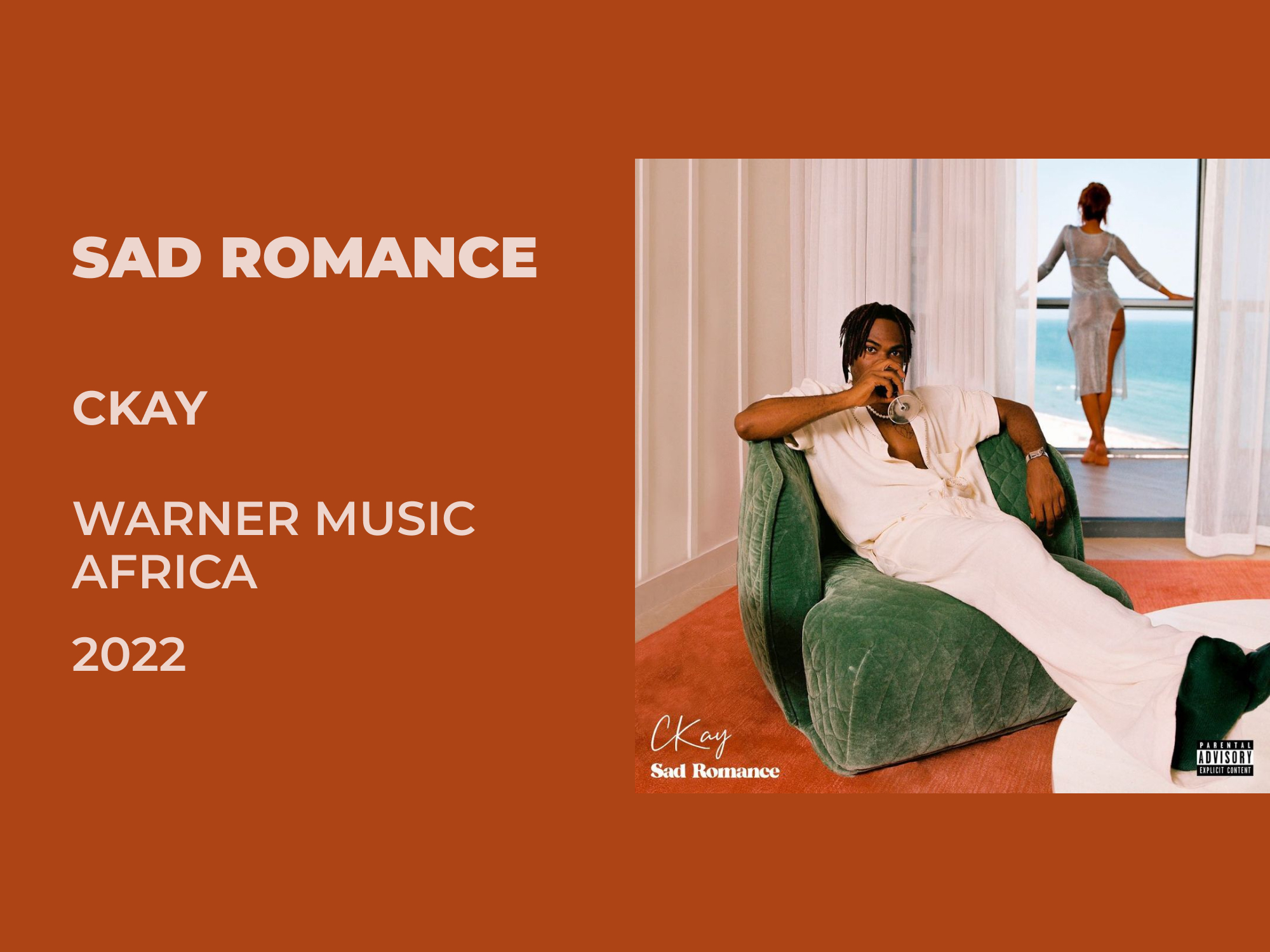
Best New Music: CKay’s “you” Embodies The Sad Thrill of Toxic Relationships

Last week, just before releasing “you”, CKay sent out a couple of tweets to “get things off [his] chest”. In one of his tweets, he spoke about creating a sound that birthed a new wave of Afrobeats alongside former Chocolate City labelmate Dice Ailes. For an artist who has preferred relative obscurity, that was a momentous statement for CKay who had announced his forthcoming ‘Sad Romance’ album shortly before that day. That placed his contributions in shifting the needle of Afropop under focus, and did so poignantly, and in the contentious language readily dissected by the online music community.


View this post on Instagram


A post shared by 𝙗𝙛 💋 (@ckay_yo)

CKay’s fortunes have been ascendant and fast, but what has remained consistent is classifying his music as “emo afrobeats”. In the sea-evoking lulls of “you,” the signature flourishes of that sound (which is technically not a genre, regardless) are present. Produced by the South African Christer Kobedi, the distinct element of Amapiano forms the rocky base of the beat. However, unlike CKay’s previous single, “Watawi”, the new record’s affecting quality rests on other influences. A somber sax and violin runs through the bones of the production, its chill, oriental mood quite audible through the slow, melancholic production.

Going the other direction, CKay’s upbeat delivery skirts with the sort of playfulness often found in his lyrics. The title is apt in referring to the other, a lover whose presence and memories is lovingly recalled by Ckay. Even though he’s intent on basking in the moment, his lyrics shift at crucial points, as though by the wind, to reveal a deeper underlying tension. Early in the first verse he sings, “It’s yours, take it like it’s yours/ But we won’t take pictures, don’t let nobody see us”.

The world of modern relationships is infamously shrouded in secrecy and distrust, which is something CKay has explored since “dtf”—off his debut EP—and other early records. 2021’s ‘Boyfriend’ was however the most incisive of stories centred around toxic relationships, with songs like “Skoin Skoin” and “Mezebu” revealing an admirable grasp on popular culture lingua, as well as CKay’s lithe vocals which was a fitting medium for relaying such narratives. As a producer, it’s expected that CKay would expand his soundscape while circuiting his strongest themes, which is what “you” does perfectly.

The verses’ melancholy is watered in the sultry intent of the hook and chorus, where CKay lets all abandon fly and gets deeper into his feelings. “Baby I’m in love with you ooh/ Fuck you like I miss you, fuck you like I need you, like I’ll never see you again,” he sings on the hook, sounding like he really means every word. He gets back into the storytelling on verse two, flipping the mirror on himself when he sings, “See I’m crazy, you know this/ But you sef you chose this”. It takes two to tango, CKay seems to say, unveiling the layers to his persona’s own toxicity. 

With ‘Sad Romance’ expected sometime next month, CKay has laid down a fine precursor to his current phase. Some musicians tend to talk big and create small, but intentionality has always lied at the heart of everything CKay. His ear for beats, his pristine songwriting, the chilling quality of his vocals, the symmetry of his aesthetic with his sound—everything kind of suggests we’ll be getting an album that will be talked about for a long time. 

Listen to “you” here.


ICYMI: CKAY TALKS ABOUT STAYING AUTHENTIC WHILE EXPLORING SCI-FI INSPIRATION

Here’s a list of winners from the 2022 South African Music Awards

It’s awards season. As the year draws to an end in a few months, it’s that time in the calendar where artists are taking stock of the musical year so far, gracefully confirming their accolades and weighing up the palpable influence they’ve had on fans across the world. On the continent, a number of our premiere award shows are returning for a new season with the Headies only days away from its first-ever broadcast in Atlanta.

Ahead of this, the South African Music Awards were held last weekend to rave reviews from music lovers across the continent. Hosted by the RiSA, the annual event is celebrated to honour the country’s finest music talent over two days in key categories, as they battle for the South African industry’s highest honour.

To this end, we have highlighted the winners in the major categories announced last weekend. Here’s a list of nominees and winners below:

Album of the Year

‘Musique’ – Chymamusique (Winner)

‘Elephant in The Room’ – Watershed

‘Franco Prinsloo: Kruis Van Liefda’ – Franco Prinsloo and Vox Chamber Choir

‘Pangaea’ – Wouter Kellerman and David Arkenstone

‘Wangikhulisa uMama’ – Shwi Nomtekhala

Best Hip-Hop Album

‘B4NOW’ – Blxckie (Winner)

‘Father of Zen’ – Kid X

‘Pheli Makaveli’ – 25K

‘Today’s Tragedy, Tomorrow’s Memory: Mixtape’ – A-Reece

‘Logan’ – Emtee

Best Female Artist of the Year

‘Platinumb Heart Open’ – Msaki (Winner)

‘African Bird’ – Khanyisile Mthetwa

‘Nkulunkulu’ – Kamo Mphela

‘Trailblazer’ – Reign Afrika

‘Trouble in Paradise’ – Shekhinah

Best Duo or Group of the Year

‘Ama Roto Vol.2’ – Reece Madlisa and Zuma

‘Elephant in The Room’ – Watershed

Franco Prinsloo: Kruis Van Liefda – Franco Prinsloo and Vox Chamber Choir

‘Pangaea’ – Wouter Kellerman and David Arkenstone

‘Wangikhulisa uMama’ – Shwi Nomtekhala

Best Amapiano Album

‘Notumato’ – Young Stunna

‘Nkulunkulu’ – Kamo Mphela

‘Auti eSharp’ – Mas Musiq

‘Kwa Kwa’ – Mellow and Sleazy

‘President Ya Strata’ – Focalistic

Best Reggae Album

‘Trailblazer’ – Reign Afrika

‘He Crowned I Emperor’ – Skeleton Blazer

‘Hard To Believe’ – Ras Canly

‘The Shift’ – Botanist Mr Lamington

‘Ngatanngwe’ – Red I Scorch

Best R&B/Soul Album

‘It’s All You’ – Brian Temba

‘Real Talk’ – P. Postman

‘The Arrival’ – Melleng

‘Sour Milk’ – Joda Kgosi

‘It Is What It Is’ – Mikhale Jones

Best Pop Album

‘Trouble in Paradise’ – Shekhinah

‘Souvenirs’ – Jeremy Loop

‘Motion’ – Tresor

‘A Journal’ – Bouj

‘Don’t Let Go’ – Jacky Carpede

International Achievement Award

Black Coffee

Rest of Africa Award

‘If Orange Was A Place’ – Tems (Nigeria)

‘Son of A Tribe’ – Edgar Muzah (Zimbabwe)

‘Karabo’ – Malome Vector (Lesotho)

‘Boyfriend’ – Ckay ( Nigeria)

‘Love & Isolation’ – Tay Iwar ( Nigeria)

Best Dance Album

‘Musique’ – Chymamusique

‘Muzika’ – Miza

‘Ghetto King’ – Zakes Bantwini

‘When House Was House’ – Mobi Dixon

‘African Electronic Dance Music’ – Sun-El Musician

Best Selling Artist

‘Notumato’ – Young Stunna

Read a full breakdown of the winners here.

Featured image credits/NATIVE


ICYMI: Four Takeaways From The 2022 Headies Nominations

NATIVE Exclusive: Chike is telling relatable stories, one great song at a time

2020 was the year of the booless. At most, it was for the Nigerian audience who primarily got introduced to Chike Ezekpeazu Osebuka during what was also the year of the peak of the COVID-19 pandemic. ‘Boo of the Booless’, the singer’s debut album, arrived on the celebratory St. Valentine’s Day, on February 14, and slowly but surely, many people caught up to its riveting, poignant messages of love, hurt, heartbreak, fatality, divine help, and forgiveness, among others.

Arriving last week, ‘The Brother’s Keeper’ is Chike’s sophomore album. In the past two years, ‘BOTB’ has become a cult favourite while Chike has shown the ability to naturally extend momentum. He’s rested his acclaim on the strength of Simi-assisted “Running”, the romance-suffused collaboration with Fiokee and Ghanaian songstress Gyakie on “Follow You”, and earlier this year in May, the Dunnie-hosted “Already Won” and “Hard To Find” following shortly after, an Highlife-inflected summer-esque bop featuring the iconic Flavour. Along with his ‘Dance of the Booless’ spin-off (which refixed songs from ‘BOTB’ through the EDM soundscape), a shared quality permeating these records is the humane lyricism of Chike and his vocal range. 


View this post on Instagram


A post shared by Chiké (@officialchike)

“After the first album, I definitely knew I was going for a second album,” says Chike to The NATIVE some days before the release of ‘The Brother’s Keeper’. “So, I just started recording as much as I could, I knew there would come a time when we would have to make a selection, and that time came”. 

Chike is always creating—three years ago, he wrote the earliest-recorded song on the album. Because Chike is always in his creative process, his music embodies a unique spirit that is formed by lived-in experiences, his imaginative qualities, and an eye, always, for stories. These are peculiarities in his music, and ‘The Brother’s Keeper’ advances that vision. 

The album title references the famous Biblical phrase which was said by Cain, as told in the book of Genesis, when God asked after his younger brother Abel. “I do not know,” the hard-hearted Cain had replied, “am I my brother’s keeper?”. “I understand it having a male undertone,” he says of my suggestion that the album was catering to his male section of fans, just like the previous had done for women. 

He, however, had simpler motivations. “I think a lot of people would have expected ‘Love on the Sky,’ or ‘A Day in Paradise’. But then Brother’s Keeper as much as it seems like it has a male undertone, that’s the theme. I keep saying that ‘Brother’s Keeper’ is a state of mind; it’s the state of mind in which I recorded my music, you know, what’s going on in my life, the new state of life for me. That’s what [the album] is”. 

Chike is very deliberate about the surrounding details of each project he puts out, and ‘The Brother’s Keeper’ is no different. Even though his titles are sometimes birthed from inspiration, his team comes in to offer counterpoints and fine-tuning. “Inspiration is not really wrong, but you also have to make sure it falls in place with where you’re trying to be at that time,” he says to me now. “But, you know, when you create things, whatever you create, your mind starts forming towards that.”

In terms of collaboration, sparse is a word that describes Chike. On ‘BOTB,’ he featured just M.I. Abaga, Ric Hassani and Zoro; while on ‘TBK’, he collaborates with Flavour, Ycee, and South African singer Azana. “Three is a lot, to be honest,” he says, alluding to the number of guests he’s had on both albums. “My guys and me, we put the music first. We don’t do collaborations because we want to, but because it’s needed, or because it might elevate the music. When you strike a balance between that and actually collaborating, you find out you don’t do too many collaborations.” 

The recording process is even more seamless. And even more so on ‘The Brother’s Keeper’, whose lush, colourful soundscape was majorly provided by Deeyasso and Killertunes. Other producers include Louddaaa, Tee-Y Mix, Lord Sky, Echo The Guru, and Saszy. “It’s a small world o—Baba how far, where you dey? I wan’ make music o; e no dey long pass that one,” he says humorously when I ask about how he links up with producers, then chipping in like some aged philosopher, “Some people find it harder to make time, some people find it easier, but it depends on what you want and what you’re willing to chase.” 

Such wisdom is found across ‘The Brother’s Keeper,’ but it’s held more intimately and expressed in the nerve-touching songwriting Chike has mastered throughout his career. The album opens with “On The Moon”, a punchy record with audible influence from Amapiano’s dusty log drums. It’s also indicative of Chike’s stretching vision: whereas ‘BOTB’ began with the sombre however admonishing notes of “Beautiful People”, here he’s a bolder, richer superstar, painting a suggestive scene in the second verse which begins with, “I got my ride already, the one I told you about” and ends with “You no fit see my sugar low”

That record and “My Africa”, which expresses the desire to go continent-exploring with a love interest, are the only exceptions in a thread that runs through ‘The Brother’s Keeper’. Elsewhere, Chike creates records with great amounts of tension. He charts the progression of a relationship from bliss to destruction, even though red flags stood every way of that journey. On songs like “Spell” and “Bad”, the toxic markings in a relationship are conjured with piercing vulnerability and humorous admittance. Though the sound behind the former is muted and poignant, the latter’s groove is folded into the cherry swing of Chike’s vocals as he sings, “Don’t tell me to leave my baby/ I no fit do am, I no get that kind mind”.

The album’s second half carries the weight of crumbling things. Being an actor, Chike is able to switch characters with all the required nuance and tone. It’s also in this category where his formal training in Soul and R&B come to the fore. Going through the motions of a heartbreak, he’s alcohol-thirsty on Pour Me A Drink”, tear-inducing repentant on “You Deserve”, self-affirmative on “Enough”, and finally acceptant on “Moving On”

YCee’s verse on the trio’s middle track is a career high, delivered in accessible but emotive lyricism, and rapped with a druggy exhaustion that advances the pathos of Chike’s own singing. “Enough” is a personal favourite, a masterpiece of a song which explores the pain of having a lover who craves the thrill of the unknown. “I put on the light in me, hoping that one day you’ll see,” he sings over stripped percussion and bluesy chords, and later on joined by the reverberations of background vocals. 

Chike’s renown as a vocalist is well charted, but even less is known about his upbringing. It’s a formative part of him the musician carries carefully, and that has allowed him the licence to craft the morally complex stories in his songs. Being from Onitsha, the artist was born into the Igbo storytelling tradition. An aunt used to tell him and his siblings bedtime stories. “Most of them were scary ones, because I think she wanted to scare us to sleep,” he says, laughing. “She always wanted us to close our eyes. They were stories, it was mostly Aunty Oge who told us stories to be honest. I didn’t read much; I wouldn’t say I read the novels and the rest because I just felt like, growing up, education was always made to look like a chore. Parents and teachers did it the best they knew how, I guess, but I started paying more attention to stories when I grew older, maybe in my late teens. And right now, I pay way more attention to it.” 

Listening to Tracy Chapman made Chike love telling stories, he says, mentioning his early influences: Usher, Neyo, Styl Plus—the legendary Nigerian group which has served as a sonic touchstone for many R&B-leaning acts since the late 2000s to this present day. In his older days, he picked up on the work of British singer-songwriter Passenger, whose emotionally charged songs are closely modelled in the folksy tunes of Chike. 

You’ll hear all those influences on the last three songs on ‘TBK’, even though Chike’s originality never comes under siege. Brooding keys are paired with Trap-esque drums on “God Only Knows” as Chike bemoans the betrayal of a close friend, repeatedly belting the words, “I didn’t know you want am for yourself” in an audibly pained tone. The project’s melancholy peaks on “Nothing Less, Nothing More”, a song that catches you off guard with its haunting perspective, imbibed with the ultimate sorrow of losing a loved one. A solo piano flows over the song’s terrain: a soft landing for hard memories. 

Alternative is a word often used to describe Chike. A number of things are indicative of the possible reason: his previous participation in acclaimed singing competitions MTN Project Fame and Nigerian Idol in 2015 and 2016, respectively. His tinkering with R&B and string-based folk music. His privacy as a person. His love-heavy themes. Artists like Tay Iwar, Johnny Drille, Bez Idakula, and Ric Hassani are some names in this conversation, but I think Chike is the one who leans into pop music the most. 

His producers have adapted the electric allure of Highlife into records “Amen” and “Watching Over Me”, while “Roju” was positively received by prospective partners, blaring at weddings across the country last year. Also sharing in this vision are the records “Good Things” and “Hard To Find” which finds a natural alliance in Flavour, and features the sugary Igbo-inflected singing both musicians are famed for. ‘The Brother’s Keeper’ is very calculated, balancing all these qualities with an experiential, personal grasp. 

When I asked Chike the most personal of the songs, he chose the album’s last song, “Please”. He says, “You know the beginning of the album says I’m on the moon, I feel like I’m touching the sky, finally things are working out for me. That thing I told you I wanted yesterday, I’m getting it now; feel like there’s no limit. And for ‘Please,’ I was just saying I hope at the end of everything, that I don’t end up empty-handed, that I have something to show for [all] the popularity, the life, the fame, the art. That in my quiet time, at the end of it all, it’s all worth it.”

Featured image credits/NATIVE


ICYMI: Korty Is Leading A New Generation Of Youtube Stars

What’s Going On: Angola Opposition rejects election results, Tigray Soldiers loot from WFP & More

“What’s Going On” Tallies Notable News Headlines From Across The Continent — The Good, The Bad, And The Horrible — As A Way Of Ensuring That We All Become A More Sagacious African Generation. With This Column, We’re Hoping To Disseminate The Latest Happenings In Our Socio-Political Climate From Across The Continent, Whilst Starting A Conversation About What’s Important For Us To All Discuss. From Political Affairs To Socio-Economic Issues, ‘What’s Going On’ Will Discuss Just That.


FOUR ZIMBABWEAN JOURNALISTS ATTACKED DURING A CAMPAIGN RALLY

Last Thursday, four journalists from Zimbabwe were injured by suspected followers of the country’s ruling party ZANU-PF. The journalists were covering the Citizens Coalition for Change (CCC) campaign rally headed by its leader Nelson Chamisa in central Zimbabwe. The CCC party has been attacked twice in less than a week, and the party officials blame ZANU-PF. The four journalists were injured as they filmed the ZANU-PF convoy in hot pursuit of Nelson Chamisa’s motorcade.

10 suspected Zanu-PF supporters who donned ruling party regalia punched and kicked the journalists, the reporters were ordered to delete photos and videos before their equipment was seized. According to witnesses, the Zanu-PF vehicles attempted to block Nelson Chasima’s car from entering Chitekete as it was the campaign rally venue. CCC was formed early this year and went on to win the majority of parliamentary and local government by-elections held on March 26th forming the opposition party.

As the country gears up for elections in 2023, more campaign rallies are being held. Emmerson Mnangagwa has been the president of Zimbabwe since 2017 after he carried out a coup in November. In 2018, he beat Nelson Chamisa who was vying for the presidency after a delayed announcement from the Zimbabwe Electoral Commission. The delay resulted in street protests in central Harare which authorities controlled by firing live bullets at the protesters, killing six and injuring others. ZANU-PF has been the ruling party since 1980 after the late Robert Mugabe led the country to independence and assumed presidential leadership. Emmerson Mnangagwa took over from Mugabe. Many citizens believe the 2018 elections were rigged and Chasima should be in power.

The committee to protect journalists denounced the attack castigating the crackdown on journalists as  Zimbabwe’s human rights record has been in the spotlight recently. This is after two opposition leaders, Job Sikhala and Godfrey Sithole were arrested on charges of inciting public violence and have stayed in jail more than two months after their arrest.

TIGRAY SOLDIERS LOOT 12 TRUCKS FROM THE WORLD FOOD PROGRAM

On Wednesday morning, a group of armed men entered WFP’s compound in Mekelle and forcibly seized 12 tankers filled with over half a million liters of fuel. The fuel had recently been purchased by WFP and arrived just days before it was stolen. The WFP director David Beasley issued a statement condemning the act which occurred as fighting has resumed between Ethiopian forces and separatists following a five-month humanitarian truce.

The Ethiopian government and the Tigray soldiers have been at loggerheads since 2020, leaving many displaced and hundreds dead. According to the WFP, the theft will impact humanitarian processes as it is now impossible to distribute food, fertilizer, medicines, and other emergency supplies across Tigray, as an estimated 5.2 million people are at risk of starving to death before the next harvest in October. Ethiopia’s government has joined the World Food Program in condemning Tigrayan forces. The government demanded in a statement that the fuel be returned and the international humanitarian community take action against the Tigrayan People’s Liberation Front 

The Tigrayan soldiers released a statement claiming they did not steal but instead said it was taking back 600,000 litres of fuel it had loaned to the WFP a few months ago.

CLASHES IN LIBYA LEAVE 32 DEAD

Libya’s Ministry Of Health confirmed at least 32 people are dead and 159 injured after a clash between Libyan militias in Tripoli. The attack ended Tripoli’s one month of calmness and the Prime Minister Abdul Hamid Dbeibah stressed the need for elections. The national elections which were scheduled for 2021 as part of a UN-sponsored peace process were abandoned amid disputes about rules governing the vote.

Throughout Saturday, intense fighting erupted in Tripoli as rival factions engaged in the intense crossfire. Dozens of buildings were destroyed and several cars were smashed and burned. Forces aligned with the parliament-backed administration of Fathi Bashagha failed to take control of the capital and oust the Tripoli-based government of the country’s interim Prime Minister Abdul Hamid Ddeibah. 

The UN-backed government of National Unity (GNU) led by Abdul Hamid condemned the act calling the Libyan parties to forget all issues of the past as the only solution is elections. The attack on Saturday was instigated by Fathi Bashagha who has been trying to install his government in Tripoli. Fathi Bashagha was elected as the prime minister by the Libyan government in early 2022 but Abdul Hamid rejected the appointment stating he will only hand over power through an election warning that his dismissal would lead the country back to “division and chaos.”

ANGOLA OPPOSITION PARTY REJECTS ELECTIONS OVER COUNTING ERRORS

The main opposition party in Angola, the National Union for the Total Independence of Angola (UNITA), has rejected the provisional results of the national electoral commission. UNITA claims the process was full of counting irregularities. The elections which were won by the ruling People’s Movement for the Liberation of Angola (MPLA) will maintain its nearly half-century in power by a slim majority.

According to Adalberto Costa Junior, UNITA leader, the victory by MPLA is misguided and henceforth they will not recognize the results. He vowed to challenge the results as MPLA is set to extend its reign for another five years, giving it a total of 52 years in power. Incumbent president Joao Lourenco won for the second time after garnering 51% of the votes with more than 97% of the votes tallied. 

The opposition UNITA  say they are doing their own tallying and are preparing to share their results. MPLA’s popularity in the election had dropped as they lost the votes in the country’s capital Luanda with more than 60% of the voters casting ballots in favor of UNITA The two parties have been rivals since the country gained independence from Portugal in 1975 as the two sides fought a civil war for more than 25 years, where hundreds of thousands died.

Critics of MPLA say it has failed to deliver on its promises to fight corruption and uplift people from poverty. Meanwhile, there has been a quieter reaction from MPLA after Joao Lourenco failed to show up for a press statement on Friday. The party stated the only official results were from the national electoral commission, which attribute 51 percent to the MPLA and 44 percent to UNITA.

Featured image credits/WSJ


ICYMI: WE SPOKE TO A FEW YOUNG NIGERIANS ABOUT THE INCREASE IN MOBILE DATA PRICES

Songs Of The Day: New Music From Olamide, Gabzy, DJ Neptune & More

We’re more than halfway through 2022, and it’s been an eventful year for Afropop. There’s been a torrent of great new music, spawning a massive stack of inventive smash hit songs. From Highlife-infused Ghanaian pop, to the unrelenting force that is Nigerian street-pop, to South Africa’s indomitable Dance scene, to tantalising Drill explorations in East and Central Africa, and much, much more, we’re living through abundant and musically expansive times.

Every week, tonnes of songs from African artists make their way to digital streaming platforms, and wading through them can be intense. That’s where The NATIVE’s Songs of the Day column comes in to help. We go through as many new releases as possible, spotlighting them here, two to three times every week. This Friday, enjoy new releases from Chike, Ogranya, DJ Tunez and more. Dig in!

Olamide – “We Outside”

Following the success of the Wande Coal-assisted hit single “Hate Me,” veteran rapper Olamide has arrived with his most recent offering “We Outside.” The Magicstix produced record sees the rapper speaking on his accomplishments so far as he sees his dues paying off. He opens the record chanting “Hustle for the money, till early morning/hustle don dey pay me, I wanna jaiye ni temi,” letting listeners know how far he has come. 

Gabzy – “Set Nice”

The best word to describe Gabzy is consistent. After recently featuring on the ‘NATIVEWORLD’ album on the record “TGIF,” Gabzy is now here with the mid tempo romantic number titled “Set Nice.” On the track, he describes his love interest and the hold she has over him. He sings moving lyrics such as, “From afar I see this pretty girl chocolate caramel, she’s not the usual this girl is not typical/Body phenomenal, the way she move you know In feeling her.”

Joe Kingston – “MAPESSA”

Joe Kingston is back at the right time for the summer with a new track called “MAPESSA.” “Mapessa” roughly translates as “money,” and Kingston draws parallels between the summertime and splurging cash. He delivers a summery track to cheer listeners up at times when you need to have some fun and splurge some cash after a stressful week. This is the perfect track to add to your summer playlist.

DJ Neptune – “Grinding” ft. S1mba

On the new record “Grinding,” Nigerian DJ and producer DJ Neptune teams up with British Zimbabwean rapper and singer S1mba. The Magicstix-produced track sees the artist focusing on working hard and stacking his cash. On the chorus of the record, he sings catchy lyrics such as “Monday Tuesday Wednesday Thursday, now they see I’m shining, I’m gon keep on grinding.”

Backroad Gee – “Blessed”

Congolese-British drill rapper Backroad Gee is dominating Drill conversations coming out of the UK. Earlier this year, he teamed up with Apex village rappers, Psycho YP and Zilla Oaks for a catchy drill anthem titled “IC3,” and has now arrived with his latest offering “Blessed.” The infectious new record sees the artist at his reflective state, as he expresses his gratitude for how far he has come in his career.

Young AI – “Permit Me” ft. Zinoleesky

Newcomer Young AI teams up with Zinoleesky for the upbeat record “Permit Me.” The song sees both artists chanting lyrics to their respective muses, lyrics such as “baby don’t reason me local, i’m not joker/I don’t want to hear it’s over”

Featured Image Credits/The NATIVE

Korty Is Leading A New Generation Of Youtube Stars

YouTube has become the premier video streaming platform in the world. It was popularly acclaimed as, firstly, a platform which could be very educative, but also as entertaining. Nigerians began owning channels and producing content not long after and in 2017, Mark Angel became the first comedy content creator in Africa to hit one million subscribers. 

In the five years since, YouTube has been favoured by Nigerians in showing the myriad stories emerging from the country. Earlier this year, Business Day reported that in 2021, the percentage of Nigerian YouTube channels that made above 1million in revenue increased by over 60% in the space of just a year. With programs like YouTube Black Voices, it’s increasingly being acknowledged as an important section of popular media and has become a favourite among Gen Z audiences.

A name that needs no introduction on Youtube is 22-year-old Eniola Olarenwaju, popularly known to fans as Korty. Korty’s status as one of the most exciting YouTubers is hardly a subject of debate. In a little over two years she’s become an important force in the Gen Z narrative, owning their skills and creating fierce work that speaks to their experience. She’s well acclaimed in the Lagos art scene, and even better, it’s because of her hard earned work. 

With an adequate grasp on youth culture, she’s a daring storyteller and an even better filmmaker. Her well-paced transitions, the peaceful cinematography, the alternative-inspired soundtracks, the freewheeling nature of her questions, her relentless curiosity—every one of her interviews, from Rema, to Ashely Okoli, Chuuzus, T.G Omori possess these qualities. Watching the ebbs of her art, you just know she had different influences than the previous generation of YouTubers. She’s less of a journalist than she is a filmmaker, creating situations and scenes where humanity can be better experienced in full colour. 

Recently, Korty was the topic of contention on social media timelines when the rising star shared a tweet declaring that her career trajectory was not paved by anyone else. A bold statement to make, many opponents seemed to miss out on the fact that Korty was simply taking pride in her abilities and speaking to her reality. As a Gen Zer, she’s bound to make such self-aggrandising statements in this age of bigging up oneself and ones achievements on social media. However, that single post has generated a lot of interest as a lot of people who felt she was disrespectful of her seniors in the scene, especially with the last part. Already the placing of “stupid” lathers a disregarding vehemence on the tone, and in an online reality where correctness is strictly enforced, it wasn’t long after people started calling her out.

Many opponents of Korty’s statement felt that she was minimising the valuable contributions of Nigerian Youtuber’s that had been operating before her, as the mid 2010’s was the heat period for Youtube. Figures like Tayo Aina, Sisi Yemmie, Fisayo Fosudo, Dimma Ummeh and Jackie Aina are names that would be amiss to mention when stating the famed alum of African entertainment on Youtube. Looking at their work, it’s easy to see why—their relevant fields cut easily across travel, lifestyle, food, design, fashion, community, beauty, politics, finance, tech and culture. Individually, they’ve amassed subscribers in millions and other relative numbers, but it is the humane quality of their productions that makes them so influential beyond the continent and globally.

While Korty could have better framed her statement, there’s no denying that she could be referring to the novelty of her craft. As a storyteller offering different ways for audiences to get into the minds of their favourite African creatives, Korty could be severing herself from the canon of Nigerian YouTubing, from their artistic traditions and vision. But more realistically, Korty is most likely referring to her own work in getting to where she is today.

As far as we all know, Korty has carved a lane for herself, all by her own doing. One of her earliest videos recounts how she quit her A&R job at EmPAWA and took to Youtube full-time. During her journey, she’s got very few cosigns from established YouTubers, or the assistance of a union. Korty’s power comes from social media, which is the biggest driver for her cultural acclaim, which is the reason why we’re having this conversation today. She speaks directly with her audience and bypasses industry gatekeepers by relying on the power of social media and her loyal following. Now, she’s found herself becoming a poster girl for those who don’t quite know where they belong–which many Gen Z’s relate to.

In truth, there will always be forerunners but the next generation equally has to offer—style, outspoken about social justice, well-read, thoughtful about any number of topics while keeping things fresh—and easily the coolest young people on the planet. The impact of those who came before should not be affected simply because there are others satisfying new tastes in audiences. However, their palpable influence of the frontrunner should not be downplayed because they created initial excitement around the scene. They might not have influenced Korty stylistically but they did set the wheels running for the industry. 

In the grand scheme of things, everyone is born to a certain generation, and it’s the nature of art to progressively improve on what has been done. Some artists fail to do so; others succeed and go on to become great. Everyone admits that Korty is well on her way, and deep down, every great creator is a fine student. 

The only lesson revealed is the power of storytelling. Korty’s presence online is intentional. She’s deliberately revealing of her day-to-day activities, as well as commenting on hot topics with a voice that’s recognisably hers and very Gen-Z in tone. She also places her unique career trajectory in perspective quite often, combining her natural curiosity with a humane way of reflecting those wins and losses, and that is why she stands out. That is why she was a chosen influencer for Fenty’s entry into the Nigerian market, much to the criticism of people who felt beauty YouTubers were best equipped for the role. 

Considering the number of informative threads that’s spurned off her comment, the overall reaction should be a lot lighter. She didn’t shade anyone, and now, it’s given way for people to know a lot more YouTubers than before. Given the vast interest points that YouTube covers, this will serve as a stark reminder to curators, that they need to keep adapting with the times and consistently meet the demand for content that is instant, defiant, boundary-pushing and above all, authentic.

Songs Of The Day: New Music From CKay, Rema, Lady Donli & More

We’re more than halfway through 2022, and it’s been an eventful year for Afropop. There’s been a torrent of great new music, spawning a massive stack of inventive smash hit songs. From Highlife-infused Ghanaian pop, to the unrelenting force that is Nigerian street-pop, to South Africa’s indomitable Dance scene, to tantalising Drill explorations in East and Central Africa, and much, much more, we’re living through abundant and musically expansive times.

Every week, tonnes of songs from African artists make their way to digital streaming platforms, and wading through them can be intense. That’s where The NATIVE’s Songs of the Day column comes in to help. We go through as many new releases as possible, spotlighting them here, two to three times every week. This Friday, enjoy new releases from Chike, Ogranya, DJ Tunez and more. Dig in!

CKAY – “you”

After announcing his debut album ‘Sad Romance’ few days ago with riveting visuals, self-styled emo-Afrobeats savant CKay has released the first single from the project. “you” mildly follows the template of previous single “Watawi,” adapting the breezy pomp of Amapiano’s log drums. The newer record is however more stripped and sensual, as ambient elements from Jazz are beautifully infused in this tale of love, lust, and a sprinkle of the brooding toxicity which usually permeates CKay’s records.

REMA FT. SELENA GOMEZ – “CALM DOWN (REMIX)”

Afropop has become so big, A-list foreign artists getting our records are considered normal. And in terms of individual acclaim, few names are as big as Rema. The Mavin wunderkid’s ‘Rave & Roses’ continues to oil the motions of a global tour, while Rema has also proven eager to release new music. With the remix of the smash hit “Calm Down” featuring Selena Gomez now released, Rema’s entry into the nucleus of (Latin) American pop culture is all but completed. And how did Ms. Gomez fare? Very well, for a first timer to the genre. Some people might even enjoy this a bit more than the original.

ZINOLEESKY – “CALL OF DUTY”

Nigerian Pop undoubtedly owes a lot to Street Hop, and that movement owes a lot to Zinoleesky. His hopeful incursions into pop have birthed records with a relentless and often playful spirit at their core, and “Call of Duty” ranks among that category. The production is handled by frequent collaborator Niphkeys, and has the bubbling percussions Zino favours coasting over. However the mood is light, as Zinoleesky unfurls innuendo-spiced lyrics with hearty exuberance.

DJ TUNEZ – “MAJO” FT. WIZKID, ALPHA P & TAY IWAR

Earlier today, DJ Tunez released his ‘Cruise Control Vol. 1’ project, featuring five songs and a host of musical collaborations. A standout is obviously the star-studded “Majo,” a warm record led vocally by Tunez’s frequent collaborator Wizkid. He’s the force behind the record’s hypnotic chorus, while the other singers build around him with groovy intent. This one was made for a Friday.

CHIKE – “ON THE MOON”

Yesterday, Chike followed up on his classic ‘Boo of the Booless’ debut album with ‘Brother’s Keeper’. If you know anything about this particular singer, you’ll know he’s heavy on the art side of things, and there’s no doubt this new album would be quite an experience. If there’s any doubt about that, Chike clears them early in the project with “On The Moon,” the kind of joyous, Amapiano-inflected number you’ll expect from a musician who changed his life with one project. His vocals are bright as ever, coating this record with unique hit prospects.

LADY DONLI – “SOFT LIFE”

She’s been away for a while, but Donli’s return was never in question. On her just-released record she continues the ethos of her cult classic ‘Enjoy Your Life,’ titling this one “Soft Life” so you know just what you’re getting. On the record’s start, she adapts the ‘o mukele’ chant from Ruff Rugged and Raw’s “Wetin Dey,” before layering her glossy vocals over other parts of the record with trademark lightness. The production recalls her live music-inspired takes on neo-Highlife and, in all, portends quite a lush, luxuriating mood.

PDSTRN – “NO HOME TRAINING”

After winning this year’s Henessey VS Class, PDSTRN has been one of the most acclaimed young rappers in the country. His moves were eagerly awaited though the rapper did well in taking his time to release work which showcases the full range of his abilities. Thus a record like “No Home Training” is a perfect move; over a thumping bassline borrowed from Dancehall, the artist sings about detractors in the comic style mastered by rappers. On streaming platforms, you’ll find a prelude of the same track, where he raps head-on and stakes his name as belonging in the conversation of top-tier MCs.

OGRANYA FT. JOHNNY DRILLE – “I’M SORRY”

Prolific is the word which best describes Ogranya. Few weeks pass by when the alt-leaning artist does not release a song, and how rare that he makes such beautiful music! Today he shared his latest project, ‘Festival of the Sun’ and this warm, bubbly bop with Johnny Drille is an immediate standout. Mr. Drille has the uncanny potential of transforming any record and with the sweet toned vocals of Ogranya alongside him, it’s no surprise that the union births such sonic bliss.

KAGEDIMES FT. PHEROPIZZLE – “ONLY FANS”

Glittering synths form the sonic backdrop of “Only Fans,” the latest record from British Nigerian artist Kagedimes. A steady drumline infuses a distinct feel of Afro Swing, as the artists sing about a lady interest with snapshots into places where they’ve related. The diverse vocals and lyrical direction, as well as the scintillating groove of the production, all renders the record enjoyability while extending the sonic relationship of Nigeria and the UK.

A-1 Listen Review Of BNXN’s New EP ‘Bad Since ’97’

Since his 2018 debut, BNXN has continuously solidified his presence in Afropop, with radio-ready hits that have soundtracked our late night parties and hangouts. From “Testimony” to the Zlatan-assisted “Spiritual”, to the memorable “L’enu Remix,” with Burna Boy and his slew of other collaborations, the singer has seized every opportunity to showcase his undeniable skill and earmark himself as one to watch.


View this post on Instagram


A post shared by BNXN FKA BUJU (@toyourears)

Closing out 2021 in a heartfelt way, he released his debut EP ‘ Sorry I’m Late,’ which offered a rich throve of insight into the mind of the artist and his sweet melodies and laid-back delivery. The 7-track EP also found BNXN showcasing his versatility in composition and his knack for dropping dance floor-ready bangers with meaningful lyrics. The EP offered BNXN ample space to offer new variations on his usual sounds without erasing what we’ve come to love.

Still revelling in this stardom, BNXN is back with his sophomore EP ‘Bad Since ‘97.’ He began teasing its release, earlier this month on social media, by announcing producers such as Denzl, Sak Pase, and Ts Boy were on the EP. Now, the wait is over and BNXN has expanded his sonic tapestry with the help of seasoned Afropop veterans such as Wande Coal, Olamide, and Wizkid. Speaking with Apple Music, BNXN confirms that his sophomore album is different from ‘Sorry I’m Late,’ stating that there was more storytelling and maturity in the new drop. 

In Usual 1-Listen Review Fashion, All Reactions Are In Real-Time While The Music Plays. No Pauses, Rewinds, Fast-Forwards, Or Skip.

“BAD SINCE ‘97”

This is the EP’s titular track so I’m excited to get into this. Ouu–sounding good already. These are really intriguing sounds being fused together. I love how BNXN shows he’s capable of singing on any beat you give him. Here, he fuses Afropop and alternative R&B, while acknowledging his musical prowess with braggadocious lyrics such as “don’t compare me to nobody I dey spazz you know”. I think BNXN surprisingly challenges himself with deep percussive tones while reassuring listeners that this is his world and we are all living in it.

“BAD MAN WICKED”

From the second song, you already get the gist of the album, BNXN is getting self-conceited, and he is not apologetic about it. Speaking in the third person, he positions himself as a talented god ruling over a kingdom. He is aware of his mark in the industry and has enough audacity to place himself among the forerunners of Afropop. This is only the second joint but safe to say, I am in love with the production of the EP so far. Honestly, BNXN came for our necks, and he is stepping on them. This has to be one of my favourite numbers on the project

“MANY WAYS” FT. WIZKID

This is not the first time BNXN is collaborating with Wizkid so I’ve been looking forward to this since I saw the tracklist. The melody is on fire and subtle, compared to the previous tracks. Deviating from the braggadocious flow of the earlier tracks, BNXN explores love as he adores his muse’s emotional strength over him. Alongside Afropop royalty Wizkid, they sing with their seductive voices about light-hearted love and romance full of sweet promises. I am definitely revisiting this track.

“KENKELE” FT. WANDE COAL

Previously released in July, this track has already garnered considerable fan fare and racked up over a million streams on Spotify. Listening to it, within the context of the EP, you can feel the synergy between the two artists as the log drums compliment the song as a whole. This might not be my favourite song, but I will have to inject it into my system again. The adlibs make this song extra cool. 

“IN MY MIND”

It seems the album’s flow is getting slower and more composed as we near its end. The bass drums hit differently while BNXN’s strong writing ability shines brightest here. Painting himself as a Superman fan, he sings “I’m Superman and you’re my Louis Lane,” inviting his fans into his utopia where love is supreme. However, he paradoxically compares it to Superman’s and Louis Lane’s relationship with toxic aspects. 

“MODUPE” FT. OLAMIDE

According to African origin, Modupe is an expression of gratefulness to God, and you can feel BNXN’s sincerity from the agile production to his clear-cut voice. Olamide serves the first verse in his native language as BNXN mixes it with English. His ethos is clear in this song giving reason to why he is among Africa’s top artists as he sings “I put the full commitment in everything I do, And I stay consistent in everything I do.” BNXN pours out his emotions giving the song a reflective yet inspirational aspect of the production. 

“LOOSE EMOTIONS” 

The drums on this closer sound amazing. Of course, he had to wrap up the project with a fire Spellz production. This single is a sequel to BNXN’s “In My Mind”. In the latter, he compares his muse to Judas, however, “Loose Emotions” sees a brighter side of BNXN having moved on from the toxic love cycle. As he transitions from a grateful stance in “Modupe”,  he has a happier approach to life as he feels comfortable without his previous lover. I’m not particularly too keen on this but I guess we need more honest representations of men’s emotions so good one, BNXN.

FINAL THOUGHTS

On ‘Bad Since ’97,’ his sophomore EP, delivered less than a year since his debut tape, BNXN sheds off his old skin to make room for new. Here, he sounds more confident in his craft and capability, proving that his voice is not just an asset, as he has put his time and energy into the composition, delivery, and proper curation of the EP. As ‘Bad Since ‘97” kicks off, the hunger in BNXN’s voice is evident, as he sets out to silence the haters and oppositions over airy bass productions.

The procession of each song in the project shows his capability in encompassing vast human emotions with little but impactful words. As he tackles success, fear, love, and all the thoughts that go into existing, BNXN is telling his fans they have to believe in themselves and sprinkle a dash of dedication and determination into their craft.

In 17 minutes, BNXN delivers a masterpiece peppered with memorable verses from Afropop veterans such as Wizkid, Olamide, and Wande Coal. If you had not gleaned from the project’s title already, ‘Bad Since ’97’ is a searing body of work which solidifies BNXN as a considerable talent, capable of offering existential and poetic self-reflections that’s catchy and instantly memorable.

Listen to ‘Bad Since ’97’ here:

Mavin Records Unveil New Artist, Bayanni with Debut Eponymous EP

Mavin Records have unveiled their newest signee, Bayanni. The 25-year-old musician has gone through the label’s acclaimed development program, and has now come through the ranks into his own. He follows in the Mavin tradition by releasing an eponymous EP today, a four-track capsule showcasing his unique hang on Afropop through his svelte vocals which have proven to be captivating over time.


View this post on Instagram


A post shared by THE ORACLE (@bayanni_marvin)

Formerly known as Zhenoboy, the artist follows Boy Spyce in being the second consecutive social media sensation signed by Mavin Records this year. Attentive partakers in Afropop circles would remember the artist’s face from his freestyles and covers, posted on the comment sections of superstars who he would now call colleagues and prospective collaborators.

Bayanni is the third of five boys, and was born in Alagbado, Lagos to parents who worked in education. He got into music through church and began playing instruments shortly after. Following his father’s lead, he graduated with a degree in accounting from the Obafemi Awolowo University (OAU), a tertiary institution revered for its budding music scene.

His debut eponymous EP toes that line from living against the odds to suddenly being on the map, learning from the best in the game. Even though he’d gotten a Davido cosign previously, this unveiling, or activation as the Mavins group like to call it, ranks very high on the artist’s best days. From the aspirational “Family” to more groovy cuts like “Body” and “Ta Ta Ta”, the artist relaxes on a new lease of life while being aware of the hardwork that is required to propel himself even higher within the modern pop industry. “So I carry my family for head, if dem never chop I must double hustle,” he sings on the evocative opener, admitting his motivation with unpretentious honesty.

Closer “Kala” flows with propulsive energy, the percussions colourful and teasing what is Bayanni’s most invested performance across the tape. Like previous debut EPs from Mavin acts, this introductory phase is supposed to sketch the potentials of the artist’s sonic pallette. There is no doubt that he’s in great company, and Bayanni has risen to the occasion as well by making his bow with this particular project.

Listen to ‘Bayanni’ below.

How Ruger is championing the hypnotic sound of Dancehall

There’s a video currently making rounds on social media; it’s of the Nigerian artist Ruger performing at a packed venue in Port Harcourt, the capital of Rivers State. He’s leaving the stage, the crowd roaring and his gait triumphant. Then suddenly, he turns back and the familiar, sunny bounce of “Girlfriend” fills the room, causing the audience to go even wilder. The artist then raises his shirt to flawlessly execute the waist-turning dance move he’s associated with the record on TikTok and other social channels. 


View this post on Instagram


A post shared by BLOWN BOY RU (@rugerofficial)

That seconds-long clip highlights everything that makes Ruger a very unique artist in the African pop scene. With bold splashes of Dancehall, the 22-year-old artist has created truly big records while adapting a similarly energetic edge to his overall brand, not excluding stage performances. Right now, only a handful songs are circulating Nigeria with the vim of “Girlfriend”. It’s not yet a fixture on the charts but, in a way akin to “Buga,” it’s being championed in the streets and all sorts of public spaces, as Ruger sings a sweet tease about not sticking to one woman. 

Interestingly, the song is housed in a project titled ‘The Second Wave,’ which acts as a statement on Ruger’s evolution. He arrived like many before, snapped from the gift that is social media and chiseled into almost perfection by Jonzing World’s D’ Prince. The self-styled Omo Oba became highly revered after his discovery of Rema, proving that he had eyes and ears for not just singing talent, but characters with big personalities. On “One Shirt,” he united both proteges to sing of trying times, which from the onset, weaned Ruger towards that level of introspection. As an active artist, he’d blended his sex-alluding tracks such as Take Banana with comically-delivered lessons, as on Oga Titus. A way sort of, to diversify the thematic material.

Those were big shoes for Ruger to step into. He had undergone a year of artist development under Jonzing Records but the world of music, with its slippery field and charts system could easily leave one disillusioned. If he was nervous, it never showed in the music. On his eponymous single, his spritzy lyrics laced with Jamaican patois, and his lyrical dominance (“it’s crazy none of them ah can debate me”) earmark him as a rising star to watch. It was remarkable to witness as Ruger’s potency wasn’t solely rendered by the words he sung, but how he sung them. Each line was delivered in a zesty style modelled after the object of his moniker, bending syllables akin to the ways of great Dancehall purveyors.

That debut project was named ‘Pandemic,’ a title that could have easily been a PR disaster if the music wasn’t that good. Though the self-titled record aligned his values of ghetto-bred resilience, “Abu Dhabi” exposed his sweeter ways, a broad lyricist capable of pulling the heart’s strings as easily as the trigger of a gun. “Yekpa” and “Monalisa” were sweaty entries into the frenzied state of a party. The latter was especially vibrant, bursting with full drums as Ruger coerces the named maiden, in summary promising a good time and wanting to “deplete your ozone layer.” Lewd? Perhaps. Creative? Sure. 

Ruger comes from a generation of clever songwriters with enviable wordplay, blending their real messages behind the assurance of a metaphor. It’s a particular talent of Ruger to know how to switch in-between, when to openly state what is and when to utilise an imagery, to evoke a moment in time. Those characteristics abound in “Bounce,” the longest lasting hit off ‘Pandemic’ and the biggest emblem of his first wave. It wasn’t the immediate catch off the six-track EP but when it did, those sunny progression of its early notes couldn’t leave one’s ears.

Whether at an outdoor party or in a market, “Bounce” easily slotted in. Its leap into the Apple Music Top 100 in sometime in June 2021 was visibly emotional for the artist who tweeted a note of appreciation to  his fans, D’ Prince, his Jonzing World team, and to producer Kukbeatz, “for helping me produce the HARDEST project out now.” That alliance between producer and artist has birthed two acclaimed projects, fitting everything within a cohesive whole yet colouring the individual songs with unique sounds. It’s a marvel of artistry which hasn’t been given its deserved acknowledgement until now.

Kukbeatz’s cockcrow signature sound has been a consistent feature of Ruger’s hits. On the Dancehall-leaning records (“Bounce” “Ruger”), he’s adept at looping bright keys which jump around solid bass. Following Ruger’s knowledge of indigenous music, disruptive drum patterns are borrowed from Fuji for records cut for an Afropop classification (“Yekpa” “Monalisa”). So far, “Snapchat” portends his finest entry into the lush plains of R&B, painting sensual pictures and with a really good hang of his tone, working that to chilling effect over the song’s three-minute runtime.

Ruger’s second wave began with the release of “Dior” last year November. Inspiring covers among other things, it was readily soaked into the folds of popular culture and set a course for Ruger’s global aspirations. With themes of opulence embedded within that catchy line, “Bad man looking good in Dior,” the effortlessly fun vibe sped up its acclaim. 

On the back of the record’s chart success, Ruger released the visuals earlier this year and has toured massively ever since. His travels on the road have revealed him as an energetic performer, eager to embody the sensual direction of his music much to the pleasure of female fans. He’s been sexually harassed, severally, and has refused to comment in interviews. In all, Ruger’s been in our faces, but it’s credit to him that music is always connected to the reason why.

The well-publicised “clash” which coalesced in a thankfully short-lived show-off between BNXN and Ruger started with someone raising a slight at Ruger by comparing him to the artist previously known as Buju. Looking closely at Ruger’s take on what stands him out–multiple hit songs, no features, stagecraft–he’s not far from the truth. He’s perhaps tired of the underrated tag, casted with the image of a second-tier player. You get the sense this is what the second wave is about: to solidify his name in such discussions, to command respect by being a dope writer and an even better performer.

Musically, he’s been able to place that never-ending search for artistic excellence in perspective. On project opener “Champion,” he’s set by ominous keys and scenic chords as he charts the pain of his come-up while acknowledging recent wins. “I be the only Ruger, nobody fit take my place,” he sings assuredly. His well-narrated experience of being a phone repairer at Computer Village enters the autobiographical record, extending the triumphant edge of “Bow” into a more informed check at the popstar material he’s cut from. 

Even a lesser acclaimed record like “Useless” still burns with Ruger’s passionate artistry. Artists usually claim to have no bad songs, but with Ruger that’s stating the obvious. A deluxe version of the EP saw Ruger include three songs, namely, “Girlfriend,” “Wewe” and “Warning”. The first two are engrossed in the everyday affairs of love and sensual existence, heavy on the sharply-delivered innuendos Ruger has dazzled with over the past year. 

Personally, I return to Warning more than any other record in Ruger’s discography. Part of the reason is because of his recognition of musical lineage, which is obvious in the shout-outs he gives to Nigerian musicians Burna Boy, who brought him out last year at the O2 Arena, Wizkid, D’ Prince, D’Banj, 2Baba, the late Sound Sultan, and his elder brother Baba Dee. 

Ruger is a student of the game, and it’s a record that also reminds you how assured he is for one so young. The debut albums of Wizkid and Burna Boy were released around ten years ago, which means Ruger’s formation and evolution all happened within last decade. With the mentions of Marley and Dube, he notes an underlying love for Reggae. There’s a shared ancestry between both continents, and crystallised through Reggae’s entry into Africa starting from the seventies. Sonny Okosun’s 1978 record Fire In Soweto was one of the early African songs with a recognisable Reggae element, and in latter years musicians like Ras Kimono, Majek Fashek and Evi Edna-Ogoli did great things with the genre. In the late eighties and nineties, Dancehall struck off from that success with a less moral perspective on life. Of the many, Blackky’s Rosie has become the quintessential record of that period.

In someway, Ruger’s sound harkens back to that era. In style, the sound of contemporary Afropop is audibly influenced by Dancehall and we’ve had musicians try to infuse its distinct feel into the Nigerian mainstream to different results, from Shank to General Pype, Endia, Ketchup, and Cynthia Morgan. Even ahead of his protege Patoranking, the Bayelsa-born Timaya has arguably been the most successful in this category, parlaying years of continental dominance into an early crossover in the mid 2010’s, collaborating to potent effect on records with Caribbean music icons such as Sean Paul and Machel Montano. 


View this post on Instagram


A post shared by BLOWN BOY RU (@rugerofficial)

So far, Ruger has collaborated with Dancehall and Reggae artist, Projexx on the remix of Sidepiecewhile his growing profile indicates he’ll be getting a much bigger act on a record soon. In interviews, he’s been quick to show love for Popcaan and Gyptian (whose Whine Slow is Ruger’s favourite song ever), while he could also orchestrate a crossover with an R&B leaning act. There’s a lot of potentially great ways Ruger can go with his career and for that he deserves a lot more respect whenever the next conversation comes up.  As gleaned from “Bounce” and now “Girlfriend,” Ruger has the potential to become Africa’s biggest musical export to the Caribbean. 

Songs Of The Day: New Music From Tanasha Donna, 9ice, Runda and More

We’re more than halfway through 2022, and it’s been an eventful year for Afropop. There’s been a torrent of great new music, spawning a massive stack of inventive smash hit songs. From Highlife-infused Ghanaian pop, to the unrelenting force that is Nigerian street-pop, to South Africa’s indomitable Dance scene, to tantalising Drill explorations in East and Central Africa, and much, much more, we’re living through abundant and musically expansive times.

Every week, tonnes of songs from African artists make their way to digital streaming platforms, and wading through them can be intense. That’s where The NATIVE’s Songs of the Day column comes in to help. We go through as many new releases as possible, spotlighting them here, two to three times every week. Today, enjoy new releases from Tanasha Donna, Deto Black, Runda, 9ice and more. Dig in.

Tanasha Donna – “Karma” ft Barak Jacuzzi

Kenyan singer and songwriter Tanasha Donna is here with new single “Karma,” which features a guest verse from Barak Jacuzzi. The record sees the rapper spitting disrespectful lyrics over the song’s bouncy production. She sings lyrics such as “why you all up in my face, all in my business copy and paste/bitch i’m a star, you’re riding my wave,” to her opps and haters. 

Deto Black – “Bad S.L.U.T” ft. Mowalola 

Last week, Deto Black and Mowalola shared a new infectious single titled, “Bad S.L.U.T,” a braggadocious number that found them talking smack to the haters. Now, the pair have updated the track with a new video that finds both artists making the most important vow of all. The Chukwaka Nwobi-directed video features clips of Deto Black and Mowalola tying the knot, to the horror of a stunned Nigerian crowd. 

Runda – “No One”

On Nigerian singer and songwriter Runda’s new record “No One,” he explores the possibilities of love and romance with the woman of his dreams. Over the melodious production of the record, the artist sings “No one no one no one, no one fit to love you like I do/All i want is you, have sex girl let’s do,” expressing the hold she has over him and his life.

9ice – “Aye Labowo”

After his brief hiatus from releasing any solo music, veteran singer 9ice made his return to the music scene back in 2020 with the release of ‘Fear Of God,’ a 9-track album. This year, he’s also released a slew of singles including “Igabadun” and “Strong Thing.” The singer now arrives with a new mid tempo record titled “Aye Labowo,” a track which sees the artist chanting prayers to his maker in his Yoruba dialect. 

Borelson – “411” ft. Omaremii & Moncliche

Gabonese-Congolese Afrofusion artist and rapper, Borelson has  teamed up with Nigerian artist-producer Omaremii and Congolese Afropop artist Moncliche to deliver the infectious new record 411.” The catchy record is a summer bop that delivers a glorious melting pot of sounds, driven by Rap, R&B and Afropop. 

Tha Boy Myles – “Shawty” ft. Skiibii

For the record “Shawty,” newcomer Tha Boy Myles teams up with Skiibii to deliver a romantic number which finds them singing to their love interests about the things he’ll want to do to prove his love for her. Over the Niphkeys production, Tha Boy Myles sings sweet words such as “my baby, how much be money wey I no get for you/how much be motor wey I no fit buy for you.”

Featured Image Credits/NATIVE
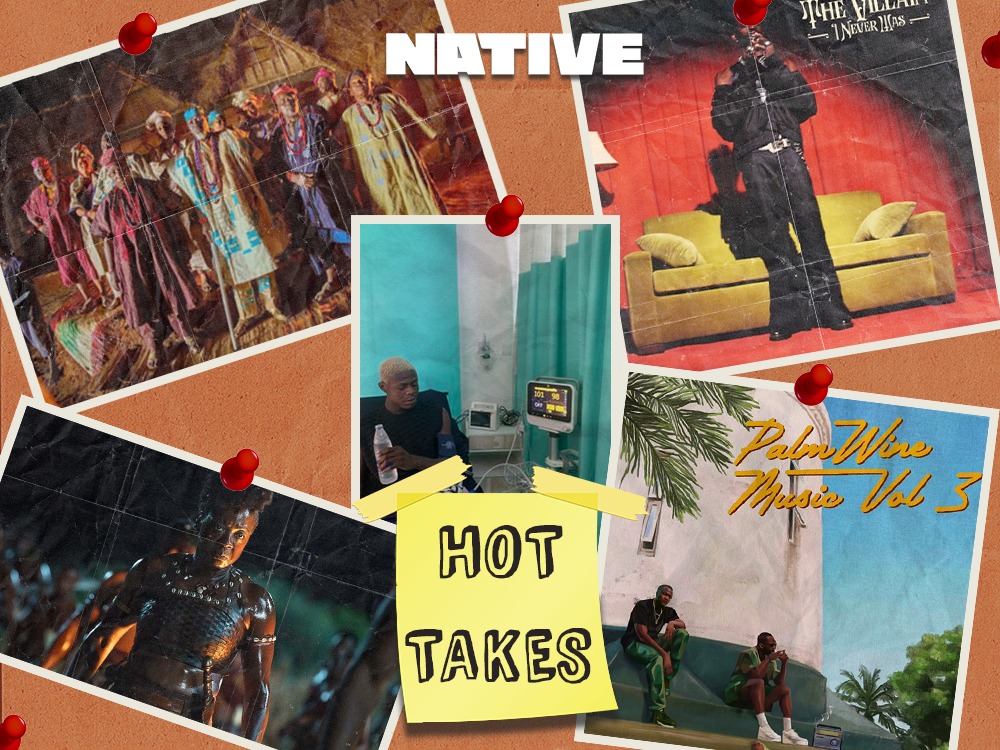
Hot Takes: Sad Boys Club, Adichie & FN Meka, the AI-Powered Rapper

At every moment of our lives, something is taking place to shift the course of the future, whether pleasant or not. There is no debating that fact. All around us, the wheels of the world keep turning (even faster than before), leading many of us back to old routines, as we course towards the end of the year. In Nigeria, summer for us means rainy days, cloudy skies and tumultuous winds, and with the new year only months away, anticipation is rife for the general elections next year.

Last week, I joined the NATIVE, ready and eager to take on the task of spotlighting our culture, sounds, music, fashion and more from this side to the world watching. This week, I’ll be taking the reins on my first-ever Hot Takes (!!!) uncover my listening and visual pleasures, the Adichie-backed wins at the NBA conference and an interesting occurrence where music meets technology meets gaming. Enjoy.

What I’m listening to

I find myself returning to Omah Lay’s ‘Boy Alone’ and several tracks on Rema’s ‘Rave & Roses.’ Since Omah Lay’s breakout in 2020 with his well-received EPs ‘Get Layd’ and ‘What Have We Done,’ I have remained a fan of his moody bad boy music.

The singles that followed those EPs—“Understand,” the Justin Bieber-assisted “Attention,” and “Woman”—were great but nothing prepared me for the utter beauty that is ‘Boy Alone.’ It is wholesome sad-boy-with-sprinkles-of ashawo vibes but Omah Lay’s vulnerability and honesty are irresistible. “soso” is a personal favourite as every track gets to me, pulling me deeper into the singer’s world.

On the other hand, Rema’s ‘Rave & Roses’ on the first listen didn’t blow me away. I had anticipated the album as I felt it would be the artist’s crowning glory since his debut in 2019 but it left me feeling that something was missing. Although I recognised the intricate world that music producer London built for Rema, I felt the singer was still in search of something in music that seems to elude him. Lyricism, perhaps? I don’t know.

But on several listens, tracks such as “Dirty,” “Calm Down,” “Soundgasm,” “Time N Affection,” “Jo,” “FYN” and “Runaway” have stood out for me, and I am in awe of how Rema utilises his vocals around the instrumentals and produces melody after melody.

What I’m watching

I have been watching the 1994 British dark comedy crime film ‘Shallow Grave.’ It is British director Danny Boyle’s feature directorial debut. The film is about three roommates who find a suitcase of money belonging to a dead new roommate and the conflicts that arise from their decisions.

I am yet to complete the film but it is an interesting watch so far. I am familiar with some of Boyle’s other works such as ‘Trainspotting’ (1996), ‘T2 Trainspotting’ (2017), ‘Slumdog Millionaire’ (2008), ‘127 Hours’ (2010) and ‘Steve Jobs’ (2015), so it is interesting seeing how his career kicked off feature film-wise.

Adichie’s words at the NBA Conference

On Monday, August 22, 2022, the Nigerian Bar Association (NBA) held the opening ceremony for the 62nd edition of its Annual General Conference at Eko Hotels & Suites. The eight-day conference, which started on August 19 and ends on August 26, will feature panel discussions, speeches, training and male and female inter-branch football competitions.

Nigerian author Chimamanda Ngozi Adichie was a keynote speaker and during her speech, she decried the fact the country lacks true leaders. She also made a case for “troublemakers,” as they are the people she believes will fight injustice and tyranny. Several politicians vying for roles in the 2023 general elections were in attendance.

Adichie, an widely known feminist, also raised concerns about the disparity in prize money for the winners of the male and female football competitions: the male team will win 500,000 Naira while the female team will win 200,000 Naira. Soon after, several personalities contributed to the prize money for the female teams, increasing it to a sum of Four Million Naira.

While some people have praised Adichie for calling out the disparity, other people have hinted at an “unfair treatment” of the men. I say that if the NBA had been fair in the first place, Adichie wouldn’t need to have pointed out the difference in prize money. Considering the exploits of the women of Team Nigeria at the 22nd Commonwealth Games, it is a shame that the NBA didn’t read the memo that women should not play second fiddle as it concerns talent and opportunity.

Rap’s AI experiment gone wrong

The wave of technological advances sweeping the world is unstoppable, and the music industry isn’t left out. Last week, American record label Capitol Records signed FN Meka, a virtual rapper powered by artificial intelligence (AI). FN Meka is the creation of Anthony Martini and Brandon Le, who are co-founders of Factory New, a virtual record label.

FN Meka has a huge following on social media with 10 million followers and over a billion views on TikTok. “Florida Water,” his debut single under Capitol Records, features American rapper Gunna and professional Fortnite player Clix. “Florida Water” is a Trap song about flaunting wealth and a luxurious lifestyle. I couldn’t figure out which part of the song was FN Meka’s but it felt like I was listening to a conventional American Trap song.

Yesterday, news came out that Capitol Records dropped FN Meka from the label and issued an apology after an activist group released a statement condemning the mannerisms of the digital rapper, which they say is a copycat of thousands of black artists such as Gunna (who is in jail because on RICO charges). This development also comes after an old Instagram post of FN Meka resurfaced that showed him making light of police brutality and incarceration.

Initially, before the new information, I didn’t find anything wrong with FN Meka and virtual rap. Throughout the years, as Trap music gained more steam, rap purists have concerns about it signalling the death of “real rap,” rap is pure lyricism and technicality. Still, the genre lives. I don’t think virtual rappers will knock human rappers off the scene. I believe this is simply an effect of technology, as evidenced in other industries such as healthcare, transportation, finance, etc. But following recent developments, Capitol Records have done the right thing. While it’s entirely outrageous to co-sign a racist AI rapper in any way, I feel this won’t stop Capitol or another label from signing a digital rapper in the near future. It’s scary times.

We Spoke To A Few Young Nigerians About The Increase In Mobile Data Prices

It’s no secret that mobile networks in Africa are vastly unreliable. Ever so often, Africans complain about the alarming data prices and fickle network connectivity in the country which leaves many unable to access basic Internet services and social media platforms. According to Tech Cabal, as at December 2017, internet penetration in Africa was at 35%, which is lower than the 54% world average.

Although this number has been growing for the past five years, data costs are still relatively high in many African cities. This year alone, Nigeria ranked as one of the top 5 countries in Africa with the highest data costs, with $0.61 as their respective prices for 1GB. Due to the shift away from traditional calls and the rise of social media and telecommunication apps, Nigerian telecom companies are diversifying quickly to mobile data plans to offset the decline in voice revenue.

According to reports, mobile Internet subscribers in Nigeria has increased from 64.1 million in January 2014 to 128.4 million in January 2020. Earlier in the year, the Association of Licensed Telecommunications Operators of Nigeria (ALTON) disclosed that it will be implementing a proposed 5% tax on voice calls, mobile data and text messages to tackle a mounting fiscal crisis.

The announcement did not say when collections of the levy, which is in addition to a 7.5% value-added tax on calls and data, will begin. However, the impending rise has not been favourable to Nigerians who are already reeling from inflating prices in food stuffs, fuel prices, and more. The spike in data prices continues to particularly affect young Nigerians, who are now spending more time at home due to the rise of remote work since the COVID-19 pandemic.

There is still a long way to go for telecoms networks in one of Africa’s most populous nations. Nigeria’s telecoms industry is still in its infancy, as it was run and regulated by the country’s government for a very long time. Now, that private players such as MTN, Airtel and more, continue to grow and develop around the country, many local users are turning their attention to the network providers to redress the problem and provide them their money’s worth. As such, we spoke to a number of young Nigerians about their mobile network providers, their monthly consumption of data and how they plan to manage the extortionate costs.

MOJI (20)

What telecom network provider do you use and how much data do you use in a week/month?

I use Glo and I use about N10,000 a week.

Have you noticed an increase in data consumption?

Yes I have, it’s so bad.

How has this affected you and now how do you manage your data?

It has really affected me because funds are really tight, so I’ll have to manage the way I use my data to reduce the way I buy data. I always have to sacrifice some apps and even with that, I don’t still see much difference. I thought to switch to another network but I’m not sure if this will make any difference as a lot of people are making the same complains.

MOREWA (24)

What telecom network provider do you use and how much data do you use in a week/month?

About 24GB per month.

Have you noticed an increase in data consumption?

Yes.

How has this affected you and now how do you manage your data?

Well, I now spend more on data and end up using money I want to use for other things, to buy data. As a student who lives off an allowance I try not to go on social media apps like Instagram and TikTok unless I need to. Mindless scrolling is what consumes a lot of data. Also switching from LTE to 3G which can be frustrating but at least I’ll spend less.

AMAKA (22)

What telecom network provider do you use and how much data do you use in a week/month?

MTN and I use 50GB for two weeks plus.

Have you noticed an increase in data consumption?

Well, they scrapped the cheaper data options so, yes.

How has this affected you and now how do you manage your data?

My university is online, so most of the work I do requires using cellular data. I’ve been in an exam before and my data finished and I had bought 50GB just 4 days before that exam. I had to switch to Swift Mifi modem which has been working really well for me, and now I only buy a bit of data because it’s not even worth it anymore.

CHIOMA (21)

What telecom network provider do you use and how much data do you use in a week/month?

MTN N5,000 per week 

Have you noticed an increase in data consumption?

Yes, I have.

How has this affected you and now how do you manage your data?

I switched to Mifi because the data attainable for a lower price is more durable than on a mobile phone and I’ve noticed that it lasts longer. 

ZION (23)

What telecom network provider do you use and how much data do you use in a week/month?

MTN N6,000 50GB.

Have you noticed an increase in data consumption?

Yes, I have.

How has this affected you and now how do you manage your data?

N6,000 for 50GB doesn’t last up to a week, so imagine spending N12,000 every 3 days. It’s a lot of money for a minimum wage earner. I use an iPhone so I switch off cellular data for most of my apps except Whatsapp which is what I use often.

ARIKE (25)

What telecom network provider do you use and how much data do you use in a week/month?

I use MTN and typically purchase N1,500 6GB.

Have you noticed an increase in data consumption?

Yes, I have.

How has this affected you and now, how do you manage your data?

It’s not cost effective for me because now I spend about N5,000 for more data and it still doesn’t last for a long time. I don’t use TikTok as much as I want to anymore and I have to cut down on my data usage. This iPhone limit app has also helped me control how I use data nowadays.

Featured Image Credits/

Best New Music: M.I Abaga taps Olamide & Nas for the meditative single, “Bigger”

Last Friday, Nigerian rapper, music producer and entrepreneur M.I Abaga released his eleventh project and fifth studio album ‘The Guy’. The album’s title sets the stage for the rapper’s reinvention after an immensely successful 15-year old career that has produced a rich discography, numerous awards and recognition as Nigeria’s most revered rap artist. Abaga’s state of mind on the 12-track project is both relaxed and contemplative, assuredly basking in the longevity of his career and looking to the future with purpose.

A track that quickly caught the eyes and ears of many music lovers is early album highlight “Bigger”, which features American hip-hop legend Nas and Nigerian rap great and prolific hit-maker, Olamide. It is understandable if this M.I Abaga and Nas combo is said to have been nine years in the making, considering the lawsuit-tied history between both artists. Finally, Abaga gets his Nas feature and it’s worth the wait, largely because it’s far more sentient and personally refreshing than the boilerplate, politically charged effort many envisaged it would be—due to the alleged touchpoints of the seemingly scrapped lawsuit.


View this post on Instagram


A post shared by THE GUY (@mi_abaga)

Produced by M.I Abaga and the late Nigerian music producer BeatsByJayy, “Bigger” is a meditative, mid-tempo number with gentle piano chords and a bounce that’s very Nigerian, even though it evokes the trademark boom bap knock. On the song, M.I, Olamide and Nas express gratefulness for the success that they have acquired in their careers and a desire to conquer more challenges. “…this is history right here,” Abaga says in the intro of the song, fully aware of the cultural moment about to unfold, the rare trans-Atlantic collab in Nigerian rap. He delves into his verse with sharp, witty writing as he makes a case for himself being unstoppable. He recognizes his place as an elder statesman on the Nigerian rap scene when he raps, “This is for the kid within listening/People who have talent, have discipline/My vision it gets bigger with time/If I ever rest, shit/I give you mountains to climb.”

In his verse, Nas unfurls gem-like lyrics brimming with stunning metaphors; he reveals sneak peeks of a flamboyant lifestyle that hasn’t dulled the hustle in him to seek new challenges and make an impact with a mic. “I’m an alligator salivating at your heart/Leaving teeth marks in your soul Alucard,” he raps. His most recent releases—2020’s Grammy-winning ‘King’s Disease’, its well-received sequel and ‘Magic’ from last year—are evidence of Nas’ constant strive for excellence, and there’s extra gravity to “Bigger” that he’s in fine form, making a wondrous appearance that adds to the tone set by M.I Abaga on his opening verse.

On his part, Olamide’s chorus, delivered in both Pidgin English and Yoruba, firmly roots “Bigger” in the Nigerian context, reminding listeners that Nas’ presence isn’t a mere act of teasing the attention of western audiences but an avenue for creators divided by geography to unite on a sonic field. A master in the game with a record label responsible for the blooming of the careers of many artists, most recently the irresistible Asake, Olamide uses the chorus as a bittersweet tale of the pressures and pleasures associated with fame. It has a moving effect similar to what Bella Shmurda did on Olamide’s “Triumphant” from 2020’s ‘Carpe Diem’.

The choice of Nas and Olamide as features for “Bigger” is a masterstroke from M.I Abaga. It enforces the notion that, for many big names, success isn’t the end of a journey but the beginning of another one. M.I shows that real success is consistently conquering the fears that stand at the gate of every new beginning.

Listen to “Bigger” below.


ICYMI: READ OUR TAKEAWAYS FROM M.I ABAGA’S ‘THE GUY’

TurnTable Top 100: Tiwa Savage And Zinoleesky’s “Jaiye Foreign” Debuts On The Top Ten

Fireboy DML and Asake’s “Bandana” continues its leading streak as it spends a fifth week atop the charts. This week, the catchy single by the YBNL collaborators reached a new peak as it earns its fifth consecutive week at No.1 on the Turntable Top 100.

The track tallied a record 67.7 million impressions in radio reach and 4.48 million streams (it is also the No.1 song on streaming this week, moving up 0.1% on the chart). This earns Fireboy DML a new record as it becomes his longest staying single at No.1 on the charts, surpassing “Peru” which spent four weeks at No.1. This is also Asake’s first single to stay this long on the top chart for consecutive weeks.

For a third week, newcomers Carterefe and Berri-Tega’s “Machala” holds at No.2 on the chart, closely followed by Burna Boy’s “It’s Plenty.” Both tracks are followed by another Burna Boy number, “Common Person” at No.4 for another week. Rounding out the Top five this week is Crayon’s “Ijo (Laba Laba)” which rises from its previous position at No.9. The track earned 68.5 airplay impression and is currently the biggest song on Nigerian airwaves ( radio & TV respectively despite coming at No.3 spot on both charts).

At No.6 this week, we have Asake’s “Peace Be Unto You (PBUY),” while Kizz Daniel’s “Buga ( Lo Lo Lo)” is at No.7 on the charts. Tiwa Savage and Zinoleesky’s “Jaiye Foreign” makes its debut on the Top 100 at No.8 this week. The track gained 43.5 million impression reach on radio (landing the No.6 spot on the radio charts this week) and 1.71 million streams (coming in at No.9 on the streaming charts). Rounding up the Top Ten this week is Ruger’s “Girlfriend,” which ascends from the 11th spot to No.9 this week while Burna Boy and Ed Sheeran’s “For My Hand” falls from the 5th spot to No.10 on the charts.

Moving away from the Top Ten, we have Peruzzi’s “Hypertension,” which debut at No.43 on the charts while L.A.X’s “Para” launches at No.62 on the Top 100.

Read a full breakdown of the charts here.

Featured image credits/

Mo Abudu Is Set To Make Her Directorial Debut With Two Short Films

Mo Abudu is the name on everyone’s lips in the film industry. The ace entertainment entrepreneur through her film company, Ebony Life Studios has orchestrated some of the most memorable Nigerian cinema in the past few years including ‘Fifty,’ ‘The Wedding Party,’ and more.

Now, following the announcement of her collaboration with Netflix Naija on forthcoming film, ‘Elesin Oba,’ which will premiere at the Toronto International Film Festival, Abudu is set to make her directorial debut with two short films, ‘Her Perfect Life’ and ‘Iyawo Mi (My Wife).’


View this post on Instagram


A post shared by Mo Abudu (@moabudu)

The filmmaker is about to embark on a new journey in her career this month. According to a press release, Abudu will direct two short films, and be in charge of the entire filmmaking process for the very first time. This will mark Abudu’s first full-length feature since 2015’s ‘Fifty’, where she guided the storytelling process as an executive producer, but always sought experienced directors to helm each project. 

Her upcoming short films will find Abudu toeing new storylines. ‘Her Perfect Life’  is about 39-year old Onajite Johnson-Ibrahim who seems to have the perfect life, happily married with beautiful children but still wants to end it all. The film stars Pearl Thusi and Joseph Benjamin. It will also feature appearances from Omawunmi Dada, Uzo Osimpka, Christian Paul and Mary Lazarus. The cast for ‘Iyawo Mi (My Wife)’ includes Adedimeji Lateef, Bolaji Ogunmola, Segun Arinze and Jude Chukwuka.

‘Iyawo Mi (My Wife) is about Kunle and his wife Eniola, who has gone mad and wants to kill everyone. Kunle takes matters into his own hands and this results to tragic consequences. Both films will be executively produced and directed by Mo Abudu and Heidi Uys as Supervising Producer. These two projects are supported by The British High Commission and the French Embassy in Lagos, Nigeria.

In a press statement, Abudu shared: 

“I  believe in learning and understanding any major assignment I undertake. Directing is an art form that takes years to master, so I’m beginning with baby steps. I have written two short films that I will be directing – ‘Her Perfect Life’ and ‘Iyawo Mi (My Wife),’ a predominantly Yoruba language film.”

“Although these stories are fictional, they highlight the mental health challenges, hardly spoken about in Nigerian society, that many people deal with all over the world. Mental health issues can affect anyone, regardless of age, race, income or social class, and they are on the increase.”

Featured Image Credits/

uNder spotlight: The Soulful Message of Wendy Kay

uNder is our monthly column committed to spotlighting the Best New Artists from around our musically diverse continent. Each month, we’ll be taking a step further to highlight the artists featured on uNder by offering in-depth interviews and exclusives about their music, their journey’s and their plans for taking their sound from this side to the world watching.


When Wendy Kay graduated from high school, she wanted to act in musical plays. “Broadways, musical plays,” she describes them. She was only two plays in when someone suggested she join a one-year artist development program called Sauti Academy, to sharpen her singing and songwriting. “I was like, ‘okay, fine,’ I mean it’s free so let me go and learn something,” she said to the NATIVE last week.

That same year, in 2012, Wendy Kay was introduced into a community of like minds. Through the programme, she rubbed shoulders with many rising talents—some of them household names in Kenya now. During her time in artist development, she realised many people had enrolled to better their own qualities, and that healthy push of competition worked to reinforce her self-confidence. “I just found myself going through with the music and I’ve never stopped since then,” she says. 

Born Wendy Kemunto, the artist makes music that is laser-focused on uncovering her true self. The lucid wisdom in her songs recalls the music of her earlier years: R&B, Lingala, African traditional choir music, Jazz—“All that mixture,” she says with a light chuckle. Those were however cut from the tastes of elder family members which inspired her early foray into music. Now, Wendy has fashioned a sound that is decisively personal, minimal, and updated with contemporary stories. 

While Wendy Kay finished university, Wendy performed with live bands, getting some money while finessing her artistry. “I was mostly doing covers,” she explained, “because at that time I was very shy. I wasn’t confident in playing the songs that I’d made. But I used to do cover songs with different bands, so we’d sing Rock, we’d sing Reggae, we sang Country, we sang Indian, so we were singing everything. That has really helped my vocals; it really helped me a lot.

Sometime in 2017, she got into Coke Studio as a backup vocalist. “It was actually life-changing,” she says of the experience. “I never thought I’d make it to Coke Studio but I got the chance; I met so many amazing musicians and got to work with them. I got to see them in their element. It even developed my work ethic because we used to do so much work in short periods of time. People don’t really see the behind the scenes, but there’s a lot that goes into the production”. 

Wendy Kay released her first single just before the end of Coke Studio’s own premier season, which gave her the reaffirmation that she didn’t want to be just behind the scenes. Her debut record “Made In Kenya” was created alongside Joe Motoriah and CS in-house producer Young DLC. She got to perform that on the show’s main stage as well, a crowning end to her time on the Coke Studio show. “It was one of the best days of my life,” she says now with exhilarating fondness. 

As you’ll glean see from the song’s Youtube page, Kemunto used to be Wendy Kay’s artist’s name. Before then, it was Miss Kemunto. After that, Wendy Kemunto and, finally, Wendy Kay. So in some sense this particular artist we see today has been constantly evolving, and this portends her most mature version of herself yet. Much of the music released under her earlier aliases aren’t available on streaming platforms except SoundCloud.

“I am very much independent,” the artist responds when I ask if she’s signed to a record label. “I am basically my everything.”  Wendy Kay, however reveals she just inked a distribution deal with Platoon. Kay’s independence pours into the music, the reason why her two projects are titled ‘My Way’ and ‘My Way: Volume II’. The first was an EP released in 2020, and showcased the bold and evocative voice of Kay through the prism of colourful Kenya-influenced sonics. Standouts were the affirmative “My Way” and the ethereal swing of “Samahani,” which apologises to a departed lover. “Why didn’t I treat you better?” asks Wendy in the chorus of the song, while Rigga delivers a stark verse about the nature of the world, asking “why do smart people do stupid things?” 

Earlier this year, in May, the uNder alum released her debut album, continuing the ‘My Way’ title. It contains twelve tracks, with features from Njerae, Steph, Reign SA, MR. LU and Scar Mkadilani, who appears on two tracks, “My Way (Remix)” and “Safe Space.” The soundscape is even more colourful than its predecessor, but here, those flagrant bursts are handled more masterfully. Wendy Kay’s singing has developed admirably as well, her vocals expressing several moods–nostalgic, regretting, groovy, heartbroken–throughout the album’s 37 minutes runtime. 

Whether crooning sweetly about adult-rated desires on “Fantasies” or raising a fist to Kenya’s political struggles on “Pewa,” Wendy Kay excels in her mode of expression. “This album took three years,” she says. “It was such a process; so many songs didn’t get on the album, I was going back and forth. And then again, you know, this was my first time handling a whole album on my own—like where do I even begin, following up on different people, pushing, planning–so honestly it was a lot, but I learnt so much about myself. And I was like, after this album, I’m definitely going to take a break”. 

“A young girl in Nairobi, just trying to hustle her way out,” she offers as the album’s reality. Wendy Kay wrote the songs from a feminist perspective, and the characters inhabiting its world are riveting models from real life. “Trying to pursue the unthinkable and sticking to what you believe in. And in the process you meet some good guys, you meet some bad guys, you fall in love, you get heartbroken, your leaders let you down, you have to look for other alternatives of income—things that we are going through”.  

“Life is about the moments you’re in, wherever you are. For me though, I love staying near the water, I love the ocean.”

Her family resides in Nairobi but Wendy Kay calls herself a nomad. “Just before the corona happened I wanted to go on a little mid-year road trip around Africa,” she says. “Not the whole continent, but just some countries. Then [the pandemic] happened and I started travelling around Kenya more, and my country is so beautiful. But for me, where I feel a sense of peace, a sense of, you know, people accept me for who I am—that’s home for me”. 

Stream ‘MY WAY: VOLUME II’ below.

NATIVE Exclusive: Asher Yelo Is Making Memorable Music

Realising your passion at a young age is a privilege many young people never experience, as most only encounter this later on in life. For 20-year-old singer, songwriter and producer, Asher Yelo, he realised his talent from a young age. Growing up as the son of a highly renowned British-Nigerian actor, Asher fell in love with the arts and performing. However, unlike his father, he was more interested in making music and creating new sounds.

Asher began his musical journey as early as 11 years old, when he began producing music on the Garage Band software found on his mom’s laptop. Aside from producing music, by the time he was 14, Asher was ready to explore other parts of his artistry which gave him ample space to perfect his singing skills. By the time Asher was 16, he had sang and recorded his own original music, and when he was 20, the singer released his first-ever project, a 5-track EP entitled ‘Know Me’.


View this post on Instagram


A post shared by ASHER YELO (@asheryelo)

Asher’s confidence in his abilities stems from his strong family background. Raised in U.S., where he’s been living the last fifteen years, he tells me that his parents realised early on that he had a love for music and entertainment. As such, they nurtured Asher’s skills, pushing him to develop them further and make a career out of it.They trust me to do it to the best of my ability and it’s because I had started so young, at the age of 11. They just saw that I was working hard with what I love to do,” Asher shares. 

Asher Yelo is very intentional about his craft and shares that he is a perfectionist when it comes to making music and writing his lyrics. Listening to his EP, you can tell how much he loves to tell a story, and how vivid he is when depicting the moods and feelings he sings about. “I call myself a story teller, everything is very much a narrative and you can hear that in my projects,” he says. “In the EP, the transitions are seamless because I’m very intentional with how things move, sound and are placed. Very much a beginning, middle and end. Everything is deliberate.”

Asher simply aims to create really good music that he hopes, in turn, will speak to people all over the globe. One of his earliest releases, 2021’s “Know Me” is a double entendre imploring his fans to “get to know [me],” while also presuming they know a considerable amount about him and his journey. This theme of getting listeners to understand more about him runs through his next body of work. The forthcoming project is meant to serve as a re-introduction to Asher Yelo, the artist and newest sensation on the scene.


View this post on Instagram


A post shared by ASHER YELO (@asheryelo)

With a deeper emotional understanding about who he is and where he stands in the game, Asher approaches his sophomore project with a profound sense of clarity and a cohesive vision for his artistry. Recently, the singer shared new single, “There Ain’t Nobody,” an earworm track that finds the artist crooning about love and modern-day relationships. He displays an impressive balance of vulnerability and levity, which Asher shares can also be expected on his forthcoming sophomore release ‘Mr Misunderstood,’ which will further peel back the layers to the artist and man.

Ahead of the project release, we caught up with Asher Yelo to talk about his upbringing, his music career, his family roots, and his sophomore EP. Our conversation, which follows below, has been lightly edited for clarity.

NATIVE: How did you start making music?

Asher Yelo: Oddly enough, I found my love for music through Lego at 11 years old! I’ll explain how that came about. For the first 5-6 years when we moved to the U.S., my brother and I were home-schooled by my mum due to the constant traveling we’d have to do because of my parents’ work. And during that time, I was absolutely obsessed with Lego building; I’d create bionic arms from scratch, dragons and sci-fi looking worlds I’d play in, and so much more! I was convinced I was going to be a master builder at Lego HQ. But then one day, I came across my Mum’s laptop and found GarageBand. I explored around this music production program and found that all these loops you could find in the sound bank could be pieced together and structured to make a whole world, just like Lego! And so it was a very quick mental shift that allowed me to dive very deeply into music production at a very young age. 

Did you have a music around you while growing up?

My mum is always singing and playing piano throughout the house, and I grew up listening to a lot of my parents favourite music like the Fugees, U2, Linkin Park, Fela Kuti, Jay-Z, even contemporary worship from the likes of Hillsong. So I had a very diverse palate of music before I even considered making it myself.

That’s pretty diverse. Do you feel that your multinational background helps you connect with a global audience?

I think it really does. Being Biracial (English and Nigerian), an immigrant, living in the US, having been in French, English, and American school systems, and having travelled throughout almost every continent at only 20 years old has very much matured my worldview and perspective as a human. My mind and heart has been exposed to the grandeur of life ever since I can remember. This inevitably informs my ability to write and create music that can connect to people from many different walks of life.

You are considered a ‘bedroom producer’. Has this production style made it easier to have your own unique sound?

Yeah, I believe so. Since it’s a very unorthodox approach to music creation, you find methods and styles that are unique to your own work flow. I think one of the biggest components that differentiate people’s styles is the vastness of their musical taste; the various genres they listen to, the different forms of songwriting they enjoy, the kind of emotional atmosphere they’re attracted to, etc. All these pillars alter the sound that naturally comes out of a creator/producer, especially as someone who works for themselves in their own environment (namely in a bedroom). So yes, it’s helped me a lot to truly find my own sound and voice that I enjoy.


View this post on Instagram


A post shared by ASHER YELO (@asheryelo)

You teach people about producing on Reddit live streams. As a self taught artiste, what were the major sources that you used to educate yourself?

It’s honestly quite simple: listening. My most valuable tool up to this point has been my ability to intentionally listen to every kind of music and figure out its blueprint. So replication, execution, and experimenting has been my primary method to educate myself. 

What’s been the highlight of your career so far?

The highlight of my career so far would have to be getting nominated for International Rookie of the Year at the Denniz Pop Awards in Sweden. The ceremony is on Sept 7th near Stockholm! It’ll be so fun to go out there and meet everyone.

You’re set to drop a new project.

Yeah, my upcoming EP is called ‘Mr. Misunderstood,’ and it’s about the mental, emotional, and spiritual journey of navigating how to be kind in a dark and turbulent world. I believe we’ve all felt alone and misunderstood at some point in our lives. I wanted to bring a voice to that state of mind because it can be so self destructive and scary at times. I hope it helps people to heal and navigate those emotions. 

NATIVE: How long did it take you to create the entire project and what was the most challenging part of working on it?

ASHER YELO: It took about 8 months to get all the songs made and finalised. The hardest part about the process was figuring out how to make sure that each song had its own identity while also making them live in the same sonic world so that it’s a cohesive experience. For those who don’t know, I make my EP’s transition into each other perfectly so that you can listen from beginning to end as if it’s one whole song with moving narrative points. But at the same time, each song works as a stand alone, so you can put them into your playlist and still love it!

What inspired the songs on the EP? 

Life inspired the songs and my girlfriend as well. You have my mum there for “it was you” which was fun to make. It’s just me talking about leaving the nest and how it makes my mum feel. It’s all from a different place but centred around love. I wanted a soft entry into what I wanna portray. My next project goes way deeper and very introspective, very relatable for the self and it will be intriguing to see how people react.

The “Know Me” movement experience was a 15 minute dance video playing all the tracks on the project. What fed into this decision to share your music in this way? 

It was all coordinated by a team in Quincy Jones productions. They coordinated it without me knowing, it was a surprise release party by telling me it was gonna be an interview but had friends and family who came. They had amazing dancers dance through the whole EP and it was cool to see how people interpret the visual aspect of the song. Having dancers interpret the music I made was such a cool thing to witness. It’s definitely motivated me to look further outside the box as to how I can help express the essence of the songs I create, whether that be through visual arts, poetry, technology, or whatever else. 

How did you get signed to Quincy Jones management? 

In high school, during my senior year, Gezim Gashi (who is now my management consultant), created a program at my school called the Institute of Arts and Innovation that I was accepted to. Alyssa Lein Bryant, VP of Quincy Jones Productions was the first speaker for one of the master classes. I really related to her as she was talking about building a strong character and things that actually matter, so I really appreciated that. I introduced myself, and we kept in touch from there. Long story short, she wanted me to finish high school before we could officially work together. After I was done with school, on February 3rd of 2021, I finally signed a management agreement with her as my manager, via Quincy Jones Productions.

What’s next for Asher Yelo? 

I believe a lot of things are about to unravel; the prospect of being able to perform my music on stage, collaborating with artists as a fellow artist and producer/writer, continuing to broaden my reach within the arts, and growing as a person. I’m still very young and have a lot of life to live and I’d love to use my craft as a way of recording my journey. So all in all, we’ve got a lot to look forward to!


Written by Ada Nwakor and Moore Wright

Songs Of The Day: New Music From WhoIsAkin, Deto Black, Blaq Jerzee & More

We’re more than halfway through 2022, and it’s been an eventful year for Afropop. There’s been a torrent of great new music, spawning a massive stack of inventive smash hit songs. From Highlife-infused Ghanaian pop, to the unrelenting force that is Nigerian street-pop, to South Africa’s indomitable Dance scene, to tantalising Drill explorations in East and Central Africa, and much, much more, we’re living through abundant and musically expansive times.

Every week, tonnes of songs from African artists make their way to digital streaming platforms, and wading through them can be intense. That’s where The NATIVE’s Songs of the Day column comes in to help. We go through as many new releases as possible, spotlighting them here, two to three times every week. Today, enjoy new releases from WhoIsAkin, 3rty, Blaq Jerzee and more. Dig in. 

WHOISAKIN – “DAMAGED”

The talented Nigerian act signed under emPawa Africa has released his new record, “Damaged”. A softly-strung record built on percussions and swooning violins, the musician’s Biker phase continues as he riffs on life, adversity and triumphs. He’s ultimately determined to steer clear of temptations, singing with a wizened perspective how he intends to stand out in the music industry. With inventive rhymes and the subject matter, this is definitely the most affirmative we’ve seen from a musician better known for his tales of young, complex love.

3RTY – “BROWN SUGAR”

For years, lovers of a certain kind of alternative sound have rang loud the gospel of 3rty. He describes his music as one with healing vibrations, deftly immersed in the practices of African traditional lifestyle. The musician is however able to extend those qualities into a peculiar kind of pop-centric record, which is what he does on “Brown Sugar”. Almost muted from the start, the record progresses with dreamy perfection and, later on, the Wande Coal-esque vocalising which is rendered in pristine Yoruba.

BLAQ JERZEE  – “DANGEROUS” FT. JAS KARIS

Ever since he began creating songs as an artist, Blaq Jerzee has been on a consistent ascension. He’s proven capable at delivering unique Afropop records with a soulful edge, and “Dangerous” is another object from his bag of tricks. Drawing from the Palmwine-suffused sound of Juls, the production sets a mellow field for Jerzee and London-raised Jaz Karis to trade tales of their undefeatable love, portending a danger for naysayers. The Prince Dovlo visual is shot in Ghana and warmly translates the song’s theme with tender, colourful scenes.

LANRAYX  – “YGTLT (YOU GET TO LIVE TWICE)” FT. MAKA

Revered Hip-Hop producer Teck-Zilla stays behind the boards for all the songs off LanrayX’s new project, ‘Step It Up’. The soundscape is a collage of mellow, lo-fi beats which are paired with laidback, introspective rapping and evocative singing from a guest such as Maka. On “YGTLT,” the musicians tackle existential themes with stylistic assurance. “I care less about what society thinks/ They only care about your titanic luxury until it sinks,” LanrayX raps in his first verse, merging Old School knowledge with pop culture references.

DETO BLACK & MOWALOLA – “BAD SLUT”

When two fierce female voices connect, you know you’re in for a treat. “Bad Slut” is barely two minutes long, but the energy that jumps out will stay with you for a long time. Built on rocky drums and psychedelia-tinged loops, the record has that you-can’t-restrain-me energy that was the outlying feature of the Alte movement. Even with the colourful vocals and fast-paced nature of the song, its aspirational turn is obvious in lyrics like “Bitches want everything” and “I know I can fly”. The Shanti-directed visualizer also does beautifully in capturing the flagrance and fun.

LAYCON – “GOD BODY V2” FT. A-Q

Even before winning the much-followed BBNaija, Laycon was always heavy on his artistry. He wanted to be known as an artist, specifically a rapper, first, and he’s been keen to show that. On the second version of fan favourite “God Body,” he unites with the veteran rapper A-Q for a spaz off session. Over minimal, boom bap production they both unfurl lyrics with relations to the religious overtone in its title, making their claim on the rap game while paying homage to God for their uniquely successful trajectories. “God makes the tables turn, Jesus was the carpenter,” raps Laycon in his second verse, showcasing the deft wordplay which permeates this record.

HIGO – “TSUNAMI” FT. JILEX ANDERSON

Having soundtracked iconic Alte records for the better part of five years, Higo has been extending his sonic material. On his latest record titled “Tsunami,” he calls up Jilex Anderson for a vocal performance. His guest delivers in scintillating fashion, layering his calm vocals over Higo’s atmospheric production. What results is an undeniably sensual record, with the titular word employed as a metaphor for a woman’s explosiveness.

Featured image credits/NATIVE