Angel Maxine is Using Her Music to Protect Queer Lives in Ghana
As Ghana's first openly trans artist, Angel Maxine faces significant institutional risks simply for existing, yet she continues to show up

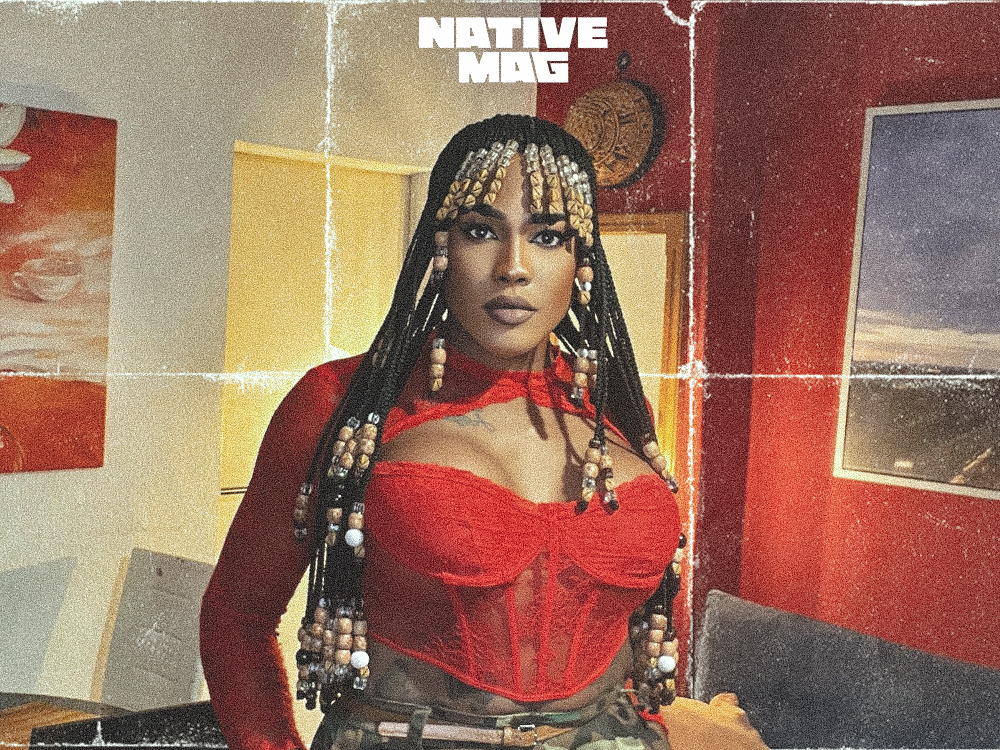
As Ghana's first openly trans artist, Angel Maxine faces significant institutional risks simply for existing, yet she continues to show up
In 2021, Angel Maxine, alongside Sister Deborah and Wanlov the Kubolor, shared “Wo Fie,” a song whose title translates from Twi to “Your Home.” Released as a message of love, the song insists on queer people’s right to community and belonging. “I wanted the song to remind people that they are worthy of love, dignity and community, no matter what society tells them,” she tells NATIVE Mag. Five years later, “Wo Fie” has become the definitive anthem for Pride Month on the continent and beyond.
As the country’s first openly trans artist, Angel Maxine faces significant institutional risks simply for existing, yet she continues to show up. For years, Ghana’s state-sanctioned hostility has persistently closed in on the local LGBTQ+ community. Homosexuality continues to be criminalised under a colonial-era law that refers to “unnatural carnal knowledge.” In recent years, however, the situation has grown more intense with the introduction of the Human Sexual Rights and Family Values Bill. First brought forward in 2021 after an LGBTQ+ community centre in Accra was shut down, the bill has triggered harsher political pressure on queer people.
Just last month, a new anti-LGBTQ+ bill passed in Parliament, increasing that pressure by criminalising parts of identity and speech, introducing prison sentences for simply identifying as trans or queer, intentional cross-dressing, and up to ten years for advocacy, funding, or reporting favourably on LGBTQ+ issues. For queer Ghanaians, it has always been a matter of life and death, and this bill fans the flames, showing just how oppressive the Ghanaian government is willing to be. For Angel Maxine, the fallout is devastatingly real. Her livelihood is being strangled, from lost brand sponsorships to cancelled opportunities, and her creative space has further narrowed, as many allies are now afraid to show public support.
Africans exist globally as the radical Other within systems shaped by race and colonialism, which is why it is incoherent that similar logics of exclusion are reproduced internally against LGBTQ+ Africans. Because queerness is often perceived as aberrant and transgressive, an anomaly outside the category of the Human, African homophobes are not just deeply hostile towards it but actively paranoid. This is the precise nuance that drives “Wo Fie.”
The track is a brilliant trap for bigotry, demystifying the myth of the sinister Other imagined as a supposed abstract sexual contagion existing somewhere out there. It makes a simple point: you hate LGBTQ+ people and you think queerness is deviant and frightening, but your “hairdresser could be LGBTQ… / your tailor could be LGBTQ… / your doctor could be LGBTQ / your bestie could be LGBTQ.” Your loved ones, the familiar faces around you, the people who share in the quotidian routines of your life, could be LGBTQ+. And while you should not only care about the LGBTQ+ people you happen to know personally, charity does begin at home.
In addition to contributing her art to support and protect the lives of the LGBTQ+ community in Ghana, Angel Maxine has been carrying out vital on-the-ground activist work in an effort to ensure that Ghana’s legislative chokehold fails in its primary objective of stifling the presence of the queer community.
We spoke with her about the realities of living and creating as a Ghanaian trans artist, the implications of the proposed anti-LGBTQ+ bill, and the sources of hope that sustain her vision.
“Wo Fie” has become a song that many LGBTQ+ Africans deeply connect with. When you first made it, did you imagine it would take on this kind of meaning?
When I created “Wo Fie,” I knew it carried an important message, but I never imagined it would grow into what it has become today. At the time, I was simply speaking from my own experiences and the experiences of many LGBTQ+ people around me who were longing for acceptance, safety and a sense of belonging.
The title “Wo Fie,” which means “Your Home,” came from the idea that every queer person comes from a home and deserves a place where they can exist freely and be loved for who they are. For many queer people across Africa, home is often complicated. Sometimes, the very spaces that should provide comfort become places of rejection. I wanted the song to remind people that they are worthy of love, dignity and community, no matter what society tells them.
A huge part of the song’s impact also came from the involvement of Wanlov the Kubolor and Sister Deborah. Their participation made the song into something bigger than my personal story. They understood the importance of creating a message of inclusion and solidarity. At a time when many public figures were afraid to openly support LGBTQ+ people, they chose courage. Their allyship gave the song even more strength and helped it reach audiences that may not have otherwise engaged with its message.
How does it feel knowing that many people across continents love the song and find it affirming?
Seeing people from Ghana, Kenya, Uganda, Nigeria, South Africa, the USA, Europe and beyond connect with “Wo Fie” has been one of the most beautiful experiences of my life. It showed me that our stories are interconnected and that music can create a sense of home even across borders. It is deeply emotional and humbling. As an artist, you always hope your work will touch people, but there is something extraordinary about hearing someone say a song helped them survive a difficult period in their life. I’ve received messages from people who said “Wo Fie” helped them through family rejection, isolation, depression and moments when they felt completely alone. For many LGBTQ+ Africans, simply being seen can be life-changing. We grow up hearing that we do not belong, that we should hide, or that our existence is somehow wrong. Knowing that “Wo Fie” has become a source of comfort and affirmation tells me the song is doing exactly what I hoped it would do: it is reminding people that they are not alone. I am also grateful that the song brought together queer people and allies. The support from Wanlov and Sister Deborah showed that allyship is powerful. It demonstrated that standing up for human dignity is not only the responsibility of LGBTQ+ people, but of everyone who believes in justice and compassion.
Ghana has seen intense struggles around LGBTQ+ rights in recent years. How has that affected you?
The climate has affected me profoundly, both personally and creatively. As Ghana’s first openly trans musician, I carry a visibility that comes with both opportunities and challenges. The increasing hostility around LGBTQ+ issues has not only affected how people perceive me, but also my ability to sustain my work as an artist. There have been collaborations that never materialised because people were afraid of being associated with me. Opportunities have disappeared once organisers or brands learned who I am and what I stand for. There are people who privately support me and enjoy my work but are unwilling to do so publicly because they fear backlash. That reality can be incredibly frustrating, because it means that sometimes the barriers I face have nothing to do with my talent, professionalism or the quality of my work.
Financially and professionally, it has made the journey much harder. Like many independent artists, I rely on collaborations, bookings, sponsorships and public support to sustain my career. When an entire political and social climate encourages people to distance themselves from you, it inevitably affects your ability to grow and thrive as an artist. Personally, it can be exhausting to constantly see your identity turned into a political debate. There are moments when it feels like people spend more time discussing my existence than engaging with my music and artistry.
At the same time, these experiences have shaped my creativity. They have made me more intentional about the stories I tell and the legacy I want to leave behind. My music has become a space where I can document our realities, celebrate our resilience and remind people that queer Africans deserve not only rights and protection, but also joy, love, success and the freedom to dream. So while this climate has created obstacles, it has also deepened my commitment to using art as a tool for visibility, truth and change.
How do you think music can help foster empathy?
For me, music becomes even more important in those moments because it can reach people in ways that politics and public debate often cannot. I always say music does not know gender, religion, race, nationality or political affiliation. It speaks to emotion, and emotion is something we all share as human beings. When conversations become hostile, people can lose sight of each other’s humanity and begin to see labels instead of people. But a song can remind us that behind every headline, debate or political argument are real human beings with real feelings, dreams, struggles and hopes.
As an artist, I’ve seen how music can bring together people who may disagree on many things. Someone might not engage with activism or human rights discussions, but they will listen to a song. Through music, they can connect with stories of love, heartbreak, resilience, joy and survival. That connection can open the door to empathy and understanding.
For LGBTQ+ people especially, music can also be a source of comfort. There have been times when songs made me feel less alone, and I’ve had people tell me my music has done the same for them. Knowing that a song can give someone hope, strength or simply make them feel seen is incredibly powerful. So in hostile times, I see music as a bridge. It brings people together, creates space for empathy and reminds us of our shared humanity. For me, it is both a refuge and a form of resistance.
The new anti-LGBTQ+ bill has raised concern in Ghana and beyond. What are your main concerns about what it could mean for queer Ghanaians?
My biggest concern is the fear this bill creates and the message it sends to LGBTQ+ people in Ghana. The danger goes beyond the legal aspects of the bill. Laws influence how people treat one another. When political leaders and public figures repeatedly portray LGBTQ+ people as a problem or a threat, it can encourage discrimination, harassment, violence and rejection within families and communities.
I am particularly worried about young queer people. Many are already trying to understand who they are in environments where they may not feel accepted or safe. When they hear messages that tell them they do not belong or that their existence is something to be feared, it can have a devastating impact on their mental health, confidence and sense of self-worth.
I am also concerned about how this climate affects everyday life. It can make people afraid to seek healthcare, access support services, express themselves or simply live openly and honestly. It pushes people further into isolation and fear.
Most importantly, I worry that we are losing sight of our shared humanity. LGBTQ+ people are not strangers; we are Ghanaians. We are artists, students, workers, parents, siblings, friends and neighbours. We contribute to our communities just like everyone else. My hope is that people look beyond politics and remember these conversations affect real human beings whose only wish is to live with dignity, safety and equal opportunity.
What’s keeping you going in the fight for LGBTQ+ rights in Ghana and across Africa?
What gives me hope is people. I see young Africans questioning harmful narratives and choosing compassion over fear. I see parents learning to accept their children. I see activists, artists, lawyers, journalists, faith leaders and allies continuing to stand up for human dignity despite immense pressure.
I also see queer Africans refusing to disappear. For generations, people have tried to tell us that we do not belong here, yet we are still here. We are creating art, building families, leading movements, supporting one another and contributing to our communities.
Change rarely happens overnight. History shows us that progress is often slow, difficult and sometimes painful, but it also shows that people who fight for justice can transform societies. My hope comes from knowing that every conversation, every act of courage, every song and every person who chooses love over hatred moves us closer to a future where LGBTQ+ Africans can live openly, safely and proudly. And I believe that the future is possible, not because it is guaranteed, but because so many people are working every day to make it real.
Support Angel Maxine by contributing to her GoFundMe here.

