NATIVE Exclusive: Mavo’s Universe
Taken from his Bizzypedia zine, Mavo talks NATIVE Mag through his blistering rise to the top and the unique powers that make him inevitable.

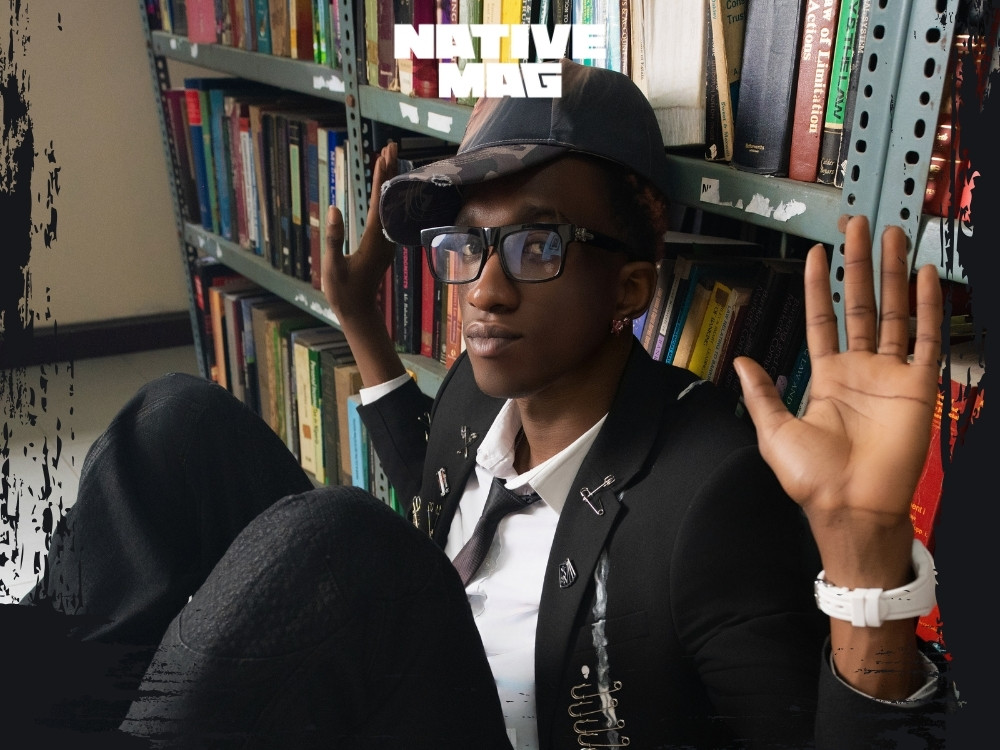
Taken from his Bizzypedia zine, Mavo talks NATIVE Mag through his blistering rise to the top and the unique powers that make him inevitable.
On a sunny Wednesday afternoon in August, Mavo is talking through outfit changes for his Bizzypedia shoot at a law library in Ikoyi, Lagos. It’s only the first part of a tasking stretch that would see him have multiple fit swaps and work through several poses in front of the camera before heading to another studio in Lekki for an audio-visual accompaniment to his specially curated zine, Bizzypedia.
Mavo does all that’s required of him with calculated precision, responding when his input is sought from him or a clarification is needed. Still, halfway through his time at the law library in Ikoyi, there is a realisation that our interview, originally scheduled to be held at some point during the shoot, will not take place anymore as his team of stylists and photographers take over the show, hard at work to perfect all the elements for the shoot of Bizzypedia, a one-of-a-kind publication that’s designed to be an immersive incursion into the alternate universe that the Benin-born singer has designed for his fans and listeners.
The need for Bizzypedia is necessitated by how slippery it can be to classify Mavo. On some days, he’s a 21-year-old student of optometry at Afe Babalola University in Ekiti State. On other days, he’s an ascendant force in Afropop who comes up with radio bangers in his dorm room in his free time, preferring to hunker down with his music while his peers go to football pitches to blow off steam, but perhaps the most fascinating part of Mavo’s composition is an intuitive apathy for language.
Where other rising musicians rely excessively on tonality and vocal dexterity, Mavo’s playful inversion of language has seen him weave compelling narratives around heartbreak, ambition, and despondency into an entertaining brand of music that’s addictive and resonant. It comes from years of studying music and working his way towards writing songs people would gravitate towards. “Growing up, I always listened to music, but I was more of a writer,” he says when we finally get a chance to speak near the end of August. “I was always writing music. I always wanted to write lyrics. I was always writing them out, trying to mime, trying to know them in my head.”
It is fitting that he lists Wande Coal and Duncan Mighty as critical acts who shaped his music, praising them for their writing style, the singing style they employed, and the way they’ve navigated independence in a brutal industry. “I really appreciate their vocal presence and lyrical flexibility,” he says. “They could go from high to low so easily, and they were not really mainstream artists, but they did not have to do so much and did not have to be like Wizkid and Davido to show that they were so good in the music, and people still recognise them as very good artists. That’s what I wanted for myself.”
That streak for self-sufficiency is a legacy of Mavo’s childhood. Born in Ekpoma, Edo State, he moved to Warri in nearby Delta State as a child before returning to Edo for secondary school as a boarding student. It was as a student of Lumen Christi International High School that he was christened Mavo, setting him on the path to global fame. “When I got to SS1, there was a club called Music Club. In that club, every Friday you go there to sing what we have made, or what we’ve written,” he remembers. “That’s where I started putting out my music. I started showing that I was an artist and I could make music. From SS1, guys were already vibing with me. They would always wait for Friday to hear what I have to drop.”
When he got admitted to study optometry at Afe Babalola University, he was determined to level up as a musician, seeking out collaborators to work with on his music and improve his craft. For his first four years in university, all he did was write music and record while building an expansive digital vault of songs. When the time came to start releasing music professionally, in 2023, he had 300 songs ready to go. “I record by myself,” he explains. “It’s not that hard.” His first set of songs performed well online, receiving over 5,000 streams on SoundCloud just a few days after they were released. Sensing an opportunity to structure a proper campaign, his manager, Bevs, took down some of the songs from SoundCloud. “I decided to release it properly on DSPs because those songs required proper attention,” she says.
Those songs formed the backbone of his debut project, ‘Ukanigbe,’ an exploratory seven-tracker that housed gems like “Tumo Weto,” a spiteful rumination on a failed relationship, “Timo Wena,” an amapiano-inflected rendition of the depths he’s willing to go to prove his love to a romantic interest, and the titular track that’s a defiant declaration of his independence. Listeners were confused about this fascinating new voice and his insistence on maintaining independence in an industry where many crave connections to major labels and the promise of success that those affiliations seemingly promise. For Mavo, the freedom to do things at his own pace was important for the singer in the early days of his career.
“Everybody was confused about why I was saying that I was independent,” he says. “Guys were like, ‘Why is this guy trying to do this at the first stage of his music career? Why is he trying to say he is independent? Why does he not want any help?’ I was just trying to build myself first. I wanted to see what I could do by myself before taking help from anybody.”
Armed with a trove of music and a nimble team aligned with his vision, the singer followed up ‘Ukanigbe’ with a series of projects that expanded on his id while introducing fresh dimensions to his delivery and style. What has remained constant is a fierce dedication to making music deeply marked by luxury and indulgent consumerism, as evinced by his go-to line: no more way for poor people. For better or worse, it’s an honest reflection of the thought process of a young Nigerian living through some of the most torrid economic conditions in the nation’s history.
He doesn’t shy away from admitting that his music is made with opulence in mind when I ask him how he would define his music. “I define my music as luxury music; my music is just luxurious,” he answers without missing a beat. “That’s why not everybody can understand it. If you are focused on making money, you can grasp my music, but not as much as those who are already making music. If you want to make money, you can get it to an extent, but not as much as those already making money. If you are currently making money and money is getting into your account, there’s no way you will not feel my music because it’s luxury music.”
Still, he goes through great odds to explain that he regards himself as an artist who is obsessed with music. “The thing about me is that I’m an artist who always cares about the art,” he shares. “I feel like just singing about God’s blessings or singing about parties is not how to be an artist. For me, an artist is meant to be able to make a song about any situation. Art should not be confined, and an artist should not be limited. I have songs about parties, I have songs about food, I have songs about drinking, and I have songs about smoking. I just have songs for different moments.”
While his catalogue is indeed packed with songs that run the gamut of the human experience, it is a song about the unabashed embrace of opulence and palatial grandeur that has provided the momentum propelling his career forward over the last six months. “Escaladizzy,” a song he wrote in his room, has become one of the most defining songs of 2025, thanks to the confluence of his unique slang infused in indigenous rhythms and WAVE$TAR’s breezy delivery. What started as a viral moment across social media became a catalyst for Mavo’s emergence as a solid contender for the breakout Nigerian act of 2025.
“When I went to WAVE$TAR’s house, I told him that I already had this song I wanted to record, but I didn’t know if he would be nice on it,” Mavo says. “I was just playing the beat, and he was vibing to it. So, I was just like, ‘This is a nice vibe that would lead up to the part I already wrote.’ We actually didn’t even finish the song; we just stopped at the chorus, and that was it. We didn’t record the verses. It was after we finished for the day that I told him maybe I’ll drop the song, and he would just record his verse and add my part later.”
Initially, Mavo had planned to release a deluxe version of his April album, ‘Kilometer,’ but the demand for “Escaladizzy” forced him in a different direction, leading to the biggest hit of his career. He’s insistent that this moment was always going to come. “I was always sure of myself,” he says matter-of-factly. “I was already sure that no matter how much the music didn’t go so far at first, it was going to go so far eventually, I was just going to continue pushing.”
Still, the scale and demands of his meteoric rise to fame shock even him sometimes. “The most surprising thing is me not wanting to go out and not wanting people to see me,” he admits. “Like, I don’t want to be outside. Normally, I thought that when I started popping or getting recognition, I would be an outside guy so that people could take pictures of me and all, but when it happened, everything changed. I get so overwhelmed by people talking to me and the constant interaction.”
A key part of what has contributed to Mavo’s rise is his peculiar slang style, which has been adopted by a generation of onlookers and fans eager to decipher what the meaning of words like ifatizzy, bur bur, and burti mean. In some ways, his unique slang represents the work from his POV and an attempt to build a world around his music. “I have always wanted to create an alternate language where people can have fun, and people will not understand, and this is similar to that,” he explains.
With an ever-expanding audience tuning in to his music, Mavo is keen to help them find their way through his music by providing illumination on some of the slang used in his music. “Bizzypedia represents me,” he says. “I feel like it’s a better guide to who I am. It is a guide to people understanding me, because I feel like I’m very hard for people to understand. I like the fact that I’m not easy to understand because when you’re easy to understand, you’ll be easy to access.” With Bizzypedia, he’s aiming to invite people into his world and allow them to get a look at the world from his perspective: “Bizzypedia is going to be a general guide for everybody to finally understand that this is what this Mavo guy is about, and he’s a different person, not just a regular guy, or the regular artist that drops music and goes.”
Not content to sit on his laurels, Mavo is itching for more, invariably leading us to his forthcoming project, ‘Kilometer II.’ While he won’t share a lot of details, he describes it as an improvement on its predecessor. “The first was a race of a lifetime. ‘Kilometer II’ will be a flight of a lifetime,” he says. “We’re flying now and doing unimaginable things. People are always relating us to smoking and doing cana, if you’re doing that, you’re basically on a flight.”
As it is, Mavo is busy acclimatising to the demands of stardom and fame while working to complete his degree in Optometry. The release of ‘Kilometer II’ is strategically planned to ensure that he can be back in school in time for classes at some point in October. It’s a seemingly endless grind that would burn out even the strongest person, but Mavo is just keen to get on with it.
This is the life he always wanted; now that it’s within sight, he just has to reach out and own it.

