Five Years Later, What Is The Legacy of The #ENDSARS Protests?
In 2020, Nigerians took to the streets to protest police brutality. Half a decade later, we revisit #EndSARS' impact on today’s Nigeria.

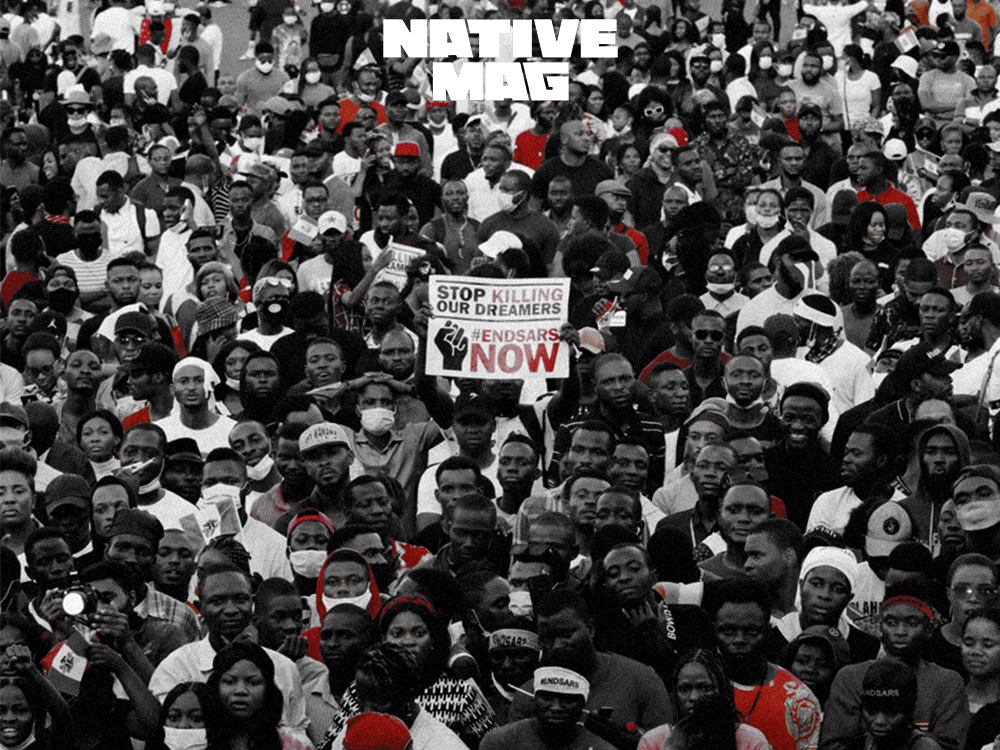
In 2020, Nigerians took to the streets to protest police brutality. Half a decade later, we revisit #EndSARS' impact on today’s Nigeria.
“The protests had begun in Delta and other parts of the country,” recalls Femi Fadahunsi, who was working as a reporter for Nigerian culture publication Zikoko in 2020 when the EndSARS protests broke out. “In Lagos, it began as a group camping outside the state government house. I’d seen it unfolding on Twitter and felt something was different about this one. There was no organized movement behind it.”
It was on day two of what would come to be considered the 2020 #EndSARS protest that Fadahunsi joined the protest grounds. By the time he got there, the energy was visible as he watched an even larger crowd join the already sizeable crowd at the Lekki Toll Gate, which became the epicenter of the nationwide protest. “It hit me when I arrived at the grounds,” he remembers. “The energy was palpable, and in that moment, I knew this was going to be something momentous.”
Ebele Molua, a media and events consultant, helped provide protesters with food during the protests. She still remembers when she realized that what was unfolding was something special. ‘‘I suddenly saw a wave of people charging in the direction of the group of protesters that were already there,” she recounts. “It was another group of protesters that had walked all the way from Agege to join the group I was leaving. You could literally feel the momentum of the protesters that were already on the ground shoot through the roof. They were not alone. I knew in that moment this was going to be one for the books.’’
By the time October 2020 rolled around, it felt like the world had already lived through every possible plot twist. The year had opened with a global pandemic that forced the world into lockdown. It left everyone glued to the news, watching death tolls climb while scrolling endlessly through social media. Then came the #BlackLivesMatter protests in the West, sparking a global reckoning with institutional racism.
in Nigeria, a different type of reckoning with institutional authority had been brewing. The Special Anti-Robbery Squad (SARS) was a specific unit of the Nigerian Police Force that was created to deal with violent crimes like robbery and kidnapping. Since its formation in 1992, the unit had become known for being particularly violent to civilians whom they often profiled based on looks. Accusations of extrajudicial killings, extortions, and torture had inspired several protests and pushbacks from many over the years. In fact, reforms had been promised in 2016, 2017, 2018, and 2019, all to no avail or visible change. If anything, SARS got more violent as the months and years passed.
In October of 2020, a video showing a SARS police officer shooting a young Nigerian at Ughelli, Delta State, hit the Internet. Soon after, reports of SARS officials gunning down an up-and-coming musician named Sleek also surfaced. Something about these videos in quick succession caused the internet to respond with fervor, and soon after, young people hit the streets of states around Nigeria.
EndSARS was, in many ways, a collective national coming-of-age. It felt like we were a newly minted generation of young adults baptized by fire, suddenly seeing our country and ourselves with clarity. This cohort would come to be known as the Soro Soke Generation ( meaning“Speak Up” in Yoruba). The excitement was electric. Everyone was tweeting, posting, and amplifying not just police brutality but also the broader political and social injustices that had been ignored for decades.
For the first time in many of our lives, here was a movement that wasn’t defined by party politics, ethnic divisions, or personal ambition. It was a collective push for real change that, we hoped, could make our lives better. It felt like we were unlocking a dormant muscle, realizing who we were and how much power we truly held. The political class scrambled, visibly shaken by the sheer scale and unity of the youth-led uprising.
The EndSARS protests soon captured global attention. Unfortunately, on October 20, 2020, five years ago today, the movement was brutally suppressed in a display of state-sanctioned violence that the government continues to deny. We all watched, in horror and disbelief, as the Nigerian army opened fire on unarmed protesters waving the national flag.
Where the start of EndSARS was defined by faith in our collective strength and a rare sense of patriotic optimism, the events of that night seemed to undo it all. Many young Nigerians were abruptly awakened to a new political and social consciousness. For the first time, we were forced to confront the brutal truth of our disposability and how little regard the state had for our lives, our voices, and our rights.
‘‘Before EndSARS, I believed there were certain lines the government wouldn’t cross,’’ journalist Nelson C.J. told NATIVE Mag. ‘‘Shooting unarmed citizens felt unimaginable. I assumed there was a baseline of decency, a kind of unspoken code. That illusion shattered on October 20th.’’
In Greek mythology, when Pandora opened her box and unleashed all the world’s evils, one spirit remained: Elpis, the spirit of hope. Watching Nigerians come together across ideologies and subcultures during EndSARS felt like we’d been given that spirit to tend to. But on the night of October 20th, it felt dampened as we watched Nigerians who held the Nigerian flag and sang the National anthem being shot at.
‘‘The reminder I have of EndSARS happening is the toll gate not being functional, which I believe is a doggy bone that will soon be snatched away,’’ Molua shares. ‘‘Other than that, it feels like we’re being punished. The country has gotten so much worse since then, by every single indicator.’’
Five years might be a short time in a country’s history, but in a person’s life, it’s long enough for wounds to harden into silence. And seemingly that is what has happened to the generation that a few years ago thought that to ‘Soro Soke,’ was going to be our defining characteristic. Five years ago, we shouted, tweeted, and posted about how we were not like our parents’ generation. It seems like Nigeria is happening to us still. We may rephrase or reframe it, but it is visible in how the big Nigerian dream of today is to ‘japa’ where for our parents, it was ‘checking out’. It all feels like a case of different names but the same reality.
‘‘Sometimes I fear that the Nigerian goldfish memory has set in,” Fadahunsi shares. “We forget the horror. We forget the power we once felt as we marched, demanded, and hoped. We forget the shock of watching our government shoot its own citizens, people armed with nothing but the flag. We forget how quickly the truth was buried under propaganda.’’
So, did we change Nigeria, or did Nigeria change us?
‘‘The change was sadly not transformative. It unlocked, I’d say, a hunger for escape and a sad sense of statelessness in many.’’ C.J. says. ‘‘While it may seem like nothing really changed, the protests really did show us what is possible. And while it may not happen again, it is a confirmation that when the time comes, we will know how to find our voice again.’’
It is in that possibility, the possibility of our collective power causing change, forcing the political class to look at the state of the country and to get that story out there on the global stage, that the greatest win of the ENDSARS movement lies. Young Nigerians, in a matter of days, created and maintained a decentralized movement that the entire country and the world felt in the middle of one of the most action-packed years of our lives. This should be the legacy of ENDSARS: a constant reminder that we can demand better of institutions meant to serve us.

