Review: ‘Swaguu’ by Seyi Vibez
If you can set aside nostalgia for the Seyi Vibez of 2023, ‘SWAGUU’ is a fairly decent portrait of an artist wrestling with the price of his own ambition.

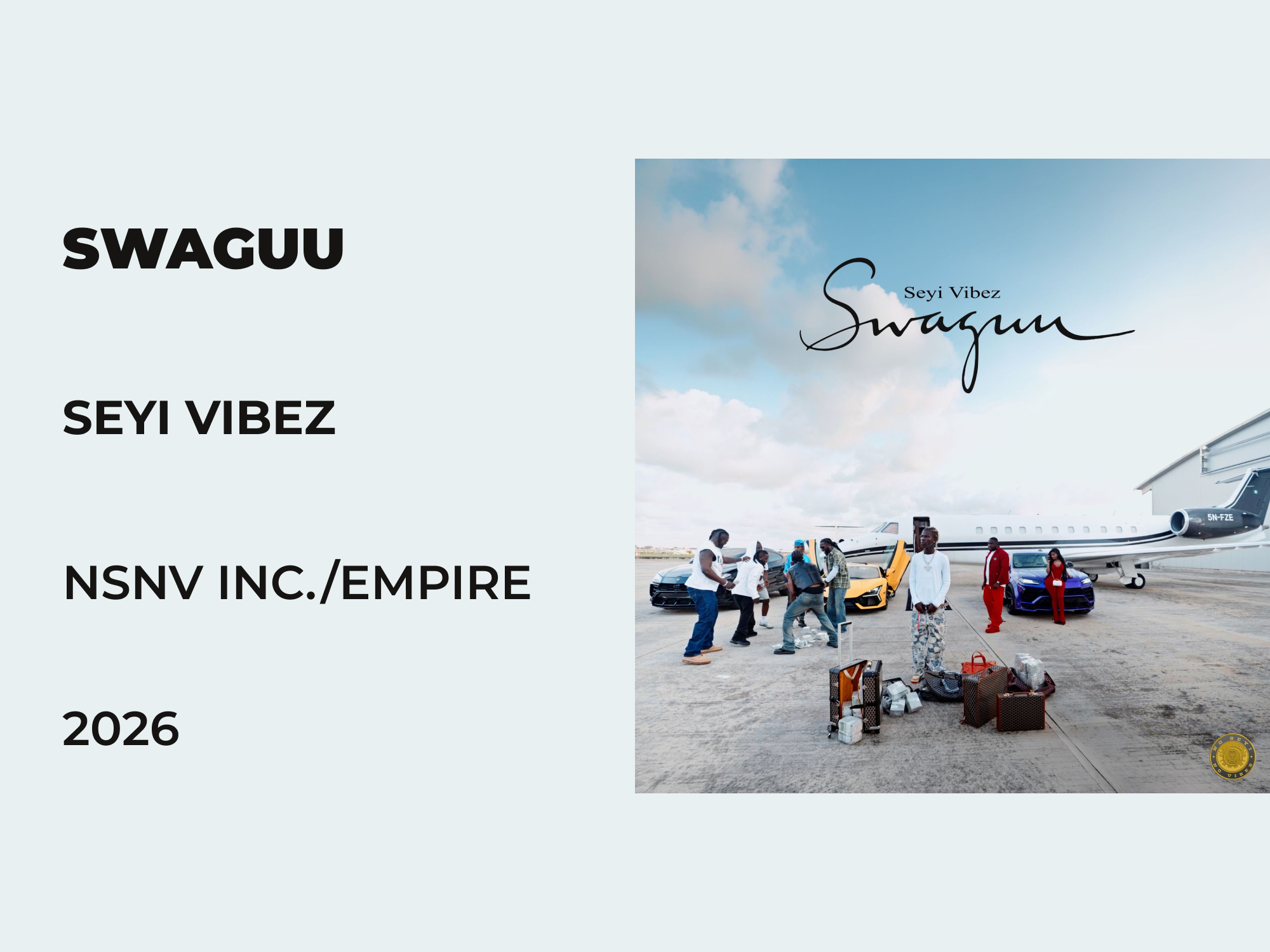
If you can set aside nostalgia for the Seyi Vibez of 2023, ‘SWAGUU’ is a fairly decent portrait of an artist wrestling with the price of his own ambition.

It’s wryly amusing that the very first words Seyi Vibez utters on ‘SWAGUU’, right on the opener “Volume”, go thus: “Have mercy on me, e no matter my money, e no matter my luxury, I need more money to take care of my family.” There is something almost pre-emptive about that plea. If ‘SWAGUU’ is the record where Seyi begins seriously angling beyond the Nigerian market, perhaps the subtext is that he already knows there will be something to answer for. After the conspicuous materialism of ‘FUJI MOTO’, where both money and luxury seemed to acquire an almost ideological importance, Vibez now seems to be offering a more defensible reason for wanting more of both.
Amiri Baraka writes in ‘Black Music’ about how easily we “take for granted the social and cultural milieu and philosophy” that produces music. Street-Pop has become the genre it is today because there is something imaginatively alive about it, a quality that captures the essence of that fugitive thing we call soul. It has taken some convincing to get to this point of broad acceptance, because it was not always this way. In 2022, I wrote about some of this when Street-Pop was still being met with a peculiar mixture of contempt and fascination that had followed it for years. There was a certain elitism in the grudging acceptance of the music and the culture that gathered around him. A lot of the unsavory language used to describe the subgenre was really a way of describing the people who made it and, by extension, those who loved it.
Yet, the artists responsible for the best of the music kept that soul extant, preventing the genre from slipping sterilely into the echo chambers of middle-brow Afropop culture. Because the majority of Nigerian popular music is built on the need to flex, there is a tendency to enforce those standards of excellence as criteria for performance on a music that, in its most profound manifestations, is completely antithetical to such standards. Street-Pop has been one of the most potent artistic forms available to young Nigerians who had something to say about their lives; artists who felt that impulse went naturally into the music itself. When Seyi Vibez emerged at Afropop’s commercial peak with a style unlike anything before him, he was almost too hot to handle. He had a certain je ne sais quoi that embodied the full expression of everything we love to hate about the streets.
Seyi Vibez’s masterstroke was never simply that he represented the streets—a generation of formidable artists, including Asake, Zinoleesky, T.I Blaze, was already articulating that experience. What set him apart was that he seemed to understand how much could be done inside the form. Loseyi could be prophet, professor, and griot at once, giving language and melody to feelings that often existed ineffably. For young Nigerians constantly waiting for prophecies to become manifest, songs like “God Sent” and “Dejavu” remain channels through which spiritual work is done to us that might not have been accomplished otherwise. He also had the charisma and brio to turn almost anything into quality Pop that could take over the zeitgeist. Now, Seyi Vibez has fully come into his own, and ‘SWAGUU’ finds the fantasies that once animated his music a little closer to reality.
Listening to ‘SWAGUU’ for the first time, the first question that comes to mind is: who is this album for? Burna Boy, its executive producer, has already made his feelings about the economics of Nigerian streaming pretty clear. In 2025, he wrote off the significance of topping local platforms, arguing that the money attached to those numbers was too little to mean much. That stance casts a long shadow over Seyi Vibez, an artist who has spent the last few years accumulating the kind of Nigerian streaming numbers most musicians would kill for. If those domestic streams have hit a hard financial ceiling, wouldn’t it be sheer folly to keep squeezing blood from a local stone when he’s already maxed out the territory? The Burna Boy connection makes the play fairly obvious: this is Seyi putting his money where his ambition is, trying to turn the enormous audience he has built at home into a passport for somewhere else.
Even without much of the anarchy and hijinks of Seyi Vibez’s heyday, ‘SWAGUU’ is full of songs that show he still possesses the materials to make some of the richest music of his generation, music that honours the history of his subgenre while adding to the larger story of African popular music. “Volume” is a stellar curtain-raiser, laying down an expectant tone. From there, the record fluctuates, with pretentious missteps like “Back 2 U” sneaked among genuine highs like “Pansa” and “Ilome“. On the latter, Seyi is calm, but do not be fooled by the placidity. The song’s sensual minimalism seems to do very little while quietly doing a great deal, submerging itself in the lush waters of the Niger Delta and its musical memory. Seyi moves between Bini, Urhobo, and Yoruba references over warm Highlife riffs and sharp Ogene accents, while his invocation of “Joromi” binds his modern craft to an older West African sonic heritage.
Elsewhere, the dissolute “Akpan Akpari” offers plenty of fuel for Detty December, while the buzzer-beater “Oble (Original)” gives the artist room to reclaim a phrase he authored–one that DJ YK Mule’s “Oblee” subsequently embedded in Nigerian party culture– on “Flakky”. The run from “Alubarika” to “Oble (Original)” is so solid that when we get to the final track, the title track with Quavo, whatever rise the preceding songs have gotten out of you is immediately snuffed out—it is not a bad song, just painfully thin. In an interview with Apple Music’s Africa Now Radio about the album, Vibez calls it the record that completes ‘SWAGUU’, but completion is exactly what it lacks. Though Vibez molds his cadence around Quavo’s Atlanta Trap flow and staccato delivery, there is virtually no chemistry to justify a collision of styles. “SWAGUU” simply drones on without finesse, bringing the album to an oddly deflating finish
If you can set aside nostalgia for the Seyi Vibez of 2023, ‘SWAGUU’ is a fairly decent portrait of an artist wrestling with the price of his own ambition. The album is heavy with the feeling of old dissolving to make room for the new. The vicious creativity that fuels a Nigerian artist’s debut has always been an unsustainable flame. Truth be told, the Nigerian audience can be impatient and short-winded, but that would matter less if home were not so routinely treated as a mere stepping stone to the real prize: a Euro-American audience with a transient appetite for the exotic.
Crossing over is a gruelling walk through fire, one that not every artist is able to make through successfully to the other end without collapsing into empty, desperate husks. Seyi Vibez began that walk with the tepid ‘FUJI MOTO’, and ‘SWAGUU’ finds him still working it out, only this time with a clearer strategy and Burna Boy by his side. But the African Giant seems hardly equipped to chaperone another artist through a crossing whose costs he is still tallying himself.
Seyi Vibez is too self-aware to sever his tether to home; instead, he attempts to make compromises, indigenising his foreign ambitions to get the best of both worlds. This leaves him caught in a liminal space, a weird in-between that is occasionally painful to watch and reflected directly in how uneven the album sounds. When Loseyi trusts the strange, specific musical intelligence that got him here, ‘SWAGUU’ cackles into life and becomes spellbinding; but because he is caught between what he has already mastered and what he believes might exist beyond it, the spell often breaks.
Listen to ‘SWAGUU’ here.

