Review: ‘Starrgirl’ by Ayra Starr
As she aims for global domination, the range of themes and sounds Ayra Starr explores on ‘Starrgirl’ is genuinely breathtaking.

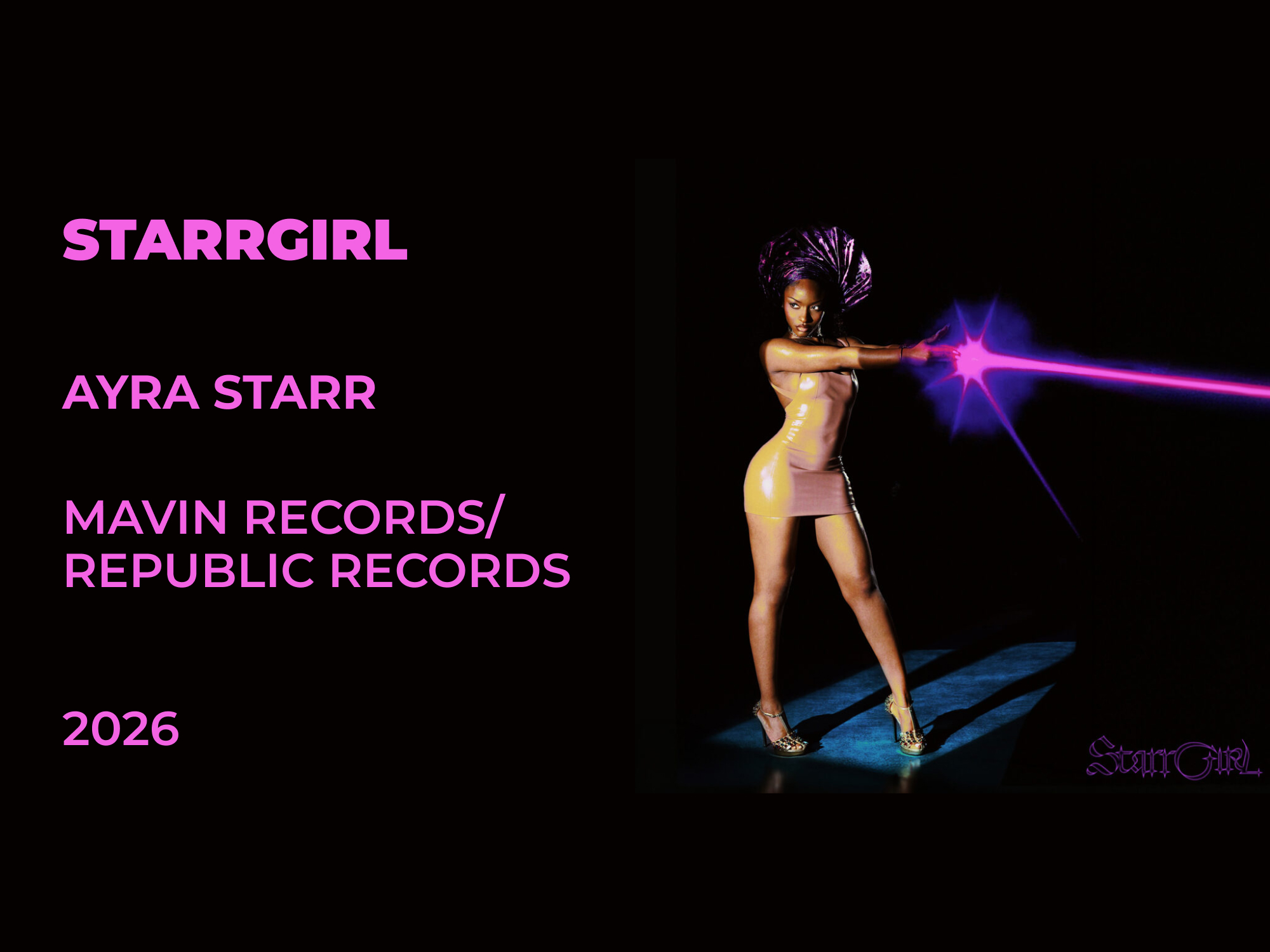
As she aims for global domination, the range of themes and sounds Ayra Starr explores on ‘Starrgirl’ is genuinely breathtaking.

‘Starrgirl,’ Ayra Starr’s feverishly-anticipated third studio album, begins at a frenetic pace. On “Dangerous,” the opening track, cavernous drums rumble, buoyed by moody synths that evoke a superhero film score. Apala-inflected ad-libs by Terry Apala and label mate Lovn, however, smuggle in a Nigerian texture. In a tone teetering between braggadocio and indignation, Ayra adorns herself with praise, offers tribute to her army of fans, Mobstarrs, and scowls at her detractors. “Won o le ri mi tan,” she sings defiantly on “Dangerous.” The song offers useful clues for parsing what the 24-year-old virtuoso describes as her “grown woman living in New York City” era. Firmly in her girlboss epoch, she’s done with playing nice. A fierceness glistens across the album, reflected through lyrics asserting that she’s done begging for love and placating foes. Crucially, on ‘Starrgirl,’ Ayra Starr offers an expansive vision of African Pop.
Ayra Starr shot to superstardom in January of 2021, when she released her eponymous EP. As the lore goes, years before, music impresario and label boss Don Jazzy had scouted her from a cover she posted on Instagram and promptly funneled her into the Mavin Academy, where she was minted into a star. When she released her debut EP, a mix of stricken ballads and springy romps, very few might have anticipated her breathtaking career arc. But even then, it was clear she was special.
By 2024, when she released her sophomore album, ‘The Year I Turned 21,’ a mix of sappy romantic ballads and punchy confessionals, she’d taken her place amongst Afropop’s vanguard. Along the way, she had also acquired an army of devotees whom she christened Mobstarrs, entering the rarefied echelon occupied by generation-defining stars like Madonna, Wizkid, and Beyoncé. These fans champion her achievements, parry rival fanbases, and ensure she remains in relevant conversations.
“Mobstarrs na my family,” she sings on “Dangerous.” Coming from another artist this might read like a case of a celebrity goading fans into parasocial behavior. But anyone who has seen Ayra’s fans come out in their numbers to support her would agree that addressing them as family is perhaps not so much of a stretch– as an act of support in the lead-up to ‘Starrgirl,’ they christened an actual star after the album. Fervor at this intensity tends to come with some dogmatism, and this case is no different. Mobstarrs view themselves as extensions of their patron saint, internalizing both her successes and perceived slights against her. Shortly after her last album, fans began to murmur that her distinctly Nigerian branding was perhaps holding her back from becoming a true global star. In many ways, ‘Starrgirl’ feels like a rejoinder to this criticism.
On ‘Starrgirl,’ Ayra Starr trades her distinctly Nigerian sound for a cosmopolitan one, weaving Afrobeats, Soul, R&B, Pop, Dancehall, House and Bouyon into a glorious carnival, as she makes her case for global hegemony. On “Midnight in New York,” one of the most exquisitely produced records on the project, she’s melding Afropop and Dance music with practiced ease. It’s midnight in New York, Ayra is dressed in a bare-back dress, heels swinging in her hands, as she steels herself for a memorable night with her lover. In July last year, Ayra Starr inked a management deal with Jay Z’s boutique label Roc Nation, and jettisoned Lagos for New York soon after. With “Midnight in New York,” among other things, she seems to be saying the journey is going très bien.
The project has a significantly wide range, which means that listeners who lean back during solemn moments might find themselves blasted backwards when the project swerves into boisterous terrain. It slips into R&B territory on the Kwn-assisted “Amazing.” Over slippery melodies and fuzzy synths, Ayra Starr and Kwn take turns painting rompy, sex-centric scenes. Meanwhile, on “Ms. Paper,” a majestic Bouyon number featuring French-Congolese artist Theodora, restless drums crash into careening melodies, summoning the frenzied energy of a carnival. “Dance,” which finds her ecstatic about her gilded life, subtly nods at House Music’s growing influence in West Africa. With its pidgin delivery and ecstatic percussion, it would sit comfortably on the playlists of the raves taking over nightlife in Lagos and beyond.
Across ‘Starrgirl,’ Ayra Starr is eager to tell us she’s a grown woman now. Moving away from the dreamy notions of romance emblazoned on her earlier work, she resurrects the archetype of the girl boss that dominated the early aughts, embodied by superstars like Madonna, Riot Grrrl, Mary J. Blige and Beyoncé. 90s and Y2K girl bosses, as portrayed on the screen by celebrities, served as the manifestation of feminism’s third wave in Pop culture. Their ethos included taking up space, laser focus on career or ‘getting the bag’, and, not least, optimizing for maximum possible attractiveness. These forces ripple across the album. Their combined effect is that ‘Starrgirl,’ can feel like a contemporary manifesto for young women across the world– and maybe that is the point.
On “Ms. Paper,” she spurns a love interest in pursuit of money. “I make money bae, I call you later,” she sings, making the case for career taking precedence over tenuous matters like romance. It’s also not enough for her to have money, her ideal man is equally well-off. Later in the song, she sings: “Mr. money come see ms. paper.” On “Where Do We Go,” even as she teases out a thorny romantic situation, she sings about matching Mercedes with her romantic interest. In songs like “Who’s Dat Girl” and “Tornado,” she is throwing around her weight in ways certain to inspire women across the world.
Across the album, the subject of hotness simmers in the background, rising to the surface in specific instances. There’s also a lot of sex on ‘Starrgirl,’ described in vivid and colorful language. “When I put my body on private, you just wanna put miles on it/ I just wanna give you, give you that sweet escape/ Touch me,” she sings on the Leon Thomas-assisted “Pressure.” On “Amazing,” featuring Kwn, she ups the ante, singing: “Earthquake in my legs. While the backboard ’bout to break. Put a hole in the wall/ When we freakin’ on the sheets, put that arch up in my back.’ Nonetheless, the moments when she dials down to an emotional register will leave you misty-eyed. In “Heaven Baby,” featuring ZAYN, surfing a somber piano melody, she offers lyrics so vulnerable and pristine, they feel like the journal entries of a love-struck teenager. “You could be my heaven baby/ Die for you if you let me baby/ You’re an angel, god damn it, baby,” she sings. Listen long enough and you’ll start pining for the kind of whirlwind romance that exists only in movies.
As she aims for global domination, the range of themes and sounds Ayra Starr explores on ‘Starrgirl’ is genuinely breathtaking. Eclectic projects typically struggle to achieve cohesion. Nonetheless, for all its sonic adventurousness, the songs on the project sound like different expressions of the same central ideas. Another remarkable feature of the project is how raw and honest it feels. Despite the flawless writing on her earlier works, the lyrics tended to feel like cleverly constructed fictions as opposed to lived experiences. Fictitious lyrics certainly have their place. But in a world where artificial intelligence and the blizzard of misinformation on social media are blunting us emotionally, the ‘Stargirl’s’ diaristic nature makes it particularly compelling.
In 2017, Afrobeats pioneer Wizkid made a gambit for global acclaim with his initially polarizing album ‘Sounds From The Other Side.’ With its novel fusions and eclectic sonic ambitions, it struggled to find its footing in the monocultural zeitgeist of the day, when the predominance of television and radio meant that much of society consumed a streamlined media diet. ‘Starrgirl’ arrives under wildly different circumstances. Its ambitious soundscape feels very much like a product of our post-monocultural era. Going solely by its quality, ‘Starrgirl’ will go down as a classic. The question is: will her globe-trotting sonic cocktail be enough to catapult her to global dominion? The album emerges at a time when the momentum African pop experienced shortly after the pandemic seems to be cooling off. Yet its thematic breadth, intimate lyrics, sticky hooks, and calibration to the zeitgeist make it difficult to dismiss—and even harder not to root for.
Listen to ‘Starrgirl‘ here.

