How Lagos Came To Be A Den Of Area Boys
The area boy has become an index of Lagos itself; follow him closely enough, and you can trace the city’s history.

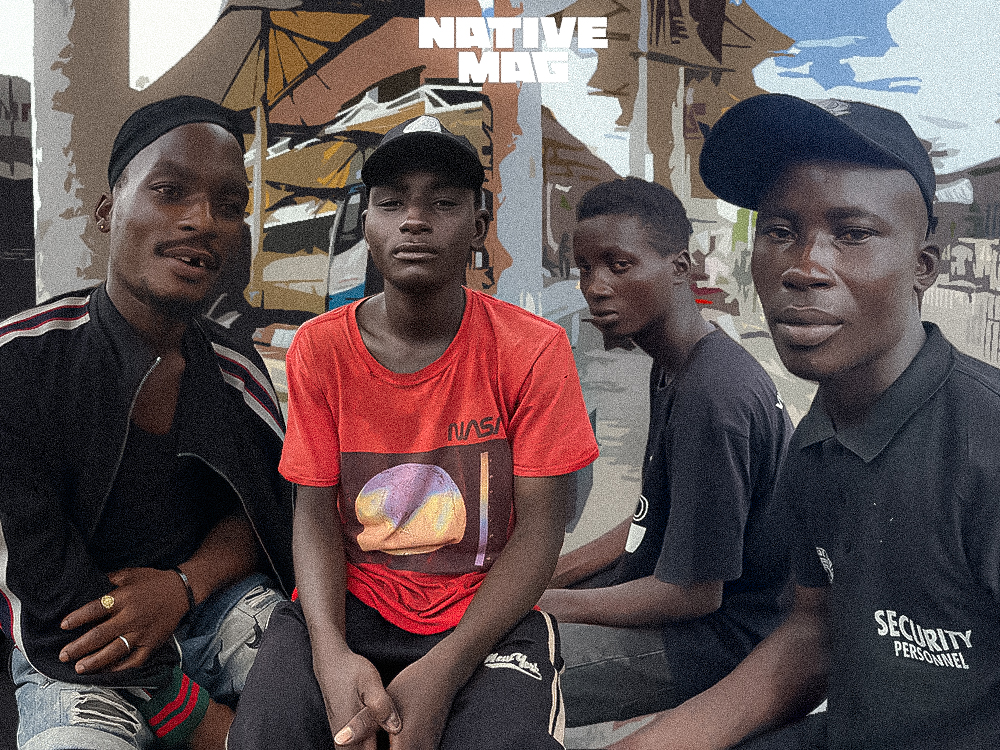
The area boy has become an index of Lagos itself; follow him closely enough, and you can trace the city’s history.
Lagos is divided by more than water.
On one side of the Third Mainland Bridge, a young man, his face mapped by old scars, leans into the window of a waiting car with an easy smile, hands aloft. “Twale! Egbon, anything for your boys?” The driver laughs, fishes out a note without looking at it, and hands it over before the light turns green.
The driver’s wife sighs. “These area boys sef.”He shrugs, rolls up the window and drives on. It is an exchange repeated so often it has acquired the rhythm of ritual.
Across the lagoon, the same red light means something different. Here, a convoy can bring traffic to a standstill. “Na Wizkid! Machala!” Men emerge from behind kiosks, beneath flyovers, and from corners that seemed empty moments before. They gather not because they know the streets, but because they know what the streets carry: money.
Sometimes they ask. Sometimes they insist. Sometimes refusal has a sound. The crack against Mavo’s Mercedes-Benz. When the fast-rising artist refused to pay the area boys surrounding his car, a stone struck his vehicle. The video ricocheted across social media, not only because Lagos had never witnessed such demands but also because many saw it as evidence that asking had, in some corners of the city, become demanding.
The area boy has long been one of Lagos’ most enduring characters, woven into the city’s fabric as much as its frustrations. Yet, somewhere between the old streets of Isale Eko and the aspirational avenues of Lekki, something in that relationship has shifted. Ask ten Lagosians who an area boy is, and you’ll get ten different answers: neighbourhood protectors, touts, extortionists, political foot soldiers, or necessary nuisances. The truth, like Lagos itself, is less straightforward.
Long before “area boy” became shorthand for delinquency and belligerence, there was omo adugbo—child of the neighbourhood—and egbon adugbo—neighbourhood elder. On Lagos Island, the title carried a measure of pride. These were the boys who organised football competitions, marshalled festivals, settled disputes and defended their streets from rival neighbourhoods. Respect came not simply from force but from familiarity.
That understanding unravelled alongside Nigeria’s fortunes. As the oil boom of the 1970s faded and the Structural Adjustment Programme (SAP) reshaped the economy in 1986, unemployment soared, and survival shifted to the informal economy. The neighbourhood guardian gradually became a collector of transportation levies from bikes (Okada) and buses, the controller of bus stops and parking spaces, and the young man whose authority depended less on recognition than on what he could extract from the street.
As formal employment disappeared, the street became one of the few institutions still recruiting young men. Through contracts or salaries, but most crucially, through allegiance. That transformation also reshaped the city’s imagination. By the time an entire generation came of age, the area boy was no longer remembered as omo adugbo—he had become a cautionary tale.
“Growing up, they were considered washouts,” 28-year-old graphic designer Emmanuel tells NATIVE Mag. “Your parents would always tell you, ‘If you don’t buckle down at school, you’ll end up as an area boy.’ It scared you straight. They were like the Baba Yaga or something.”
“Not all area boys are illiterates,” Inspector says before abruptly cutting himself off.
“You have to know who’s who.”
Dressed in a white polyester shirt patterned with green spirals and black denim shorts, Inspector, as he is known around Benson Bus Stop in Ikorodu, cradles a steaming cup of local herbs, blowing gently across its surface as he shelters beneath an umbrella from the rain. He has spent 17 years on the streets, collecting levies from buses, taxis and trailers that break down along the road. In that time, he has done whatever work came his way—anything, he insists, but theft.
“People just see the roughness,” he retorts. “They don’t see us as human beings. Some of the egbon adugbo were once omo adugbo. Some of them don travel abroad from these same streets.”
He pauses, a smile breaking across his face. “I get family. My pikin dey private school.”
His words echo an encounter previously shared with NATIVE Mag by 24-year-old author Lola Ovayoza. While trying to board a bus in Yaba, an area boy stopped her, not to ask for money, but to ask about the book tucked beneath her arm. “He asked me what I was reading,” she says. “When I explained what it was about, he asked if I could lend it to him after I was done. He said it had been a long time since he’d last read a book.”
The story doesn’t absolve the area boy of his contradictions. It simply reminds us that, in parts of the mainland where the language of egbon and omo adugbo still survives, the relationship between residents and the street can be more layered than the stereotype suggests.
Crossing the bridge, that old understanding became harder to find. In the wealthy corridors of Lekki, Victoria Island and Ikoyi, familiarity increasingly gave way to opportunity. At Tafawa Balewa Square, beside the BRT terminal, the smell of weed announced Seun and his brothers before they emerged from beneath the leaking shelter. Rainwater pooled across the cracked floor, reflecting the station’s broken roof like a second ceiling. Boys lay scattered across benches and pavements, sleeping at impossible angles, their bags tucked beneath their heads and flattened cartons shielding weary bodies from the unforgiving concrete. Sleep, here, looked less like rest than a pause between opportunities.
Seun was asleep on a bench, his cheeks hollow, his face weathered by the sun. Dust clung stubbornly to his clothes, as though the street had settled into the fabric.
Unlike Inspector, he had dropped out of school at thirteen. He and his friends in Shomolu would leave school in the morning only to spend the day drifting between street corners until it was time to return home. “Their own too much for there jare,” he says, waving the memory away with a dismissive flick of his hand, referring to the rigidity of school and its rules. By 17, he had run away from an apprenticeship as a vulcaniser. Ten years later, the street is still where he earns a living.
“Every area get e own boys. Elegushi get e own. Isale Eko get e own. Like that, like that.”
The voice comes from the pavement behind the benches, thick with years of smoke. Before the interview began, its owner had been crouched over a flattened carton, absent-mindedly filling it with spirals and crude caricatures in blue biro. Now he looks up, leaves the drawing unfinished and joins the conversation without invitation, as though it belonged to everyone from the start.
“You no fit just go another area dey do anyhow,” he says. “Boys for there go rubbish you. For Island, dem no like thief too. If you thief, dem go kill you. As we dey like this, na we dey keep this place safe.”
Keeping order, however, was only one part of the street’s economy. The other was recognising opportunity. Around the bridges linking Lagos’ wealthiest districts, opportunity often arrives on four wheels. “Island na where money dey,” Inspector had told NATIVE Mag earlier. “Oyinbo wey come Nigeria from abroad na there dem dey go.” The young men at TBS saw the same geography differently. To them, the concentration of affluence had created its own economy.“One way or the other, dem must drop,” one of the boys says matter-of-factly. “If everybody gather around your motor, you fit just ask for the king of the boys. Settle am, everybody go comot. If you no drop anything, anything fit happen.”
Beside him, Toyeeb*, a wiry young man with a charm hanging from his neck, nods in agreement. Unlike most of the others, he grew up on the Mainland before finding himself on the Island, giving him a rare view of both worlds. “Mainland no get boss,” he says. “Everybody na oga for there. But for here, oga wa.”
In a few words, Toyeeb sketches the difference between the two sides of the city. On much of the Mainland, authority is more decentralised, shaped by neighbourhood familiarity. Around parts of the Island, hierarchy is more rigid. There is someone to answer to and someone to settle.
As Lagos has changed, so too has the hustle. Some of the city’s younger area boys have discovered that standing beside privilege can sometimes be more profitable than stopping it. Instead of knocking on tinted windows, they point cameras through them. Around the Ikoyi Link Bridge, where supercars glide between Ikoyi and Victoria Island, luxury car spotting has become its own performance. Rolls-Royces, Ferraris, Lamborghinis and G-Wagons are filmed, narrated and uploaded within minutes. The cars become content. Content becomes attention—and attention, increasingly, becomes currency.
Figures such as Oba Kasari and He or She have built online followings from that familiarity with wealth. They recognise celebrities before most people recognise the cars, calling them out by name as the cameras roll. Just as often, the money comes unprompted—from fans, curious viewers or the celebrities themselves. The area boy has always adapted to wherever Lagos keeps its wealth. Today, some have realised that attention can be just as valuable.
The videos are rarely just about the cars, they are about access. The narrator is as important as the Lamborghini because he appears to belong in a world most viewers only glimpse through tinted windows. Followers return not simply to see another Rolls-Royce but to watch the familiar characters who have made that stretch of road their stage. In a city where attention has become its own economy, visibility itself has become something to trade.
Perhaps that helps explain why the recent debate around Nigeria’s so-called “Olodo Uprising” resonated so widely. Beneath the arguments over influencers and education lies a more uncomfortable question: what does Nigerian society reward today? For many young men navigating Lagos, the answer is increasingly neither qualifications nor craftsmanship, but visibility. If attention pays, then the hustle naturally follows attention.
As the interview at the terminal reached its dying embers, one of the boys broke the silence: “This one go press money before e comot here.”
Toyeeb*, Seun and the others laughed and chorused.
“Normal.”
The interview had, almost imperceptibly, permitted them to expect payment. Conversation had become another form of transaction, and its conclusion, like everything else on that stretch of road, carried a price.
Meanwhile, a day earlier in Ikorodu, the opposite had happened. Inspector never asked for anything. As we wrapped up, I reached into my pocket and offered him something for his time. He accepted with a nod, and we shook hands before going our separate ways. The distinction is easy to miss. On one side of Lagos, money is still offered. On the other, it is increasingly expected.
In that small shift lies the evolution of the area boy. From omo adugbo to collector of levies, from neighbourhood custodian to social media personality, he has adapted to every version of Lagos the city has produced. He has followed wealth as it migrated from the street corner to the bus stop, from the bus stop to the traffic light, from the traffic light to the algorithm.
The area boy has become an index of Lagos itself. Follow him closely enough, and you can trace the city’s economic history—from neighbourhood solidarity to structural adjustment, from informal levies to influencer culture. Each version of the area boy reveals the version of Lagos that produced him.
The story, then, is not simply about delinquency or extortion. It is about a city negotiating its own inequalities in public. Every traffic light, every flyover and every bridge has become a meeting point between extraordinary wealth and those trying to survive in its shadow. The area boy remains one of the clearest expressions of that uneasy encounter—not an exception to Lagos, but a reflection of the city itself.

