Review: Omah Lay’s ‘Clarity Of Mind’
For the singer, ‘Clarity of Mind’ isn't about finding solutions to his emotional irregularity; it is about embracing them.

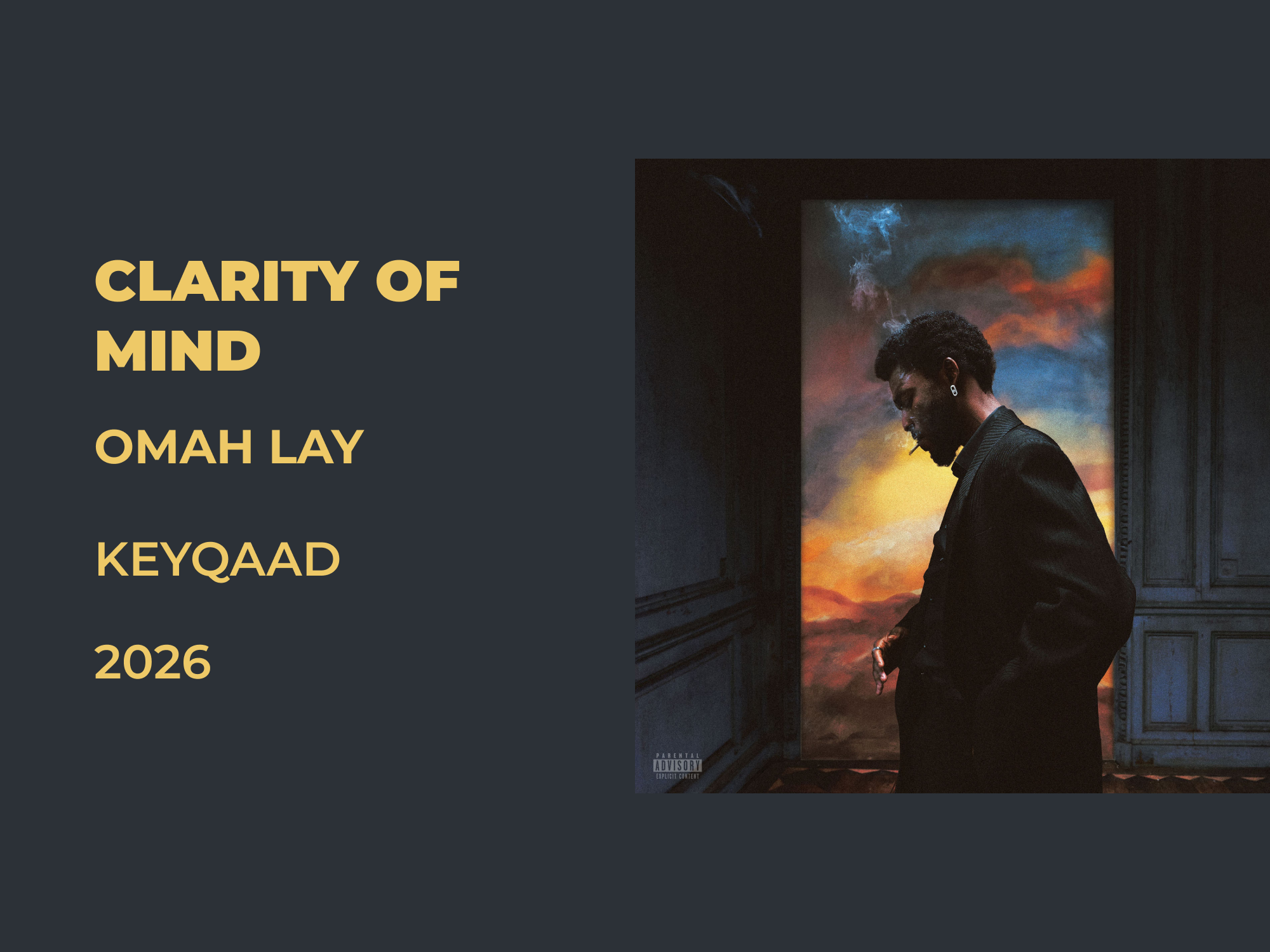
For the singer, ‘Clarity of Mind’ isn't about finding solutions to his emotional irregularity; it is about embracing them.

There is something inherently spiritual about artists deeply plugged into the essence of their sounds. Spirituality, not acutely in the sense of honoring a certain deity or extra-natural force, but the confident and superhuman manner in which they prance around the affairs of their craft. The music they make becomes an extension of their inner essence. Their listeners feel whatever they have inside: from pain to excitement, from the lowest points to the highest peaks.
Omah Lay is a spiritual singer, and almost four full years after releasing his debut album, ‘Boy Alone,’ he has returned with a polarizing sophomore album, ‘Clarity of Mind.’ That’s as simply as it can be relayed when you leave out what came before the arrival of the music: his hiatus from the public, his cryptic SOS messages online, his managerial controversy, an assist on Davido’s Grammy-nominated track “With You,” and his allegations that the initial concept for his album had been stolen by one of his colleagues.
On the night of his listening party in London, he came out carrying what looked like 20-kilogram dumbbells and pumped his arms until they could lift no more. In Lagos, he maniacally laughed when a fan asked if he was mad. And without any reference to his frantic period of exemption, he told Apple Music’s Africa Now Radio during an interview that he “has been chilling.” Throughout the rollout for ‘Clarity of Mind,’ he’s been moving with a kind of unbothered calm, and it doesn’t really make any sense.
Well, that’s because it’s not supposed to make sense. On ‘Boy Alone,’ Omah Lay established the persona of a fighter caught between hedonism as an escape from his troubled mind and the deep blue sea of its effects. He talked about the risk of a burnt liver from smoking so much, the well of trauma he has pent up inside, and even stretched out to the pollution problem in his hometown of Port Harcourt. But the thing with preserving that fighter persona is that it only lasts for so long, and at some point, the fighter who has been attacking his problems with his guard up must eventually ease up for a bit.
Leaning back to watch the party die, Omah Lay begins with a direct message on the album opener of his sophomore full length, “ARTIFICIAL HAPPINESS.” He is conscious of the hold that his addiction has on him, but, ironically, isn’t willing to push back on its caustic effects: “Before morning, the feeling will wash off / But tonight, we will die at the warfront,” he sings. Produced by the trio of David Hart, Orlando, and Tempoe, the track is maintained on a single tempo. Besides the drums, shakers, and feeble synths that blaze across occasionally, it’s mostly Omah’s vocals that steal the show, setting the stage for the album’s slippery feel.
On “CANADA BREEZE,” he continues to emphasize giving in to the euphoric sense of awareness that comes with being intoxicated and unattached. This disdain for appendages runs throughout the album. Omah orders his Bisi not to hold on to anything they might have shared on “JAH JAH KNOWS,” because he is as clueless as she is and has dropped all attempts to figure things out. All of this culminates in the theme of peace as derived from apathy. Rather than trying to make meaning out of a life that’s progressively becoming more puzzling, he prefers to leave it all to the fates.
Not only is Omah Lay intoxicated with the serenity of not trying, but his hubris on “I AM” has him at a point where he believes he is supreme. He takes no dissension nor prisoners, and again only admits the counsel of his weed. It is like the classic braggadocio that defines art makers, except that Omah’s muffled incantation of the biblical reference “I am who I am” on most of the song is intended to convince listeners to take him seriously.
The Tempoe-produced “DON’T LOVE ME,” however, introduces a new dilemma. Omah’s escape routes—the quick thrills of his Hennessey and marijuana, and other instant forms of gratification—aren’t as effective as before. Nonetheless, he won’t stop chasing them, and on “WATER SPIRIT,” he narrates an unrestrained night with a lover in highly metaphorical details: “She is on her way to come and make it rain tonight/ All she want na vitamin D, all she need na vitamin D,” he drags out. It is a mirror of the iconic and nasty “Ye Ye Ye” from 2020, and his cadence echoes early 2000s sexy Afropop. In particular, the Desperate Chick’s verse on Dekumzy’s “Who Get Dat Thing” first came to mind when he began to float over the incandescent instrumental.
Omah’s lyric-tenor allows him to consummately bounce in, out, and around pockets that Tony Duardo creates with his percussion-driven production. He bends his syllables and is nimble with his words to match BPMs that are orthodox to rap songs. Omah repeats the same trick on the first verse of the pre-released “WAIST,” and matches it with the choral motif that becomes fatiguing further along into the album. To listen to only Omah’s vocals, unfortunately, became an exercise in patience at some point.
Conversely, that isn’t the case on “COPING MECHANISM,” the only collaboration on the album, which features Elmah. Although the Afrosoul singer has fewer than ten songs in her catalogue, she rose to prominence after her single, “New Boy In Town,” took over TikTok in 2024. “COPING MECHANISM” is the first touchy-feely track on the record. Elmah takes the opening chorus, and as tenderness and vulnerability slip through the vocals of both singers, Omah reaches a seminal point in the album.
During a pre-album interview in London, Omah Lay narrated how he had to deal with a breakup and losing in his Grammy category on the same night. “I was at the Grammys, and while Justin Bieber was performing, I was having a breakup,” he said. “So, there were two performers.” Although he tries to make light of the situation, he goes deeper into his toxic connection with being in love, explaining how hard it is to be fully immersed in his craft when he has his heart out for someone else across ‘Clarity of Mind.’
The breakup becomes a turning point and brings him clarity. “CANADA BREEZE” is the first time he addresses it on the album, turning reality to art when he sings, “…lost my bae and award all in one day.” After his and Elmah’s duet, he creates a pictorial version of that night on “JULIA.” He mentions that he had already set tables for his victory, looking as stunning as possible, anticipating celebrating with his partner, only to walk away with ghostly apparitions of what could have been.
The production on the album is inspired, with his close collaborator, Tempoe, taking credit for seven of the total 12 songs on the album. The bounce on “JULIA” is the standout, as well as Tony Duardo’s trickery on “WATER SPIRIT.” Built mostly around muted percussion, there are occasional synths from time to time that give it a sort of dramatic feel, like at the end of “CANADA BREEZE,” and through “WATER SPIRIT.” ‘Clarity of Mind’ closes with “AMEN,” a manifestation of a good life where Omah has nothing else than what he desires: enough money, new Louis Vuitton merchandise, and, of course, clarity of mind.
For most of its runtime, ‘Clarity of Mind’ moves beyond the narratives explored on ‘Boy Alone.’ Omah’s inclination towards manicured lyrics and substance-powered escapism tones down the emotionality. Here, he’s no longer trying to fix his problems, but becoming one with them in characteristic fashion. For the singer, ‘Clarity of Mind’ isn’t about finding solutions to his substance problems or emotional irregularity; it is about embracing them.
Listen to ‘Clarity of Mind’ here.

