Review: Olamide’s ‘Olamide’
‘Olamidé’ is a testament to the possibilities of both refinement and redemption for its creator deep into his second decade at the top.

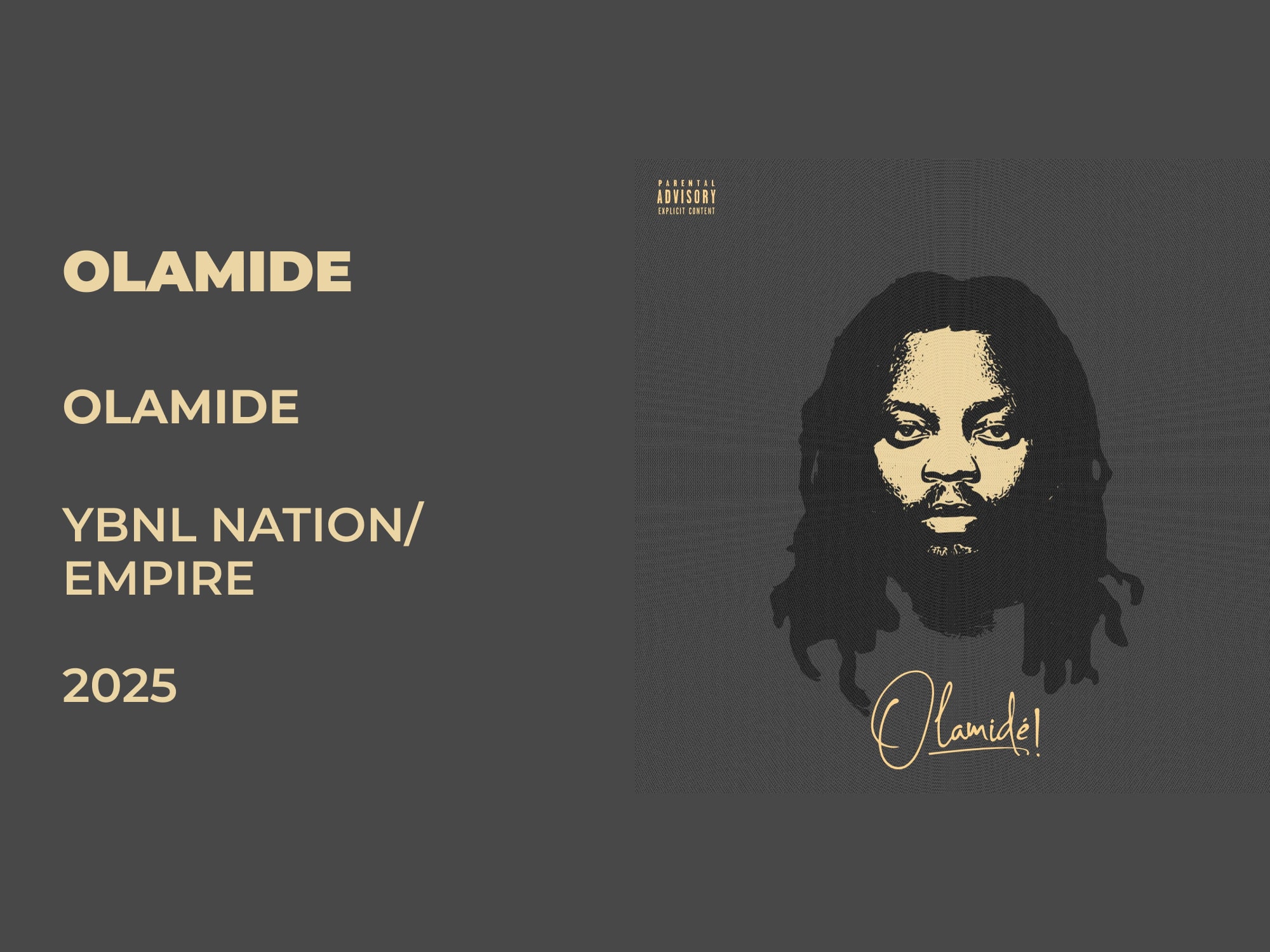
‘Olamidé’ is a testament to the possibilities of both refinement and redemption for its creator deep into his second decade at the top.

For the quintessential Olamide fan–who has diligently followed his career, listened to and memorised his bars both on albums and featured songs, watched him perform live at least once at his Olamide Live in Concert series, and watched him grow from a passionate rapper into successful record label executive–there is an overdraft of goodwill for him to draw.
Olamide has had an extraordinary career trajectory, from studio rat at Coded Tunes Records to head honcho at YBNL, the independent record label he established to release his second album, ‘Yahoo Boy No Laptop,’ in 2012. Olamide’s never-say-die spirit of resilience and drive to transcend generational poverty by leaning into his creativity made him the poster boy for the Lagos working-class kid. The son of a commercial driver living in Ladilak, Bariga, in the 90s, he rapped his way out of the marshy ghetto to prosperity.
Olamide belongs to the cohort of Afrobeats musicians who began releasing music around the time the genre finally acquired its current misnomer. Like Wizkid (first album, ‘Superstar,’ released in 2011), Davido (first album released in 2012), and Burna Boy (first mixtape released in 2011), Olamide entered the music scene on the shoulders of their forebears when he released ‘Rapsodi’ in 2011. He was the rising star of the Coded Tunes label, helmed by producer ID Cabassa, when 9ice was already the golden goose. That camp’s unique take on contemporary music was crystallised on 9ice’s sophomore album ‘Gongo Aso,’ an adventurous, synth-laden, percussion-heavy production showcasing a flair for both deep and contemporary Yoruba lyricism.
9ice’s successful foray into Yoruba lyrics coincided with an Afrobeats epoch when Hip-hop was mainstream. In 2006, Modenine released ‘E’Pluribus Unum,’ his most commercial album to date, winning praise and enjoying massive radio play. The most significant rap success from this era was M.I. Abaga, an excellent wordsmith who embraced sophisticated music production, thereby endearing himself to an audience that would typically shun Hip-Hop.
In 2008, MI’s debut LP, ‘Let’s Talk About It,’ was on every young Nigerian’s lips. In less than two years, two seismic shifts would unfold. First, a cohort of aspiring rappers–including Wizkid and Skales–responding to the global musical landscape, would launch their musical careers as certified vocalists. The second evolution was that a gang of aspiring rappers eschewed the usual practice of delivering verse in American-inflected accents, instead adopting indigenous languages. In Lagos, arguably the music capital at the time, Yoruba was the lingua franca.
Dagrin, the first commercially successful Yoruba act, unfortunately, died shortly after the release of his acclaimed second album, ‘Chief Executive Omo-Ita.’ Shorn of fillers, the record housed 12 impactful songs, vividly portraying the magical and mundane aspects of the dreams and aspirations of a young working-class Nigerian youth. He mined humour for its meaning, leaned on marijuana spliffs for psychedelic distortion of lived reality, and catcalled women with abandon.
It was this template that was handed down to Olamide, the most unlikely heir to Dagrin’s template, given that there were other heavy contenders—Reminisce, Lord of Ajasa, 2Phat—with more skin in the game. The rapper formerly known as G-Dogg showcased his rhyming skills when he penned a moving tribute to Dagrin. Once the void triggered by Dagrin’s death bequeathed him the spotlight, Olamide doubled down on his effort and did unimaginable things in Yoruba music.
Listen to ‘Rapsodi’ today, and you will encounter an impressionable rapper with graphic depictions of his lived experience. It would take a few years and albums to find his perfect pitch. Much of his early work was characterised by its irreverent humour, crass jokes, and wisecracks that couldn’t travel out of Ladilak. By the time he released his third album, ‘Baddest Guy Ever Liveth,’ he had fully come into his own.
For much of his career, Olamide has sought to strike a delicate balance between making street-sanctioned gems, pop-facing music, and meaningful love songs. This means one thing: despite his incredible work rate, his songs are not always unsuccessful. Historically, his LP albums have been uneven. While albums like ‘YBNL,’ ‘Street OT,’ and ‘Eyan Mayweather’ are filled with songs we never really hear anymore, Baddest Guy Ever Liveth and The Glory stand out as albums where creativity and thematic concepts are on par. His 2017 album, ‘Lagos Nawa,’ felt like a lacklustre effort that came too quickly after the successful 2016 album, ‘The Glory.’ His most recent EP, ‘Ikigai / 生き甲斐, Vol. 1,’ is his most successful project since the COVID gem, ‘Carpe Diem.’
A time comes in an artist’s career when you lend your name to a body of work. This notion exempts rap god Eminem, whose rampant confessionalism demanded an early and sustained obsession with the self. Beyoncé’s self-titled album, released in 2013, in retrospect, is a mid-career gem. Crossing the Atlantic into Nigeria, Sunny Ade named his pivotal 1974 record, ‘Sunny Ade Vol 1,; after himself. It was his breakaway album from his former benefactor, Chief Abioro, and his Take Your Choice record label. Ade’s existential anxiety drips into the blend of vibrant guitars, Yoruba percussion and rhetoric-rich lyricism. For Chauntese Aṣa, it was her 2007 classic debut, where she entered her elegant songwriting into the annals of eternity.
Olamide has chosen to name this late-career album after himself, but there is a catch, or should I say an errant diacritic. Olamidé. A Yoruba speaker can spot the problem here. The correct Yoruba spelling for Olamide is Ọlámidé. What could be a genuine error or a stylish omission is indeed an egregious misnomer, especially from a musician who has captured our attention by the exciting way he has used the Yoruba language.
Perhaps those of us who care about Yoruba are not the intended audience of this record. This is another disappointment, especially for Olamide, who earlier in his career rapped convincingly on his 2014 record,“Prayer for Client.” “3 million for Ibadan don do me/500k UK e no do me,” he sang. I strongly advocate for artists maximising their earnings, and the lure of forex is unimaginable, but the approach of Olamide’s cohort to this whole Afrobeats to the World project is as though their global achievement is unprecedented.
This is not the first time African music crossed the Atlantic Ocean. Majek Fashek happened. Before him, there was Fela Anikulapo-Kuti. King Sunny Ade released three albums (‘Juju Music,’ ‘Syncro System,’ and ‘Aura’) with Island Records and toured in more than forty-five cities in America in the early 80s. He presented himself as a worthy ambassador of his genre of music, Juju, and of Yoruba culture.
Once one gets past the errant diacritic, the job of critiquing does not get easier. The record opens with “Prelude”, a cabaret-styled time capsule transporting you into the belly of a smoky Sinatra-styled jazz bar. Full credit to the warm vocals of newcomer Fxrtune, but this is a false start. The album truly opens with “Hasibunallah”, where Olamide coopts Arabic with a proficiency that he has shown throughout his career. By the time you hear the sultry “Kai,” his duet with Wizkid, the album’s tone is set: Olamide intends to sing. True to form, he out-sings Wizkid. He has shown an aptitude for outsinging vocalists as he did before on “Kpe Paso,” where he helmed the hook for Wande Coal.
On the P.Prime-produced “Luvaluvah,” we are reminded of Ms Lauryn Hill’s 1998 classic “Can’t Take My Eyes Off of You.”Olamide’s approach is closer to Dancehall toasting than R&B. For a mid-tempo percussion-heavy album, Olamidé opts for easy listening and indulgent love songs. Wizkid returns with a more inspired verse on “Billionaires Club,” an instructional take on luxury living. The tune could have been a peerless delight if it had aspired beyond lazy lyricism.
“Free” spotlights Muyeez. Olamide name-drops Fuji Legend Saheed Osupa, American Pharrell Williams and even controversial Nigerian politician, NyesomWike, on the song. It chugs at similes when metaphors would suffice. On the cautionary love song “Duro,” he leans deep into a Fuji lilt for a magical pre-chorus. “Special” could have been special if it did not sound too much like an outtake from an Adekunle Gold ‘Afropop Vol 1’ Session.
On “Indika,” West Coast G-Funk meets Palmwine Highlife funk via Fela’s Afrobeat. Dr Dre lays flawless bars whilst Olamide approaches this full circle moment with excessive enthusiasm. The song’s only flaw is its short length. “1 Shot’ sounds like a letter to a young hustler. It succeeds as a practical instructional, where “Billionaires Club” fails.
The album’s standout moment is House-music inspired “99,” which features an ensemble cast yet manages not to spoil the tune with too many actors. The tender, Eskeez-produced “Rain” vaguely references Majek Fashek’s 90s classic record, “Holy Spirit,” and Olamide atones for misogynistic effacing Jamaican dancehall singer, Popcaan.
The cabaret-styled interlude “Paris,” featuring Nigerian rapper FADÍ singing in French, marks the album’s final run. With synth-laden and log-drum-indulgent production from Magicsticks, “Lalakipo” does not sound dated itself, but it accurately dates Olamide’s style. The final song is the Boj-assisted, BBanks-produced “Stronger,” where Olamide exults baddies, preaching agency, imploring them to shun toxic relationships and to get a BBL if they so desire.
‘Olamidé’ is a long way from his mid-career misogyny, a testament to the possibilities of both refinement and redemption for Olamide. But at 17 tracks, this self-titled album is an indulgence. Stacking songs with formulaic framing of self-praise, luxury lifestyle, and brief reminisces on proletariat poverty, Olamide hardly brings any new insight to wax. There is simply nothing new to say, or more appropriately, there is nothing he has to say that his core fans have not already heard.
I suppose our beloved musicians can draw from our overdraft of goodwill. This is also an indulgence we afford them, one that emboldens Olamide and the Afrobeats Class of 2012. With more than a decade at the top of their game, they are the Baby Boomers of the Afrobeats pantheon. Their music won’t get better; we will be lucky if it does not sharply decline. The most likely outcome is that which follows the natural history of musicians: they will become touring ambassadors of their heydays. This album would add at least three songs to Olamide’s touring setlist, and that too is legacy in motion once you can overlook the errant diacritic.

