Review: ‘Industry Machine’ by ODUMODUBLVCK
INDUSTRY MACHINE’ is ODUMODUBLVCK’s powerful statement of intent and a significant jolt to Nigeria’s Hip-Hop scene.

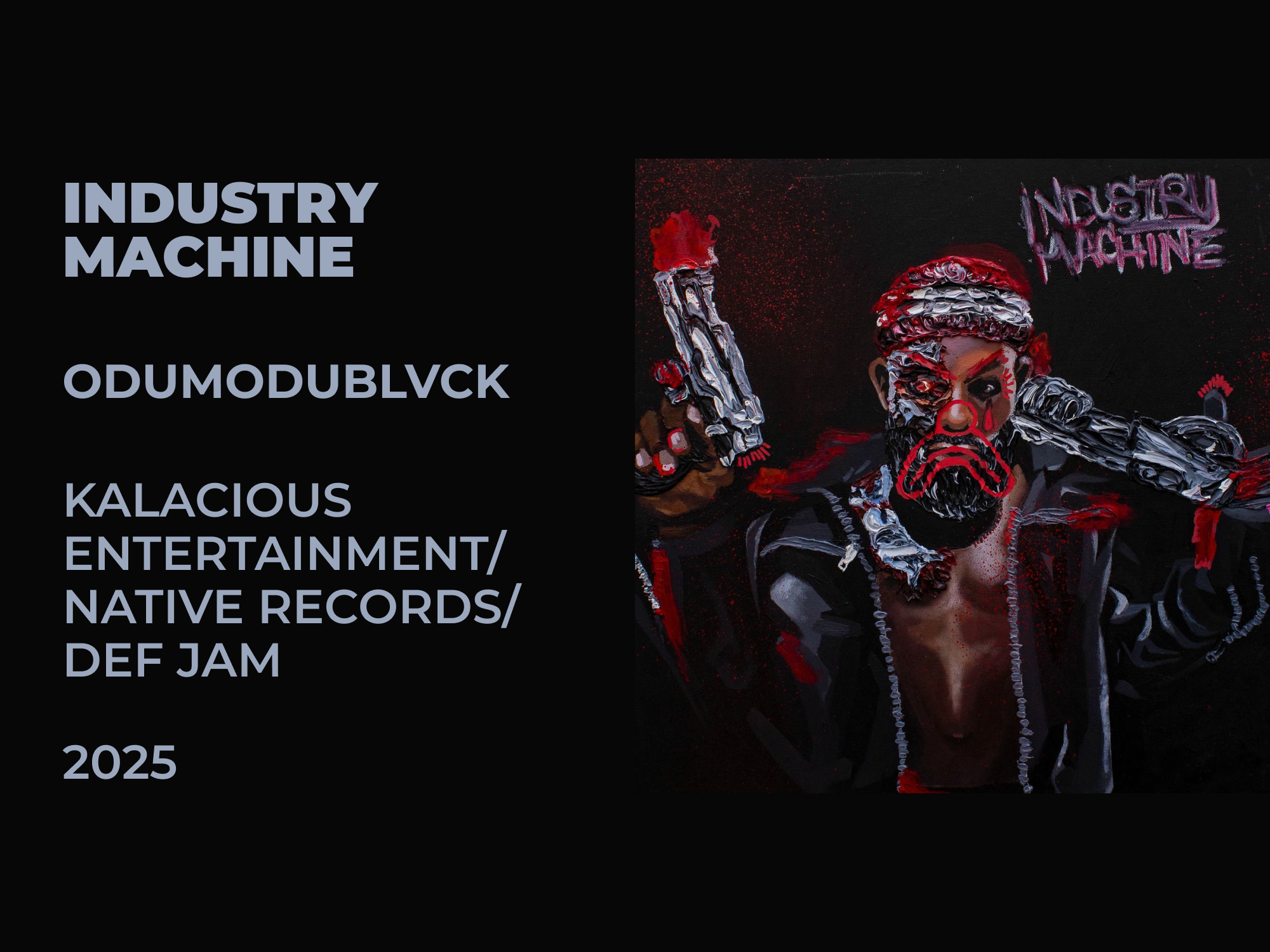
INDUSTRY MACHINE’ is ODUMODUBLVCK’s powerful statement of intent and a significant jolt to Nigeria’s Hip-Hop scene.

ODUMODUBLVCK’s ‘INDUSTRY MACHINE’ arrives on the back of the most aggressive, drawn-out rollout campaign in recent Nigerian music history. Snippets from the album and its titular track date back to last year; there have been multiple linkups with Premier League stars to whom ODUMODUBLVCK, ever the football aficionado, gave branded jerseys; an entire other project, the 16-track ‘THE MACHINE IS COMING,’ released in March, intended to whet appetites of expectant fans and raise their anticipation for the album’s arrival.
The album itself underscores just how much of a sprawling opus it is intended to be—23 tracks long, fitting in 23 guests drawn from everywhere from Lagos to London, representing every genre from Afrobeat to Drill. There’s a lot of tough talk that ODUMODUBLVCK has placed behind the album, mostly in the form of half-braggadocios, half-prophetic tweets announced with his signature all-caps-locked audacity over X, so there is very little margin for failure, and he knows it. The result is an album that is very much aware of the expectations that lies before it.
ODUMODUBLVCK succeeds in handling them mostly well. The biggest hurdle was always going to be releasing an album that can channel the ferocious and combative spirit he possesses, while holding on to the velvety melodies for which he receives the most commercial success. The tracks that attempt to balance this have always gone on to become chart-toppers and fan-favourites—“DOG EAT DOG,” “PITY THIS BOY,” “BLOOD ON THE DANCE FLOOR,” “LEGOLAS,” and now “INDUSTRY MACHINE.”
‘INDUSTRY MACHINE,’ save for its titular track, deviates from this formula, as ODUMODUBLVCK attempts a split of his sound and personality across the album; with a handful of uncharacteristically soft-spoken, sing-songy melodies directed towards a romantic interest that must be the recipient of his renewed infatuation—“BABY RAINDEER,” “CANDY MUSIC,” “BANZA BOY,” “MY ANGEL,” and “2 PEOPLE”—while the same album harbours the usual machete-slinging, enemy-cursing, booming vigour that ODUMODUBLVCK directs towards his enemies. It makes for uneven pacing at times, but ODUMODUBLVCK’s attempt to accommodate all sides of his personality ultimately broadens his image beyond what has been painted over the three years of his popularity.
Being at the top of the game for three years, too, means that a certain level of familiarity begins to develop, with the sound and with the persona. ODUMODUBLVCK is hardly the artist to switch eras for new projects—at least not in broad strokes—so ‘INDUSTRY MACHINE’ attempts innovation mostly via its production. You see it at a glance of the album’sproduction credits. There’s a lot less from long-time collaborator UCee (“DOG EAT DOG” and “KUBOLOR”) and nothing at all from Jimohsounds (“BLOOD ON THE DANCE FLOOR”) or TrillXoe and Johnwav (“DECLAN RICE” and “FIREGUN.”) With these creators’ absence goes some of ODUMODUBLVCK’s signature ‘Okporoko rhythm,’ so production sets are a lot more novel and experimental. Declan “Decs” Roberts and Sholz possess the most production credits here, but they are only two of over twenty minds responsible for the soundscape of ‘INDUSTRY MACHINE.’
ODUMODUBLVCK opens fire on “UNAWARE,” the album’s second track, taking as little time as possible to set the record straight on his greviances. “IF YOU LIKE GYM” and “LAYI WASABI” are built on similarly menacing architecture, the perfect platform for him to launch jabs at his opposition: “Take man for joke like say I no sabi/ Layi Wasabi, joke man nothing wey you sabi,” he choruses on the latter, a song cleverly built around the popular Instagram skit maker in one of the many marketing tools deployed for the album. But ODUMODUBLVCK displays some inconsistency in his delivery: “CANDY MUSIC” sports a soothing chorus but is let down by a particularly weak rap verse.
Across the project, the Abuja-based rapper tries to maintain a consistent level of antagonism towards his enemies, but he runs the risk of sounding repetitive. To avoid this, he brings on board several rappers who share a similar venom. Modenine arrives guns blazing on the reimagined “IF YOU LIKE GYM,” coming for rappers who outsource their lyrics: “AI help write your rhyme, Jadrolita/ Gimme a kilometre, dress back biko/ My rhyme book got a four-digit pin keycode.” Reminisce flows in sleek Yoruba on “LAYI WASABI,” hitting hard against fellow rappers with a similar vigour. More than just calling for backup in his rap disses, ODUMODUBLVCKtapping into older eras of Hip-Hop accords ‘INDUSTRY MACHINE’ a genuine Nigerian Rap pedigree that eluded even ‘EZIOKWU’ and ‘THE MACHINE IS COMING.’
As he sets his gaze on his rap credentials, he undoubtedly has an eye on commercial success, as in Nigeria’s music ecosystem, those are often mutually exclusive. An album this large gives some room for leeway with that, being able to fit in so many Hip-Hop numbers yet leave room for earworms that will be the staple for more casual listeners. By some combination of his congenial nature, an active team and perhaps a degree of sheer luck, ODUMODUBLVCK secures both Wizkid and Davido on his guestlist, a feat not achieved in recent years, and one that allows him to enjoy both the supportive and competitive aspects of music stanship to his advantage.
Wizkid’s “BIG TIME” is more up to the album’s speed—delivered over a steady Hip-Hop bounce, and featuring Wizkid as close to rap as he’ll ever get. It does run a little longer than it really should, as Wizkid takes the reins, walking back old memories: “Causing kasala since when I buss up on the scene/ Make you show me something wey man e never see/ Yeah, I been dey hustle, yeah, my brother till it big/ Say mama go kpai, omo, aje, I no believe,” but nobody asks Wizkid to trim down a verse.
For “GROOVING,” ODUMODUBLVCK goes in an entirely different direction, deviating from the album’s Hip-Hop template to deliver its most Afrocentric song, over which Davido and Seun Kuti are particularly well-fitted, warping to provide a mellow groove that displays a different side to ODUMODUBLVCK. It is this same form he assumes for his softer, love-laced tracks. “BANZA BOY” begins as a solemn, heartfelt devotion to a lover: “I just wanna ride, like die/ My hands in the sky, high high/ Talk to me like you’re mine, my wife/ The look in your eye, so fine.” It’s the same impulse that he carries across to “BABY REINDEER.” For a man who has built a reputation for being raw and vicious with his flow, being able to create genuine love ballads speaks to a hidden vulnerability.
‘INDUSTRY MACHINE’ does, however, also allow for an alarming degree of excess. It carries the weight ofthe many parts of him he wants to show and the expectation it intends to fulfil. It means a few songs become unremarkable, because of oversaturation. A few tracks across the album’s second half—”BAGGIO,” “BOMBASTIC ELEMENT,” “GHETTO MAN YUTE”—suffer from this effect. His rich feature list also means that sometimes ODUMODUBLVCK makes decisions that stifle the impact of some of his biggest coups.
What he has not compromised on is extracting the very best verses from his guests. Skepta is underused but effective on “ADENUGA;” Saweetie and Justin Quiles are immaculate on the electric “MARADONA;” PsychoYP is a perfect complement on the soft-bouncy “TIFFANY;” Ayo Maff and Smada make small but significant contributions to “EJOR;” and Patoranking and Chike bring their respective flavours to “DO YANGA” and “MY ANGEL” respectively.
Ultimately, ODUMODUBLVCK is the centrepiece of ‘INDUSTRY MACHINE’ and he steers its direction. It is to his credit that the album maintains a level of cohesion and quality across so many tracks and contributors. ‘INDUSTRY MACHINE’ is, by some technicalities, a debut album, as ‘EZIOKWU,’ ‘EZIOKWU UNCUT’ and ‘THE MACHINE IS COMING’ were labelled mixtapes despite their marketing and arrangement suggesting otherwise.
With ‘INDUSTRY MACHINE,’ ODUMODUBLVCK finally arrives on a project worthy enough to be uncategorically labelled an album. It’s easy to see why—the LP is robust on features, pristine in production and rhyming quality, and possessing answers to the questions of his Hip-Hop credentials that have trailed him for as long as his mainstream career. It does get bloated and repetitive in places, but ‘INDUSTRY MACHINE’ is ODUMODUBLVCK’s powerful statement of intent and a significant jolt to Nigeria’s Hip-Hop scene.
Listen to ‘INDUSTRY MACHINE’ here.

