Review: Asake’s ‘M$NEY’
‘M$NEY’ is simultaneously one of Asake’s most sonically polished projects and one of his least lyrically substantial.

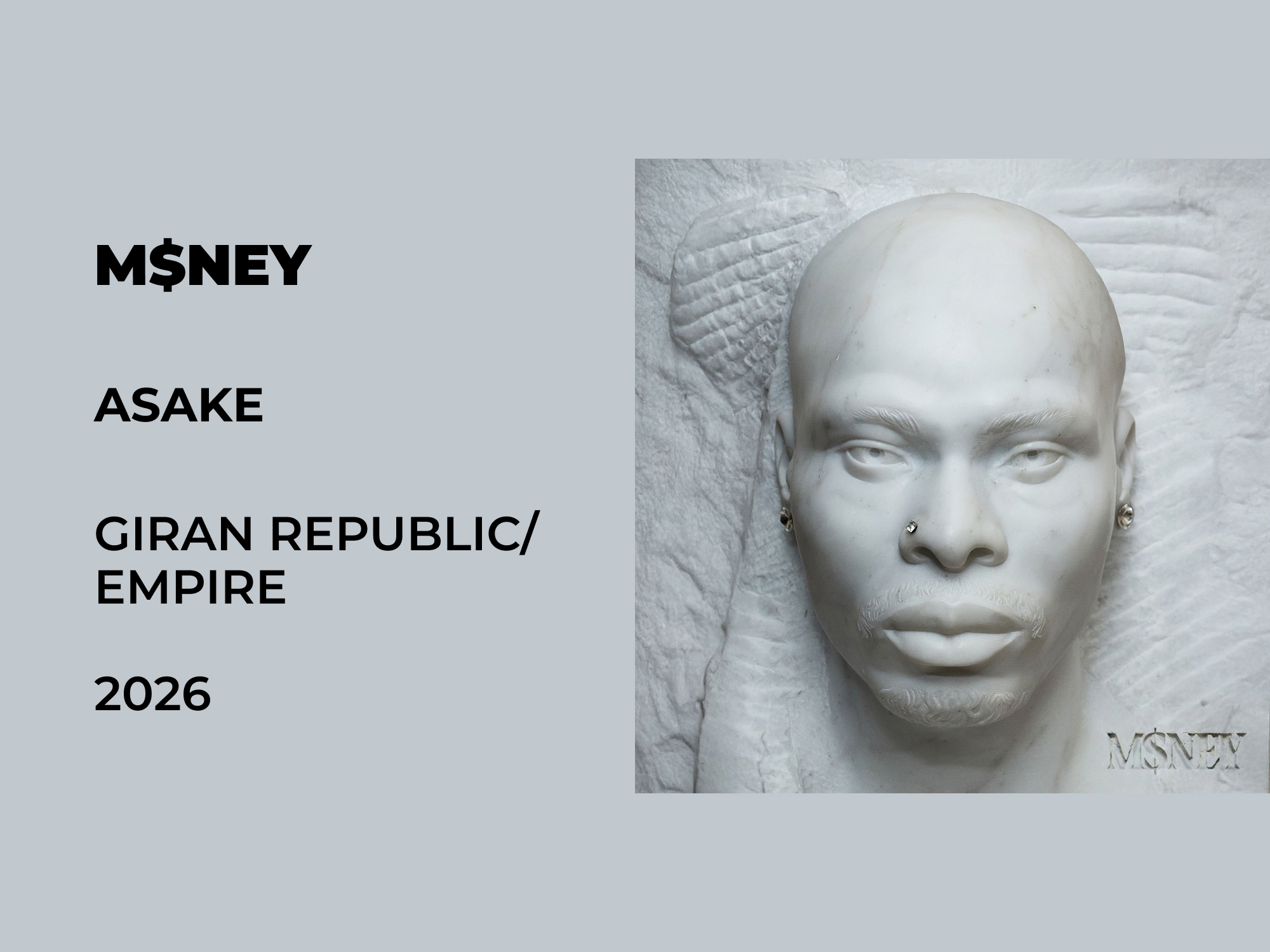
‘M$NEY’ is simultaneously one of Asake’s most sonically polished projects and one of his least lyrically substantial.

In the early hours of Friday, May 1st, as the hundreds of guests at the listening party for Asake’s ‘M$NEY’ milled around the private airplane hangar where the event was held, thousands of fans around the world tuned in to their favored streaming platforms to listen to the album. Among them was popular Nigerian streamer Gilmore, who delivered his verdict on his TikTok live stream: “Instrumentals many pass lyrics for this album,” he clasped his hands and shook his head. “Maybe when we hear it (more), it’ll grow on us.” His commentary—crude as it is—gestures at a simple truth: on ‘M$NEY,’ Asake is upstaged by the production; and without Olamide, his former label boss, in his corner, the cracks in his songwriting are in full glare.
In February of 2025, six months after releasing his polarizing third studio album ‘Lungu Boy,’ Asake parted ways with his label YBNL. He deleted mentions of the label from his social media, unfollowed everyone on his Instagram, and teamed up with his longtime producer Magicsticks for the lead single of his imminent album ‘M$NEY’ titled “Why Love,” released under his new imprint Giran Republic. As is now tradition when a high-profile artist parts ways with their label, the move prompted a stream of criticism. Fans, who had watched Asake enjoy an unprecedented level of dominance in the Nigerian music industry since he joined Olamide’s YBNL, struggled to make sense of his departure.
Part of the ensuing chaos owed something to the shock value of the news. But a huge part of the concern hinged on a simple question: without Olamide, his trusty mentor and co-writer on many of his early records, by his side, would Asake be able to live up to his near-mythical standards? Asake’s new album ‘M$NEY,’ a gorgeous pastiche evoking themes of gratitude, wealth, and placidity, in certain ways, feels like his rebuttal to these aspersions.
The months leading up to ‘M$NEY’ found Asake, who had until then led an uncharacteristically controversy-free career, steeped in drama of epic proportions. In addition to the ripples triggered by his departure from YBNL, and public worry over his decision to jettison Lagos, his home city, for Los Angeles, Tunde Perry, a former associate of his, launched a smear campaign alleging everything from homophobia to misogyny.
Another artist might have issued a boilerplate press statement and opted to lie low until the storm ebbs. By contrast, Asake released a heartfelt single, titled “Military,” addressing these concerns. In a bracing display of lyrical deftness, he surfs the glistening production, railing against his detractors, heaping praise on himself, and paying homage to Olamide. With this singular action, he launched a comeback arc culminating in the release of ‘M$NEY.’
“Military” takes on new life in ‘M$NEY.’ Reimagined under a different title: “Oba,” this new version features a spruced-up production and an entirely different set of lyrics. The original version is festooned with sharp rebuttals and rousing self-adulation—“For my set who get money pass me? Ko ma si. Emi kan like lowkey.” By contrast, “Oba” finds Asake delivering anemic and often cliché lyrics: “Big yansh, it is my type/ God dey by my side.” Likewise, his voice takes on a less spirited tone. In a sense, “Oba” functions as a bellwether for the album. In ‘M$NEY,’ Asake, who has never been much of a lyricist, seems even more disinterested in storytelling or offering affecting lyrics. Instead, in his quest to telegraph his new gilded reality, he leads from behind, playing supporting act to the lush production of the album.
Somehow, this arrangement works better than you’d expect. Consider “Gratitude,” where he offers cookie-cutter lyrics about feeling grateful, taking brief detours to rail against his haters. Nothing he says in the nearly three minutes the song runs for is particularly memorable, a stark contrast from his first two albums, both of which feature an excess of caption-worthy lines, rousing reflections, and cheeky quips. And yet, the odds are that you’ll come away from listening filled with a sobering appreciation for the miracle of life. We mostly have the poignant production of Magicsticks to thank for this. The song opens with a soaring violin melody which gives way to a poignant bass riff evoking the feeling of a church worship session. The effect is that the production sublimates Asake’s tepid lyricism, elevating what might otherwise register as thin or repetitive into a sensorially dense experience.
Songs like “Wa,” “MCBH,” and “Forgiveness,” work the same trick. The luminous production of these songs combines with Asake’s lukewarm lyrics to produce a whole greater than the sum of its parts. You’d however be forgiven for assuming the paucity of lyrical deftness on this project to be absolute. In the songs where he dials down to a more contemplative register and offers heartfelt lyrics—like in “Badman Gangster,” which finds him grappling with his Nigerian identity in the wake of his global superstardom, and “Rora,” arguably the best song on the project—the result is sonic bliss. “Rora,” especially, proves a particularly instructive example of how compelling Asake can be when he pushes beyond platitudes. Over a glistening Magicsticks production, which sounds like the closing score to a feel-good movie, Asake alternates between eulogizing and admonishing himself. It’s a rare moment of unvarnished vulnerability from a man looking down from his gilded castle and reflecting on the merits of patience and humility.
‘M$NEY’ offers other pleasures, chief among them is Asake’s palpable sense of whimsy. Four albums in, he still retains the very same playfulness that charmed us on his debut album ‘Mr Money With The Vibe.’ In “Asambe,” featuring Kabza De Small, he dispenses with the faint echoes of introspection that hover around certain portions of the album, lunging headfirst into dance mode. The lyrics here edge close to melodic babble, what Nigerian music fans commonly refer to as “Lamba.” The song is nonetheless terribly mesmerizing. Exploiting pockets of space in the production and deploying precise syncopations, Asake delivers flows that evoke the feeling of a sugar rush. ‘M$NEY’ is also Asake’s most cohesive project. Songs glide into each other with remarkable ease and mostly stick to the album’s themes of gratitude and opulence.
Perhaps the most overlooked strength of ‘M$NEY’ is how well-calibrated the album is for a live show. Most of the songs feature live instrumentation—the supple keys on “Rora,” the elastic grooves of “MCBH”—and arrangements designed for a live show, rather than solitary listening. Whatever reservations you might have of the project are likely to soften once you hear Asake perform “Forgiveness,” “Rora” or “MCBH” to a live audience.
‘M$NEY’ is simultaneously one of Asake’s most sonically polished projects and one of his least lyrically substantial. For listeners who followed the album’s carefully orchestrated rollout, during which Asake brought his fans into his world, the lack of lyrical heft might register as a disappointment. But approached on its own terms, ‘M$NEY’ has a trove of pleasures to offer. Whether those pleasures will be enough to sustain Asake in the long shadow of Olamide’s absence, however, remains an open question.
Listen to ‘M$NEY’ here.

