Ema Onigah Wants To Sing In Rhythm
The seven songs of 'ITEM VII' relay an expressive palette, suffused with influences Ema Onigah has explored throughout his career.

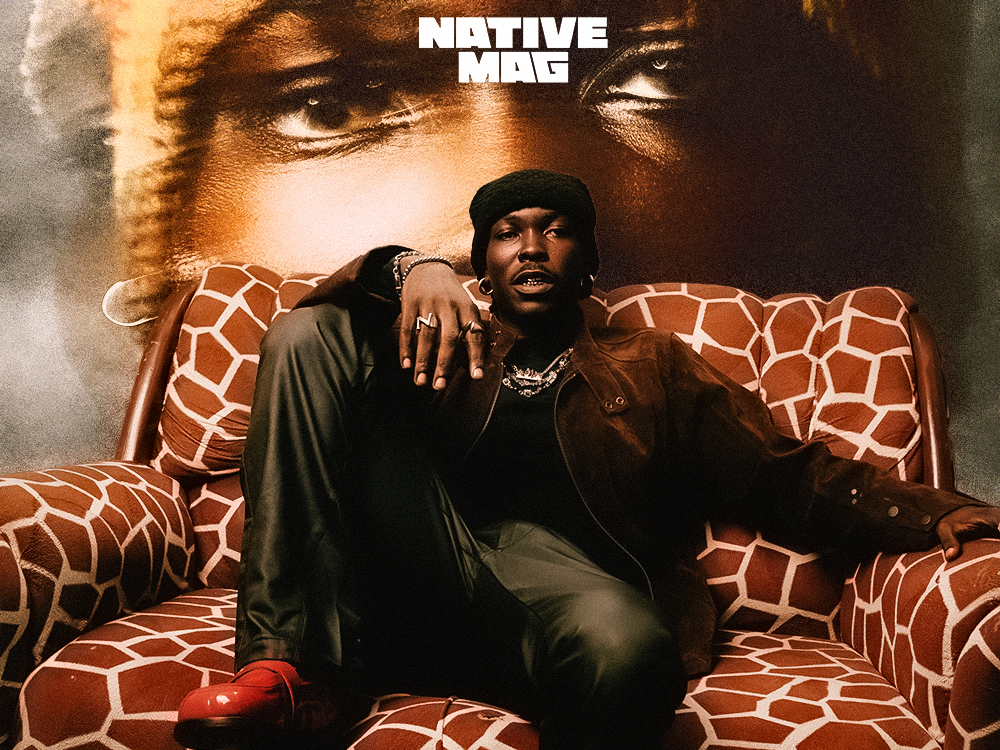
The seven songs of 'ITEM VII' relay an expressive palette, suffused with influences Ema Onigah has explored throughout his career.
There’s a brilliant line in “Chance,” a record from Nigerian artist Ema Onigah. “Why dem no go want to give me chance, when sky no dey ever fit to populate?” Rhyming within the earthy progression of the beat, it’s a sentiment that sprawls across the slim but impressive catalogue of Onigah. If you ask him, there’s no competition between him and anyone else, since everyone has been inspired by distinct life experiences and a perspective that’s adjusted enough to translate those experiences into original compositions.
‘ITEM VII,’ the singer’s new EP, is made up of such compositions. Its seven songs relay an expressive palette, suffused with influences Ema Onigah has explored throughout his career as a musician. “When I was writing [“Chance”], I was speaking to myself, and explaining my state of mind to my audience, that there’s space for everyone,” he told NATIVE Mag on a recent weekday. “I’m not there to form that entity for comparison with another artist; I’m there to do what I have to contribute to the table of Afrobeats. It might not be the most trending stuff, but people will know that there’s something different Ema Onigah brought.”
That reassurance in his abilities makes sense given the career Ema Onigah has had. With previous collaborators including revered producer Ozedikus and Afropop stalwart Tekno, whom he co-wrote several songs with on ‘Old Romance,’ there’s been no shortage of insider knowledge on how potent Onigah’s pen and delivery can be. This hasn’t always translated to mainstream popularity, even though one senses he doesn’t really obsess over such metrics. “With You,” another record on ‘ITEM VII,’ references the sonic field of what could be called a ‘hit’—crowd vocals, a pared-down lyrical style, an effervescent love tale. In several ways, it represents a new era for Ema Onigah, from his deal with Gamma Records and wanting to introduce himself to a wider audience.
The name ‘ITEM VII’ came from not wanting to sound “too serious, too boring,” he says. “People said they’ve not heard from me for a long time; people use the slang that I’ve starved them, so this is just Ema Onigah, ‘ITEM VII’”. For those missing the socio-linguistic context, the titular term refers to refreshment time (usually situated in seventh place) within the program of a social gathering, so commonly shared that it’s now become a broader reference.
“When I dropped my first EP, ‘Dust Off,’ I saw that people understood Ema Onigah more with projects,” he says, “So that’s one of the things that confirmed I’m going for a project after my singles. And especially, I’m the kind of artist who’s fond of project artists like J Cole and Kendrick Lamar. But there’s something about Nigeria, where really it’s not safe for an upcoming artist to drop an album first, so they need an introduction that would give them confidence, so that’s the EP.”
Expanding on his process, the songs on this EP seem more live the cumulative effort of a roving creative mind. “Everytime I’m recording a song, in my mind I’m compiling a project,” he explains. “The way I work on songs, it’s not like people who just vibe; I like to be intentional, I like to find elements. Once I hear a beat, I can still add some things to the beat because I want the song to sound like something that will survive any time it comes out. Even if I’m not using it for a single, it’s something that I’m bold enough to put on a project.”
Quite early into our conversation, we discussed Onigah’s love for hip-hop. Like many of his peers, he started out rapping, ostensibly learning about the wealth of storytelling in the music of Modenine and Freestyle, but it was M.I Abaga who broadened his sonic perspective. “Rap made me interested in Afrobeats from a lyrical point, before I started understanding the technicalities of the sound,” he affirms.
This was the early 2010s, and Onigah was still a youngster in secondary school growing up in mainland Lagos. His parents were religious and so exposure to media at home was limited to radio and TV, where he’d encounter the video of M.I’s “Safe.” He didn’t imbibe a lot of the popular Street music of the era. Rather his early musical education came from the church where he tinkered with drums and keyboard—a singular act of teaching from the church’s keyboardist revolutionised his entire perspective.
“[He] told me that there’s a way you can record sounds together and loop them, and it’ll come out as probably a loop, so I just discovered if I can join this loop and this loop, I can make an instrumental,” he says. “I remember I was so excited; it was almost like production. So from there, I just knew that I had that vibe that I would like to create music. And then part of it too was secondary school too, like, ‘what can I do so that people can see that this boy is serious too?’ I just found out that I could lace one or two lyrics together.”
Those humble beginnings would blossom into a favorable music career, and by 2020, Onigah was already becoming known among music circles. He would collaborate with budding music company Ejoya, where his verse on “Canabi” would become a project standout. Before then, he’d done a song with pre-“Dumebi” Ozedikus when he was going through a “ really tough time in [his] life,” and though their relationship suffered due to a third-party’s dispute with the producer, they later got back together.
This time Ozedikus had created some of Mavin’s biggest hits and invited Onigah over to record. “Playful Someone” was born from that time, produced and recorded by Onigah himself, with finishing touches infused by Ozedikus’ experienced hand. He also helped the budding artist upload the record on distribution platforms. “Ozedikus is one of the people I’ll be forever grateful for,” he says. “His house gave me the time to learn how to record myself, expand my ability on beat making”.
Several industry connections later, including the producer Tuzi, he would meet Tekno. That resulted in Onigah working on the latter’s comeback project, ‘Old Romance,’ which had a marked distinction from his sappy classics in the mid 2010s. “He’s one of the pioneers yet he’s humble to learn,” Onigah says. “He taught me about the humility to unlearn and relearn, and then he likes to—everything around him is things that will be pointing him back to the music. He wants his environment to be a place where someone should be inspired to make music. And his work ethic; he takes music more than a nine to five.”
If you speak enough with Ema Onigah, you’ll sense that this is an artist obsessed with development. It’s a humane streak piercing the iron-strong image he depicts, the spirit of poetry which elevates the gait of the uncommon soldier. On ‘ITEM VII,’ those inclinations bear on the music. In typical Onigah fashion, he views his present style as a combination of two distinct elements which separate rapping from singing.
“It’s a play with rhythm,” he explains, “there’s this unusual rhythm you understand. Some people will describe it as weird, I don’t have to explain it too much; if you listen to my songs you’ll understand. That’s why some people try to qualify it as Rap, ‘cos when it comes to singing, singing is about melody. When it comes to Rap, Rap is about rhythm. But me, I’m trying to sing in rhythm.”

