Benin Is Banking On Culture With The Festival Of Masks
The Festival of Masks is part of a larger effort for Benin an opportunity to tell its own story and how its traditions should be understood.

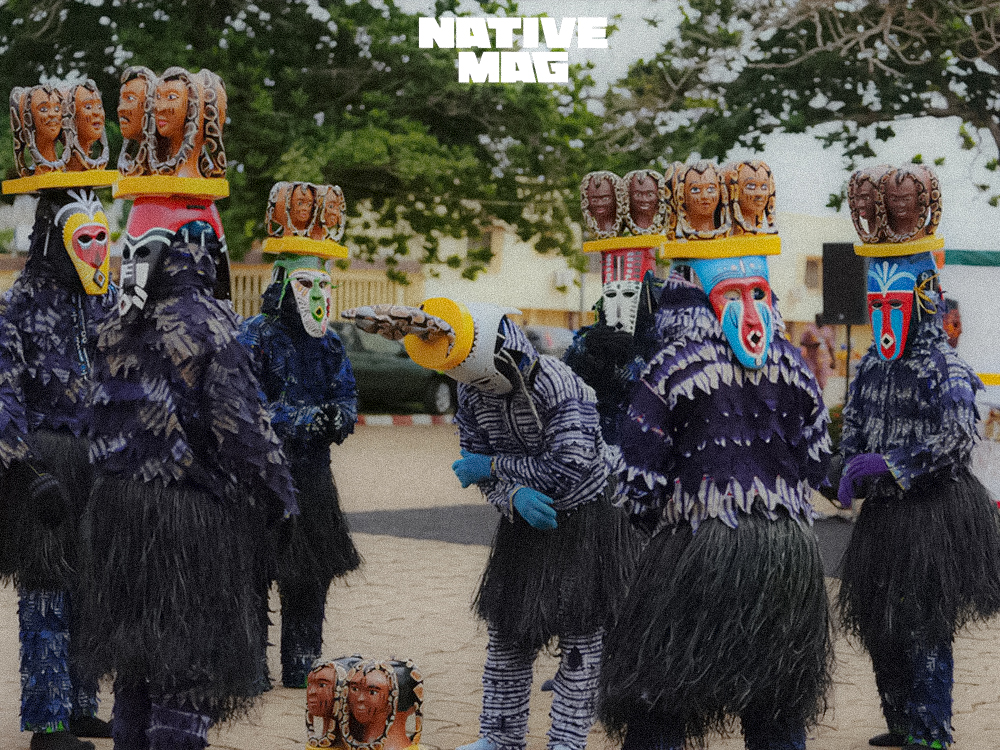
The Festival of Masks is part of a larger effort for Benin an opportunity to tell its own story and how its traditions should be understood.
On a sunny Saturday afternoon late in July in Porto Novo, the capital city of the Republic of Benin, masquerades come out to commune with natives and tourists. It is the annual Festival Of Masks, a celebration of the West African country’s cultural heritage and indigenous pride that is now in its third year. Year on year, the festival has pressed on with a mandate to reshape the image of cultural expression from the homeland of Vodun, and 2026 would not prove to be an exception. Major streets are blocked off to allow the cultural display to go on unencumbered while allowing spectators soak in the experience.
For Benin, the work of celebrating their indigenous culture is a critical part of the country’s strategy for its 21st century identity. While countries like Nigeria and the Ivory Coast might bank on their propulsive youth culture as hinges for curating its global image, the Republic of Benin is glancing back at its history for inspiration, owning the rich history of the religious and faith system that was part of public life in the country long before the arrival of colonialists. That work of restoration has necessitated the celebration of events like the Festival Of Masks, allowing the country to reinterpret its heritage on its own terms.
That reinterpretation was visible throughout the festival, where the mask was treated as something far more significant than a costume or a mere object of spectacle. In the final procession, the Zangbéto arrived first, with its towering cones of raffia spinning through clouds of its own dust, and behind them came Egungun in cloth heavily laden with embroidery, then Gèlèdè, Kaléta, and delegations from Togo, Côte d’Ivoire, and Nigeria. Chinese lion and dragon dancers moved through the procession too, a first for a festival that had, until now, remained distinctly West African.
Professor Mahougnon Kakpo, President of Benin’s Committee of Vodun Rites, described the invitation as an intentional act, not mere diplomatic courtesy. “Our intention was to show that a mask is much more than an object. A mask is the expression of an identity. It is the expression of a culture,” he said. China’s presence also widened the conversation, showing that the use of masks to carry memory and belief is not limited to one part of the world.
Benin is treating culture as an important part of its development strategy, putting it at the centre of how the country wants to attract visitors and tell its story. Kakpo described religious and cultural tourism as a lever the state intends to pull for economic growth. The Festival Of Masks sits inside that strategy, alongside Vodun Days and a growing calendar of heritage programming, with ambitions that stretch well past tourism revenue. Paired with the festival is an international scientific symposium, drawing historians, anthropologists and traditional authorities into conversation about the history behind these masquerades and what the rituals on display actually represent.
That matters because much of the story of Vodun was once told by outsiders. For most of the colonial period, Vodun was filtered through missionary writing and an European worldview that reduced it to superstition, sometimes outright barbarism. Masks entered foreign museums as specimens, admired for craftsmanship and stripped of the belief systems that gave them purpose. The return of the twenty six royal treasures taken by France in 1892, the construction of the International Vodun Museum, and the Museum of the Epic of the Amazons and Kings of Danxomè are all attempts to close that gap. But bringing the objects home is only part of the work. Benin also has to preserve the people, rituals and knowledge that gave those objects meaning in the first place.
Even the French word masque sits uneasily with Kakpo, and his discomfort is not pedantic. “I only use it because I am speaking French,” he said. “Etymologically, a mask simply means something that covers the face. You put it on, you remove it, and you see the face beneath. That is not what we are talking about here.” Within Vodun, the performer who carries a costume like Egungun is understood to have received the spirit of an ancestor through initiation, and once that spirit manifests, the human voice behind it disappears entirely. What the crowd encounters, then, is a spiritual and ancestral message. Kakpo believes understanding that message requires a level of interpretation that someone outside the culture cannot simply improvise.
Each tradition on display conveys its message uniquely. For example, Egungun allows ancestors to communicate with the living, as Kakpo explains, serving as a beacon of hope. Gèlèdè traces its origins to a Yoruba village tale about a wealthy man who destroyed children’s toys and was forced to make amends. This story evolved into a masquerade that honors justice and the women who protect the young. Buriyan Kaleta and Odigègè each carry their own histories rooted in womanhood and community life. These traditions continue to pass down their lessons with each performance.
Growing international attention has not loosened the rules at home. The Committee of Vodun Rites, responsible for inviting mask societies, overseeing rehearsals and deciding what sacred material can be publicly displayed, maintains a strict line between initiated and shared traditions. This balance becomes increasingly difficult to uphold as the festival garners more global attention. Kakpo recognises the tension between sharing these traditions and safeguarding those reserved for initiated communities. He treats this boundary as something to be protected and not to be negotiated away for a larger audience.
In Porto-Novo, the work of reclaiming Benin’s cultural identity is happening across museums, festivals, scholarship and the communities that have kept these traditions alive. The Festival of Masks is part of that larger effort, giving Benin another opportunity to tell its own story and decide how its traditions should be understood. For a country whose history and traditions have so often been explained by outsiders, there is power in creating spaces where Benin gets to do the explaining for itself.

