Anime Is Being Rescored With African Music On TikTok
Across TikTok, young Nigerians are re-editing anime fight scenes with the dense percussion and vocal urgency of Afropop and Afrobeat.

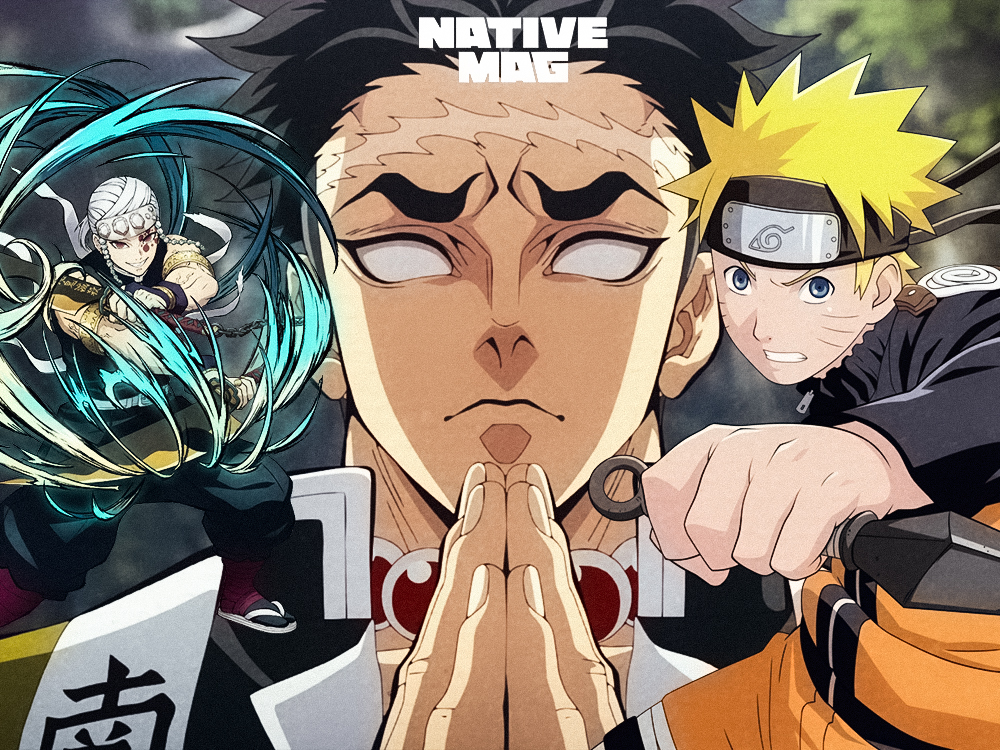
Across TikTok, young Nigerians are re-editing anime fight scenes with the dense percussion and vocal urgency of Afropop and Afrobeat.
It begins in the scroll; a thumb hesitates, then stops. On the small, bright screen, a body is already in motion: a swordsman from Demon Slayer: Kimetsu no Yaiba cutting through air that seems to ripple with heat. And then, just as the blade lands, a drum answers. Not the expected swell of orchestral tension, but something older, more insistent: the clipped snap of a snare, the restless chatter of percussion, the voice pushing through it all with a kind of joyous urgency. It is Fela Kuti’s “Zombie,” but it does not feel borrowed or imposed. The strike meets the beat too cleanly, the rhythm anticipating movement as if it had always been there, waiting.
Scroll again: A kick from Jujutsu Kaisen lands squarely on the drop of P-Square’s “Personally.” Elsewhere, a sequence from Naruto dissolves into the rolling, percussive intensity of Saheed Osupa, vocals rising, drums colliding, everything on the edge of excess. The effect is disorienting at first, then strangely inevitable. What should feel like a mismatch begins to settle into a kind of logic. The speed, the chaos, and the sudden acceleration, they recognise each other.
Across TikTok, young Nigerians are re-editing anime fight scenes with Afrobeat, Afropop, and Fuji, pairing the speed and volatility of shows like Naruto, Demon Slayer and Jujutsu Kaisen with the dense percussion and vocal urgency of Nigerian music. What began as a niche editing style has quietly evolved into a growing internet subculture. It is simultaneously reintroducing younger audiences to storied music genres while carrying African music into global anime fandom spaces online.
Somewhere between Lagos and the algorithm, a quiet act of translation is taking place. For some creators, that instinct has a very precise logic. “Historically, the talking drum – the gàn gàn – and the bàtá were used as morale boosters in battle,” says Chizitere Ifeanyi, owner of Dimpanda on TikTok, whose videos have garnered over a million likes. Speaking to NATIVE Mag, he explains: “Those same instruments are central to Fuji, so that coordinated, unmistakable sound is what I listen for.” Before he even begins editing, he adds, he is already “imagining the fight scenes” in his head, rhythm mapped onto motion and percussion onto impact.
That alignment, as it turns out, is not accidental. “Fuji is percussive and dramatic, anime is intense and motion-heavy, the overlap is natural,” says Tochi Igboko, an A&R at Nigerian culture publication and company, WeTalkSound. In conversation with NATIVEMag, he describes the pairing as a structural fit between sound and image, something that feels intuitive because both forms rely on intensity, rhythm and acceleration.
In these brief, looping videos, something unexpected emerges: not a clash of cultures, but a convergence , as if two distant rhythms had discovered, belatedly, that they had always been moving at the same speed. And increasingly, people are noticing. “People always ask about the music, especially viewers outside Nigeria,” Ifeanyi says. “I usually reply with the song name and artist.” Often, the details are already embedded in the captions before the questions even arrive, a small but telling gesture from a creator who understands that the audience on the other side of these edits is no longer purely Nigerian.
The exchange is subtle but significant. Anime fans arrive for the fight scenes, stay for the music, and then leave with the name of a Fuji artist or Afropop record they might never otherwise have encountered. What emerges is less a fandom crossover than a new route of discovery, one driven not by labels or streaming campaigns, but by algorithms, curiosity and rhythm.
What that suggests, Tochi argues, is a subtle shift in how music travels. “It shows the music is reaching beyond its expected audience, and younger creators are finding their own entry point.” In other words, the edits are not simply reinterpretations; they are informal distribution systems, carrying Nigerian sound into spaces it was never originally designed for but fits nonetheless.
If these edits feel like discovery, they are also arriving at a moment of quiet uncertainty for the sound they draw from. For nearly a decade, Afropop moved with the confidence of inevitability, a genre that seemed to expand endlessly, folding itself into global Pop while retaining its centre. Songs travelled easily; stars like Burna Boy and Rema became fixtures on international charts. But that momentum, once explosive, has begun to settle into something less certain.
In April, a Guardian report on Afrobeats’ global slowdown noted that “nobody knows what works” anymore, a striking admission for a genre that once felt almost mechanically successful. Hits are harder to predict, global breakthroughs are less frequent, and the sense of forward motion has slowed into something closer to recalibration than ascent. Part of the answer increasingly lies in older sonic languages that once defined Nigerian music before globalisation smoothed their edges. Fuji, with its dense percussion, elastic tempo and vocal urgency, has begun to reappear not as nostalgia but as raw material. Artists like Asake and Seyi Vibez draw openly from its cadence and structure, while Adekunle Gold experiments with its textures in more polished forms.
Even within this resurgence, the influence is already filtering into the next generation. Emerging artists like Kayode are reworking Fuji in more direct ways. His track “Aimoye” lifts from Saheed Osupa’s catalogue, reframing it for a younger, digital audience. It is less a revival than a reinterpretation: Fuji not as heritage, but as material.
Not everyone is convinced by these kinds of shifts. “It’s change, a lot of Nigerians are afraid of it,” Ifeanyi says, reflecting on the reaction his edits first received. “When they first see something like this, they don’t always see it in a positive light.” The criticism, he notes, hasn’t entirely disappeared. It has only softened into what he describes as “disguised hate.”
From an industry perspective, however, the opportunity is becoming harder to ignore. “From a marketing angle, it gives Fuji a new visual language beyond heritage and live performance,” Tochi says, pointing to how familiar anime imagery can act as a bridge for international audiences. Labels, he suggests, could begin engaging more deliberately with creators already working in this space.
But even that comes with a limit. “It just shouldn’t be forced,” he says. “If it feels engineered, it will die. The value of this is in how organic and unexpected it is.”And for those making these edits, the motivation resists easy categorisation. “I love editing, but our culture is what really boosted that love,” Ifeanyi says. “It’s not just content to me, it’s love. Cultural love.”

