Show Dem Camp Wants You to See the Magic in African Art
The alchemical act of creation, of conjuring substance from the void, is the central thesis of ‘Afrika Magik,’ Show Dem Camp’s new album

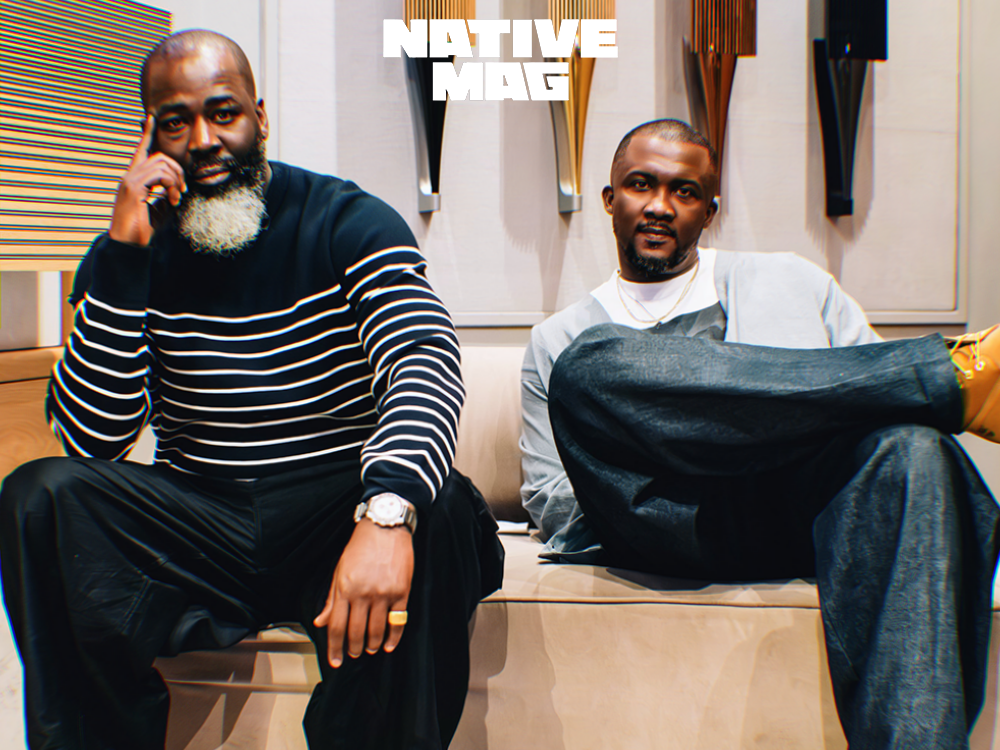
The alchemical act of creation, of conjuring substance from the void, is the central thesis of ‘Afrika Magik,’ Show Dem Camp’s new album
“They said the gods came back in human form,” Tec spits over the slow piano strokes of “Libations,” leaving ample room for speculation that he and Ghost might be the very gods being alluded to. Given Show Dem Camp’s standing, such a claim wouldn’t feel entirely misplaced or unearned. They possess the track record to justify the conceit. However, Tec deftly pivots from the apparent boast, explaining that the sentiment stems from a deeper reverence for the lineage of African creators and a recognition of the divine gift of creation.
“The consistent truth across all religions is that God is the Creator,” Tec explains to NATIVE Mag. “That, to me, is one of the most beautiful things about music or any form of art. You can walk into a studio with a producer or another artist, and at that moment, nothing exists. But by the time you leave, you’ve created something new. If that creation goes on to be released and connects with people, it travels around the world, carrying your voice and your message.”
This alchemical act of creation, of conjuring substance from the void, is the central thesis of ‘Afrika Magik,’ Show Dem Camp’s new album. The project is an explicit homage to the self-sustainability of African art expressed through the vehicle of the pioneers of Nollywood, “those who created an entire industry from nothing,” as Tec says. Its album art, the skits, and the cinematic scope of the production all draw from that well. The African music scene, like Nollywood, willed itself into relevance and influence through an unrelenting belief in its own magic.
One of the most wonderful things about ‘Afrika Magik’ is that it reveals SDC to be deeply self-aware. They’ve always been attuned to the weight of identity, but here they confront it head-on. Existing as a colonized people still structurally enmeshed within the colony compels a persistent gravitation toward whiteness, and this manifests in the disavowal of everything that makes us not just Black, but distinctly African. Too often, pride in African art feels deferred until it’s been validated by Western institutions. But SDC has built their entire career in opposition to this framework, asserting that African creativity is intrinsically valuable.
This has been the bedrock of all their work. The ‘Palmwine Music’ series, which grew into a full-blown festival, was born from this exact interrogation. “For us, ‘Palmwine Music’—and later, Palmwine Music Festival—was inspired by a trip we took to the United States,” Tec recalls. “We went to places like Bed-Stuy in Brooklyn and Compton and felt familiar with them because [American] Hip-Hop had shown us its lifestyle.”
This galvanized their mandate to create a reciprocal cultural reflection. Tec adds, “Growing up, we’d always hear about things like Moet and Hennessy in songs, but we thought, ‘How do we make our own, innately African things cool?’ The only way to do that was to represent them proudly.” They succeeded. Now with ‘Afrika Magik,’ they’re simply doubling down, pushing that project forward with an album that is a panoramic document of sound, ancestry, and, above all, spiritual vigilance.
By now, Show Dem Camp is a canon unto themselves. Every cool Hip-Hop head you know has some SDC in their library. If you’re Alté, you already get points; if you’re Alté and also rep SDC, you just might be the coolest kid on the block. The duo has long joined those responsible for ferrying Nigerian rap from a forum for technical exhibitionism into a vehicle for densely-textured, hyperlocal storytelling. On Afrika Magik, their Afropop-indebted sonics are now just one layer. The framework is augmented with new synth textures and drum programming that operate with their own logic, running parallel to the emcees’ bars.
This is the sound of them pushing all their artistic chips to the center of the table. “The beauty of Spax’s production is that he’s able to create memorable sounds that are familiar with a fresh twist,” says Ghost. “With this new project, we really tried to expand our palette. We wanted to capture elements from across Africa.” That sense of expansion is very palpable. They moved beyond the Highlife-Hip-Hop collision of ‘Palmwine’ and the live instrumentation of their past work with The Cavemen. and Nsikak David, ‘No Love in Lagos,’ to incorporate more genres of Black music.
On “You Get Me,” perennial collaborator Tems drapes her gauzy vocals over the sunlit Highlife groove. “Spellbound” downshifts into a neo-soul arrangement that gives Lusanda’s rich tones the proper space to bruise. “Pele” finds Winny gliding atop crisp rhythms steeped in vintage reggae. American R&B singer Mereba guests on the midtempo “Masterkey,” with its unassuming bass and gentle wafts of synth padding. “Small Chops and Champers” is a perfect piece of titling: the Ajebutter22-assisted track maintains the spirit of an adventure-filled montage and bottles the breezy energy of a perfect night out.
The entrancing “Magik” is one of the album’s sickest jams, and it flits about with slick, loose verses from South Africa’s eclectic Moonchild Sanelly. Tec recounts the session as highly memorable. “It was spontaneous, full of energy, and reflective of her big personality.” The collaboration became a crucial learning moment for SDC. Watching Sanelly’s approach pushed them toward structural experimentation, moving past the rigid templates of the genre. “The track doesn’t have the typical eight-bar intro, sixteen-bar verse, or eight-bar chorus that most Hip-Hop tracks stick to,” Tec says. “It just flows organically. When we were recording, whoever felt inspired would jump in, and it all came together naturally.”
Beyond the soundscape, the lyrical foundation remains rock-solid. “We also challenged ourselves to expand our lyricism and to tell different stories,” Ghost admits. Every moment on the album is meticulously considered as SDC conjoins intricate rhyme schemes into a labyrinth of dazzling wordplay and fluid run-ons. They know their audience. “We know that people want to vibe and all,” Tec chips in, “but we’re doing this for the people who actually want to hear great lines.” With Ghost flexing on “Small Chops and Champers,” “But now, I am lion-hearted / I don gather small pride,” and teasing on “Italawa,” “hairline shaky, beard gang like Gandalf,” the album is filled to the brim with humour, shifty turns of phrase, syrupy hooks, and tender professions of love. Indeed, it wouldn’t be an SDC album without the regaling of a love interest, and ‘Afrika Magik’ provides this in spades, balancing its high-minded concepts with the grounded, relatable anxieties of modern relationships.
‘Afrika Magik’ is a project that is just as much a direct, pressing response to the anxieties of right now. And perhaps no anxiety is more potent or quickly escalating than the proliferation of Artificial Intelligence. Nigerian-British comedian Ayoade Bamgboye, whose commentary threads through the project’s skits, cautions in “White Juju”: “White juju is AI, and they need to unplug that thing before it kills us all.”
“Imagine going to meet a babalawo and he goes inside the hut and asks AI for the solution,” Tec jokes. The line gets a laugh, but the point is deadly serious. AI has bled into every corner of the human experience, replacing real connection with machine-generated simulacra. “People are going to AI for love, advice, companionship,” he grouses. But the leak from the interpersonal into the creative realm is where the album’s concern rests, and the music industry is ground zero. We’ve witnessed the grotesque digital minstrelsy of the synthetic rapper FN Meka and the industry-wide panic following “Heart on My Sleeve,” the “Ghostwriter” track that used AI to create an unnervingly perfect Drake and The Weeknd doppelgänger. More recently, Xania Monet, an AI-generated R&B “artist” performing human-written songs, broke into the Billboard Adult R&B Airplay charts, reaching No. 30 and racking up tens of millions of streams.
Music, for Show Dem Camp, has always been a social organism, something that grows only when it’s fed by many hands. While a good rap beef can be creatively fertile, the sustained desire to join forces is what builds a genuine scene. In other words, both Ghost and Tec believe collaboration to be the bloodstream of the culture. They’ve repurposed their platform as an incubator, consistently anointing a new class of collaborators. “I think our story will be told by others when it’s all said and done,” Tec says. “But if I were to describe how I’d like us to be seen, it would be as artists who created a platform that great minds could build on.”
In that sense, ‘Afrika Magik’ is their most generous project yet. Within its 17 tracks, they curate an even broader African tribe; the expansion is particularly notable in its inclusion of more women. “I think the interesting thing about this project is that, for most of our previous work, across the entire ‘Palmwine’ and ‘The Clone Wars’ series, we probably collaborated with only about six female artists in total,” Ghost notes. “On this single project alone, however, we have six women featured.” The duo sees legacy as a widening circle of possibilities, not just a tally of individual accolades. Tec lays this out perfectly: “For years, we prayed we would win a Grammy. Then last year, I was at the Grammys with Tems when she won hers. That moment was a realization that sometimes the dream doesn’t have to be fulfilled by you directly.” It’s a perspective that consciously locks them into a continuum, a “rich lineage,” he explains, one passed down from “legends like 2Baba, D’banj, and the Mo’Hits crew” who shared the same dream, but paved the way for the artists who came after them to achieve it. “I just hope we’re able to build on it and carry it forward,” he finishes.

