Mowalola, Soldier Boyfriend, And Obongjayar Discuss The Significance Of Nigerian Modernism
Curated by Osei Bonsu, the ongoing exhibition is open to the public at Tate Modern until May 10th, 2026.

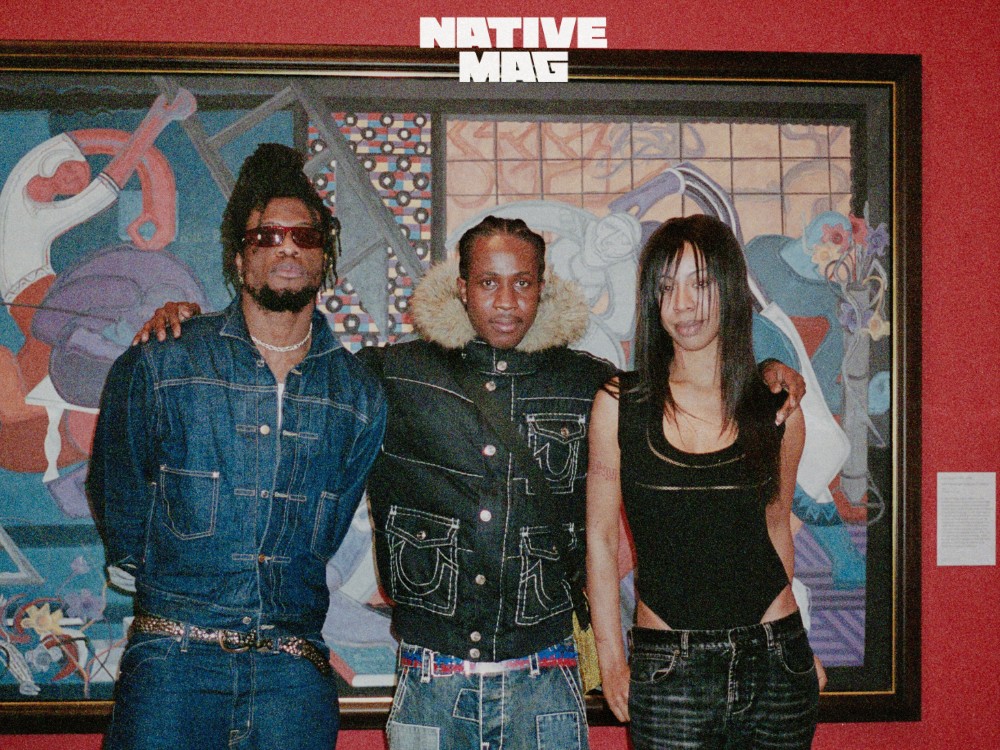
Curated by Osei Bonsu, the ongoing exhibition is open to the public at Tate Modern until May 10th, 2026.
In November 2025, Tate Modern opened its doors to the Nigerian Modernism exhibition, an important survey of the people and the work that changed the face of Nigerian art from the 1940s until the 1990s. The exhibition traces how over 50 artists, from Ben Enwonwu and Ladi Kwali to Nike Okundaye-Davies, forged a bold new visual language that documented the country’s independence from the status quo of colonial and military rule.
NATIVE and Tate invited art historian Alayo Akinkugbe to host a conversation with three Nigerian artists: Soldier Boyfriend, Mowalola and Obongjayar, key figures exporting their Nigerian talent across music, art and fashion to the rest of the world. Throughout the conversation, Soldier Boyfriend, Mowalola and Obongjayar explored how their respective pasts influence their work today.
Curated by Osei Bonsu, the ongoing exhibition is open to the public at Tate Modern until May 10th, 2026. Nigerian Modernism takes us on a visual journey through the state of the country in real time, from the sacred groves of Osun in Oshogbo to the pre-independence rebellion of the Zaria Art Society and the Nsukka Art School, which created the intellectual backbone for what we know as Modernism today.
The conversation started with an assessment of what modernism means to each artist, and made its way through the roots of their creations, how various established systems help or hinder one’s creative expressions, and how the creative exchange between Nigeria and the UK is inseparable from the painful history that established a relationship between the two countries.
“It’s easier to go into the past first before you take into the future.” – Soldier Boyfriend
Alayo kicked off the conversation with a simple question: What does modernism even mean now? For Soldier Boyfriend, Mowalola and Obongjayar, Modernism is not an art-historical category that’s easily identifiable by what you see. For them, it’s more about what one breathes, lives and inherits. Soldierboyfriend believes that today’s art world is in a neo-modern condition, where artists get to see what has been and use that as the starting point, whether consciously or not, within their art. Following careful consideration of how the country’s civil war in 1967 shaped the world and the people around him, from his parents’ beliefs to the school rules he had to follow, he sums it up by saying, “It’s easier to go into the past first before you take into the future.” These past experiences, whether his own or the collective Nigerian youth population’s, always inform the art he creates.
Mowalola’s proximity to the fashion industry growing up gave her a very clear sense of what being modern looked like in Lagos, Nigeria. “When I actually grew up in Nigeria, and then we were just seeing more like made in Nigeria promotional things, when before it was very much like a lot of white people on the billboards and adverts,” she said. “And I felt like there was just a new push of being proudly Nigerian,” identifying how Nigerians shifted away from colonial societal standards.
Obongjayar, more sceptical about the word itself, confesses that his resistance is sharpened by the absence of history being properly documented in Nigeria. “I feel like those things need to be cataloged a lot better,” he explained. “I don’t think there are a lot of people that take the time to actually find those things and put them in a place where you can actually discover them easily.”
The conversation turns quickly to what was taught, what was not taught, and how the pieces they could see throughout the exhibition enlightened their contextual knowledge of their own country. In the Tate’s exhibition, works like “Woman In Grief”, a post-cubist painting by Uzo Egonu, created soon after the Biafran War, depict a distressed, bent figure whose pose and fractured space have been interpreted as a visual embodiment of the anguish and trauma of the 1967–70 conflict.
Nigerian Modernism traces art from colonial rule to independence and beyond, and the Biafran War marks a dramatic turning point in that national and artistic story. While the country in the 1960s responded to independence with optimism, the Civil War forced a reckoning with violence and division very soon after.
“Growing up in Nigeria, we didn’t really learn any of our history for some reason.” – Mowalola says.
Born across the 1990s and 2000s, Mowalola, Soldier Boyfriend and Obongjayar only know life in its aftermath. The effects of the country’s conflict reach them through family stories, history textbooks, inherited tensions and freedoms. Without their own direct experience of it, this generational distance complicates their relationship to history, meaning they must rely on what they are told, or not told. The absence of institutionalised history in Nigeria for this generation means that it becomes both omnipresent and opaque in their lives.
In the context of their conversation, Soldier Boyfriend’s relationship to the war is especially resonant. Growing up in an Eastern family directly affected by Biafra, he expresses a closer proximity to its residue. His chosen name becomes an artistic gesture shaped by that inheritance. “I took the moniker up, not to embrace war, but to embrace the rebelliousness of it, because I feel like the world we live in is kind of built on the foundation of war and violence.” This choice does not romanticise war, but instead reveals his recognition of it as a structural condition that defines global systems of power. His adoption of “Soldier” reframes militaristic symbolism as a critique of how contemporary establishments, often through military force, were forged through violence and still operate within those frameworks.
Across the conversation, what becomes clear is that each artist’s creative instinct did not emerge in isolation. It formed in response to structures that existed in their realities: school systems shaped by colonial residue, homes shaped by religious fear, and socio-political authorities structured around hierarchy and control. As adults now holding authority over themselves, the work they produce is not simply an aesthetic choice; it is also a reaction to what has been, and sometimes a defiance of the set norms.
School is examined as an arena where structure collides with instinct. For Soldier Boyfriend, secondary school carried the lingering weight of colonial aesthetics and discipline. He recalls attending St Gregory’s College, Obalende, “an all-boys Catholic school” where the uniform, to this day, mirrors English formality in tropical heat. “They used to make us wear sweaters and blazers and I was confused because it’s so hot,” he starts, “And I’m wearing this blazer.” His imposed school uniform becomes a metaphor for inherited systems that do not fit the lived realities of being in Nigeria, and that friction feeds directly into his later resistance to aesthetic prescription.
Mowalola’s schooling experience shaped her differently, but just as profoundly. For her, the educational tension was less about colonial uniformity and more about her instincts being dismissed in a formal school setting. Before moving to the UK, she was already serious about art in school in Lagos. More serious, in fact, than the art teacher who would label her as an “ITK” (I too know, a common Nigerian jab referring to someone who is seen as doing too much). That early indifference sharpened her drive to rebel and take autonomy over herself and her art. It made it clear that if she wanted her work to matter, she would have to insist on it mattering.
Later, while studying in the UK, she encountered a different kind of structural narrowing, within a framework that erased her and people who looked like her. “I felt like when I went to the UK to actually study art, it was very much in a whole white context.” Even the tools reinforced it. “I was getting like white people’s skin colour pencils.”
In Lagos, her ambition was not taken seriously enough. In London, it was taken seriously within a framework she was expected to abide by, even though it did not consider her roots. Both of these experiences shaped the rebelliousness we see in her designs today. Where some see controversy, she presents self-validation, reminding herself that she has never needed to wait for institutional permission. Where, for previous generations, freedom often had to be earned, for this generation, freedom is assumed.
When Obongjayar declared his ambition to be a musician to his family, they all laughed at him. “I walked into the living room, I was like, ‘Yo, I just had a dream. I know exactly what I’m gonna be when I grow up… I’m gonna be a musician,” he recalls. The response immediately placed him within a framework he had no interest in. In early-2000s Nigeria, music was not seen as a lucrative or stable career path, and was considered unserious, which would have informed his family’s response. Today, as the musician he once dreamed of being, he reflects on that story with vindication.
Mowalola’s home, by contrast, contained both repression and unexpected freedom. She describes Nigerian culture’s silence around sexuality, yet notes that within her household, the shame that was ascribed did not really exist. The clash between domestic freedom and public taboo sharpened her curiosity to push boundaries in fashion. “I was always very interested in the topic of sex in Nigeria because I felt like no one really spoke about it,” she says. Her later provocative designs respond to the policing of bodies she witnessed throughout her life, and the instinct to rebel against a reality that felt contradictory to her lived experience.
“We’re fighting for new air.” – Obongjayar
Socio-political authority forms the third layer. All three artists describe Nigeria as structured by hierarchy and power imbalance. Obongjayar articulates it starkly: “There’s a hierarchy… It’s the government, there’s the army of the police… civilians literally bottom of the food chain.” Soldier echoes this sense of constant struggle. From the Nigerian military’s visible presence during his adolescence (including being stopped for wearing camouflage) to his father’s strict religious rules, this reinforces the feeling of surveillance and control. Creative rebellion becomes a refusal of imposed authority.
When he says, “Everything,” in response to what young Nigerians are rebelling against, he is not speaking hyperbolically. It reflects layered pressures: familial expectation, educational conformity, and state violence.
As a generation, some Nigerian millennials and Gen Z experienced a countrywide and large-scale political reckoning in October 2020 during the #EndSARS protests. Mowalola remembers the tollgate protests as communal and hopeful. “Everyone was playing music, people were performing… it was really beautiful.” Before the subsequent violence shattered that hope for her and for many Nigerian youth who had taken on the responsibility to stand up against police brutality. For Obongjayar, the heartbreak lay not only in the shootings of innocent Nigerians but in the system that enabled them. “To see that our government… willing to kill its own people… is hard.”
Taken together, school, home and socio-political authority do not simply influence these artists. They generate the tensions their work addresses. Obongjayar describes their role succinctly: “We’re fighting for new air.”
For much of the late nineteenth and early twentieth centuries, the relationship between Britain and Nigeria was marked by extraction. The most infamous example remains the Benin Expedition of 1897, when thousands of bronzes and royal artefacts were looted from the Kingdom of Benin and dispersed across European museums. Sacred objects, ancestral heads, plaques and regalia were removed from their ritual and political contexts and reclassified as ethnographic curiosities.
In recent years, those objects have begun to return, and institutions across Europe have initiated repatriation processes, acknowledging both the violence of acquisition and the need for restitution. Against that backdrop, the Tate’s Nigerian Modernism exhibition feels like a world with new air. Here, Nigerian art is not displayed as plunder, but presented with consent, collaboration and curatorial leadership by Nigerians. The works of the 1940s and 1960s, born from a need to synthesise and assert, sit in London decades later as proof that the synthesis succeeded. The post-modern breakthrough has brought about a generational confidence, where Nigerian artists no longer ask permission to belong to global conversations.
Soldier Boyfriend speaks about Western influence on his work in a way that already assumes hybridity. “It’s just me taking things I kind of learned from Europe or from the UK and just adding my own little twist.” For him, European techniques are materials for his art, not masters. And that is where the post-modern condition quietly hums beneath the conversation. Obongjayar’s journey maps this shift clearly. Growing up in Nigeria, Western culture arrived aspirationally, but migration showed him the depth of what existed back home.
In a moment thick with irony, he recalls discovering Fela Kuti properly in Norwich: “My white friends were playing Fela Kuti, and I was like, ‘Hold on, this is where I’m from.’” This experience challenged the way society had taught him to view traditionally Nigerian things, and led to a breakthrough about owning his Nigerian attributes, as they are.
Mowalola, entering a design world that assumed whiteness as baseline, has never felt the need to define her work by existing “African” aesthetics. “I’ve never really felt like I have to make this look very African… Because I’m Nigerian. So anything I make is Nigerian.” This sums up the state of the post-modern creative exchange between Nigeria and the UK, which has produced music, art and fashion that is globally legible and understood by all.

