Review: ‘Girl From The West’ by Solana
Under her new label, Solana has released what is meant to be the crowning moment of her blistering breakout, ‘Girl From The West.’

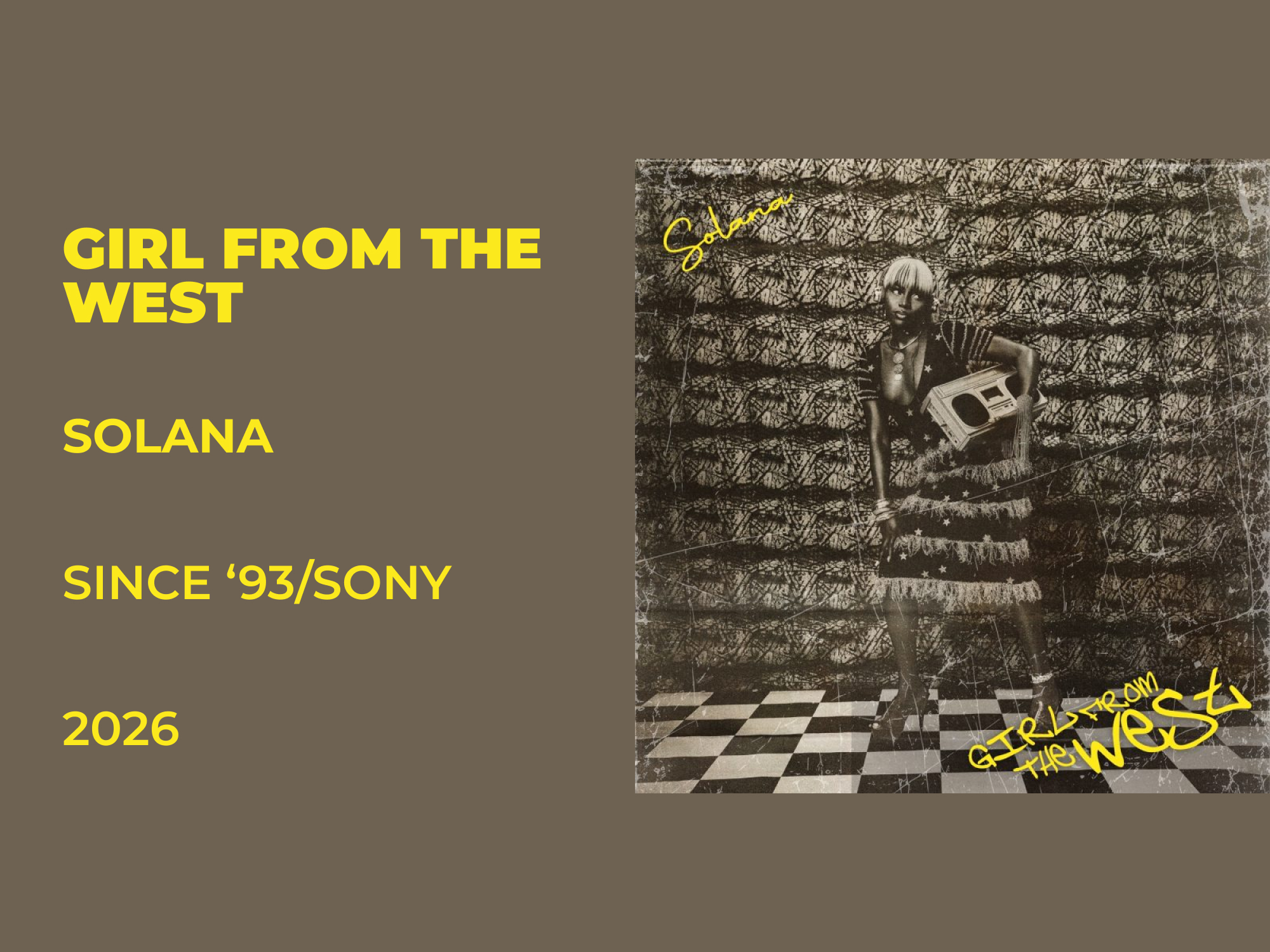
Under her new label, Solana has released what is meant to be the crowning moment of her blistering breakout, ‘Girl From The West.’
For music aficionados, discovering Afropop rising star Solana must have felt like discovering Bitcoin early, something along the lines of ‘Who is this/What is this spectrum…?’ A few weeks ago, Grammy winner Doechii took to Instagram to ask her fans to help her find the title of Solana’s global hit, “Okunkun“. “That song is so fire,” she declared, before proceeding to mouth its infectious beat: “Tun, tun… tun, tun, tun, tun.” There is something magnetic about Solana’s sound, but while Girl From The West establishes the arrival of a compelling sonic identity, it also exposes the flaws within its experimentation.
Ogunlana Oluwabusolami Habibat—better known as Solana—was once making what could be described as run-of-the-mill Afropop. In 2020, she was embraced by Mr Eazi’s emPawa initiative, through which she released her first single, “Far Away,”with Joeboy. Subsequently, she dropped “Badder” and “On My Way,” featuring Victony, but nothing ever really took off, garnering about a million streams on Spotify. At some point, Solana contemplated quitting music, little knowing that she was on her way to stardom.
All this happened before becoming one of Spotify’s 2026 Fresh Finds artists. Before being named Spotify’s EQUAL Africa Artist for October. Before Diplo, Little Simz and Tyla co-signed her. Solana has been tagged the Queen of YoruPop by Riki Bleau, co-president of Since ’93, a Sony-affiliated label with experience working with African artists like Tyla and Tems. Under her new label, she has released what is meant to be the crowning moment of her blistering breakout, ‘Girl From The West.’
Her sound—etched into shape by mainstay Afrobeats producer Killertunes, who also appears on her global single—is the most distinct and sonically magnetic part of her artistic make-up. It is exuberant and genre-fluid, with strains of Yoruba-inflected Electronic Pop. Almost as impressively, Solana draws from Fuji, Afrobeats, Synth-Pop and R&B, alongside an almost 1980s dancefloor sensibility, eerily reminiscent of the horse-running-wild feeling you got listening to Willow Smith’s “Whip My Hair.”
“Okunkun”, the song that would change things for her, was recorded in 2023 but held back for three years because people didn’t think her sound was commercially viable or aligned with the Afropop zeitgeist at the time. When she finally released it in 2026, she posted a video saying, “I think I may have just made the best song I have ever made.”
“Okunkun” wasn’t the only pre-released track from the project. “O ri mi” restyles the famous “bam bam biram bam bam” askew into a consuming ode to love. Solana sings about not wanting to lose control of the emotion. She’s fearful and wary of the scars it leaves in its wake. The production is weirdly reminiscent of The Cramps’ “Goo Goo Muck”, used in the famous dance scene in season one of the hit series Wednesday. “Dide“, a call to embrace one’s destiny, was the other pre-released track. YoruPop, a term used to describe music that taps into Yoruba proverbs and cultural traditions woven into its lyrics, isn’t necessarily proprietary. At its core, it is Afropop. There is a lineage of Nigerian artists, from the Lijadu Sisters to King Sunny Adé and Ebenezer Obey, to Asake, who have drawn from these traditions across existing genres. Solana, in her case, brings them into Garage Pop.
The seven-track project was entirely produced by Killertunes, akin to Asake’s relationship with Magicsticks. It opens with “Faaji”, a stellar entry into the Solana experience and one of the best intro tracks on an EP. Opening with a piano melody backed by triumphant trumpets, she sings about how her enemies have stumbled and can’t stand her success. The song is self-affirming. She’s backing herself to keep going, now that she has seen the good things life has to offer. Over kick-ass drums, she sings, “Duro no, mi o ni duro.” The song offers itself as a mantra, one in which her self-belief outlives both the doubters and her own self-doubt.
Although “Get The Money” tows the same line as the EP’s opener, here, Solana is more braggadocious, courtesy of her ẹ̀lẹ́dà (creator). Drawing from King Sunny Adé’s Juju style, as heard on memorable songs like “Merciful God” and “Appreciation“, it kicks off fast before building into an atmospheric medley of ’80s Fuji, with instruments like the lap steel guitar and talking drum melding with purposefully placed log drums. Here, she is laser-focused on getting the bag, and how, with the help of God, no obstacle can stop her. Despite being the shortest song on the project, she still finds space to curse out her haters. The production is the star of the show here.
“Little Birdie” rolls over similar beat patterns present on “Okunkun”. This exposes the monotony of Solana’s sound. Having them back-to-back makes the listening experience tedious. The idea behind it is admirable, but it is also the Achilles’ heel of the project, particularly when the song slowly fades into the background of your consciousness and loses your attention. The subject matter is reflective, albeit layered and repetitive. Here, her doubting Thomases are shooed away. An energy she no longer needs now that she’s excelling.
In essence, ‘Girl From The West‘ is a victim of its own arrangement. Coming right out of the gates strongly, the stakes are high. But in a bid to stick to the storytelling within its arrangement, the tail end of the project loses the attention it worked so hard to capture in the beginning, caving in under the weight of its sequencing. Judging by his comments at the listening party about having more jams with Solana in the locker, Killertunes looks set to keep making light work of giving the rising star the sound of a full-fledged Rock band with his atmospheric production doing the work of an entire ensemble. For all the noise, it is still just the two of them pulling the strings.
Listen to ‘Girl From The West‘ here.

