Anaïs Cardot Is Bringing Intimate Emotions To Life
The Gabonese-French artist’s new EP, 'Map of Her Shadows,' is a lush meditation on familial grief, vulnerability and acceptance.

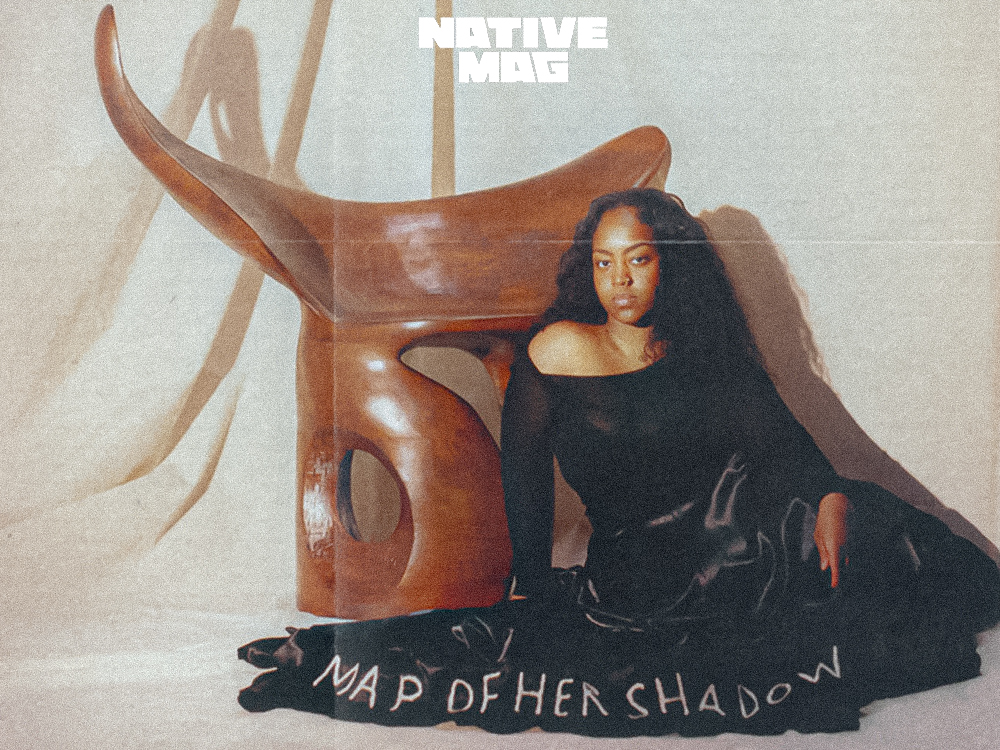
The Gabonese-French artist’s new EP, 'Map of Her Shadows,' is a lush meditation on familial grief, vulnerability and acceptance.
Anaïs Cardot grew up surrounded by music. From early morning school runs with her father to obsessing over Hannah Montana to discovering his 7,000 song-iPod when he passed, Cardot’s love of music has remained a constant in her life. This music she found went on to shape her music taste and, eventually, her approach to her own music, particularly the works of Ella Fitzgerald, Jacque Brel, and various other Jazz, Bossa Nova and Soul artists.
What started as making multilingual singing videos in her bedroom quickly turned into online fame, which led to work with Afropop icons like Wizkid, Asake and Alté star, BOJ. In 2024, Cardot appeared on stage with Asake during a show at the O2 arena, and this year, she made her COLORS debut. The latter was a lifelong dream of hers, and both achievements are what she calls her “Hannah Montana moments.”
But long before Cardot put on her metaphorical blond wig, she was a student in Ottawa, Canada, doing her best to keep her music dream going while finishing high school and university. Born in Gabon and raised between the Central African country, south of France, South Africa and Canada, Cardot is no stranger to moving around. While Ottawa was a good home to Cardot, filled with family, friendship and numerous creative collaborations, it was in Paris that the young singer was able to spread her wings, leading to the birth of her sophomore EP, ‘Map of Her Shadows.’
“I feel like when I was in Ottawa, I was really in my comfort zone,” she says. “I didn’t have to be challenged in any way, or at least I was not challenged enough. I feel like moving to France really taught me how to fight for myself, step up for myself, and speak for myself.” ‘Map of Her Shadows’ finds Cardot at her most mature and open with exquisite production and instrumentation ranging from Folk, Soul and Jazz.
At first glance, ‘Map of Her Shadow’ reads like a letter to an ex relationship. Perhaps that’s what we’ve come to expect of all Soul-bearing music, but Cardot is actually battling with a different kind of relationship, specifically her relationship with her family. The penultimate track, “Second Hand,” details a familial relationship in which apologies are few and far between. “To be honest, my heart didn’t have enough space to talk about [romantic relationships], because it was so full of other relationships, with my family and with myself,” she says. “My family made me grow so much. So I wanted to talk about it and explain these fears and pain that I’ve been carrying on myself since I was a kid.”
Dealing with the complexities of these relationships and the fears accompanying them has not been easy, as there’s little she can control, including fears of family aging. On the other hand, her family, especially her sister, is a huge support as she navigates her artistry and online fame. She’s determined to take the bitter with the sweet because she hopes to break generational curses by being vulnerable about these fears and frustrations through the music. By doing so, she hopes to help others. “I feel like I make the music that I wish I could hear when I’m not feeling good,” she notes. “So I feel like yeah, I’m embracing the sadness now.”
Cardot is also navigating a complex relationship with life itself. The project begins with “Beautiful Liar,” or as she artfully describes it, “a diss track to life.” It deals with the feeling of being duped or lied to by life; a soundtrack to her fears of getting something different than what you expected from life, both the good and the bad.
“Life is not binary, it’s not black or white,” she says. “When I was a kid, I thought it was just that or that, but actually, it’s everything at the same time. Life is still beautiful, but since it’s so beautiful, I was able to be lied to by [it].” On the last track, “Wave Goodbye”, Cardot reaches some sort of release in the form of detachment and acceptance of what she can’t control. “It’s me allowing myself to feel these things and accepting them.”
To bring these intricate themes to life, Cardot knew she had to go bigger with the production. After successful stints operating within Afropop pockets, she saw this new EP as an opportunity to dive fully into other genres, including Folk, Soul and Jazz. “I really wanted to be more concrete with what I want to offer musically, and so this is why I really wanted to just make [the production] richer.” Cardot worked with some of the most prolific British producers such as TSB (J Hus andDave), the Grammy-winning Venna (Burna Boy and Beyoncé) and PRGRSHN (Stormzy and Nao), and international creatives including LJay Currie (Drake) and Marc Antoine.
After mastering the themes and the production of this new EP, there was only one more avenue of storytelling for Cardot to explore: live performance. She wants her music to reach as many people as possible; it’s one of the reasons she sings in French, Portuguese and Spanish in addition to English. So, for the singer, stage performance was a natural next step. Despite her disability, arthrogryposis, which makes it hard for her to stand for long periods, Cardot has adapted wonderfully with the help of her team.
One of the main changes to her live performance style is a custom-built chair, inspired by African furniture she had growing up, as well as storytelling traditions of the continent. The chair made its first appearance during Cardot’s recent COLORS debut. “I feel like you can listen to music as much as you want on Spotify, on Apple Music, and all of that [but] you will not get it as much as when it’s live,” she says. “I feel like music has another dimension when it comes to being performed on stage.”
Cardot’s disability has not hampered her dreams or achievements; in fact, it’s propelled her. “It’s so funny, I was just raised to not think that I have a limit,” she affirms. This doesn’t mean she hasn’t felt the limits of accessibility and the performance expectations of artists; it just means she’s not afraid to build around it. She feels a duty to keep advocating for accessibility. “I feel like we’re in need of people with disabilities to make art more accessible, because art is not as accessible as we think,” she says.
At the end of the day, Cardot wants her music to be proof that anyone can do it too. She hopes this new offering provides a lot of peace, comfort and love, despite its sadder themes. “We can actually do anything we want if you put your mind to it, we can do anything we want,” she says. “Anything we need, we can have it, but it’s just a matter of being ready or not.”
Listen to ‘Map of Her Shadows’ here.

