THE WOMEN BREATHING INTIMACY AND INDIGENEITY INTO CONTEMPORARY NIGERIAN MUSIC
These singers are incorporating ancestral musicality and language to usher in refreshing possibilities for contemporary Nigerian music.

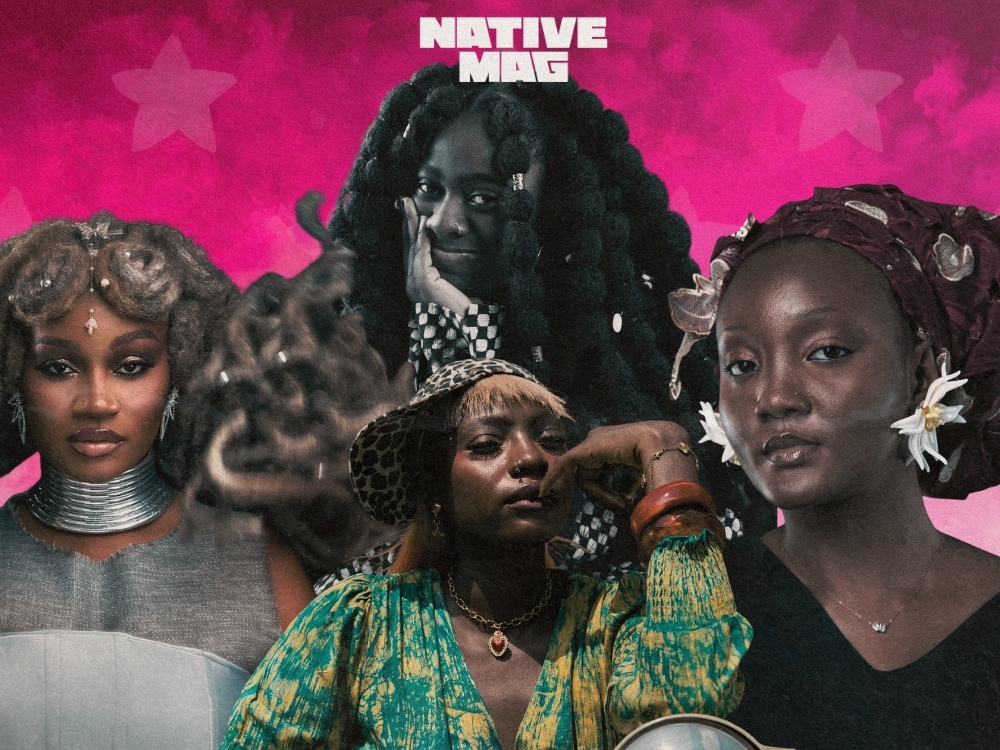
These singers are incorporating ancestral musicality and language to usher in refreshing possibilities for contemporary Nigerian music.
There are some who maintain that there is hope for Nigerian music yet, and there are others who prove it. For every repetitive charting hit, there is someone out there meshing pidgin with nihilistic Trap, and for every vapid string of lyrics, there is an artist imbuing their music with vulnerability, warmth, and longing. In this latter category, you will find a group of women best described as our generation’s answer to Aṣa. If you haven’t seen them, you’ve heard them: strumming world-worn guitars, reimagining folktales, and singing love songs so dulcet they could give you a toothache.
In a country where music enthusiasts lament the unreliability of the live music landscape, these singers emphasize ethereal music experiences and refined vocality. Moreover, they’re blending the modern with the indigenous, incorporating ancestral musicality and language into Jazz, Afropop, and Soul to usher in refreshing possibilities for contemporary Nigerian music.
Read on to discover the Nigerian women artists enriching the scene by staying true to both their hearts and their roots.
Lodù
Nobody loves quite like Lodù. Via her very own label Émilie Records, she has made a name for herself baring her heart to an assortment of lovers through honeyed Afrosoul. While her career began in 2024, most first caught wind of her gift through 2025’s “Ìfẹ́mi,” a Samba-laced number with an earworm of a chorus. Since then, she has remained versatile but forever driven by matters of the heart: “Olówó Orími” sounds like the soundtrack to a marriage proposal, “Moróuntódùn” could ignite a dancefloor, but both are odes to a lucky love interest. With cosigns from Spotify, Apple Music, and Tems–alongside her recently released debut EP Wine & Honey–Lodù is on track to claim 2026 as hers.
Teledalase
If you watched the 2024 Netflix phenomenon ‘Anikulapo: Rise of the Spectre,’ then you have heard Teledalase crooning in Yoruba across the ballads that comprise the film’s soundtrack. Her career didn’t start there, though; her releases from as far back as 2022 point to a sonic pull towards intimacy and ancestrality with inspiration drawn from her Osogbo roots. Her debut EP ‘The ones who didn’t die, Pt. 1’ is remarkably heartfelt and interior, while ‘The Bad Wife has no Tongue,’ released in partnership with EMPIRE, is expansive, featuring vulnerable confessionals alongside Synth-Pop and even Amapiano. Her special voice reemerged this year in the form of “IGBA ENI,” and to the delight of her dedicated following, she has promised that more gems are to come.
Celeste Ojatula
Celeste Ojatula is a dreamer. Think of childhood folktales, fables whispered by moonlight–she embodies it all. She’s been on the scene since 2018, plucking her guitar strings across tracks like “Black” and “Light,” but it was her debut album ‘Alo’ that cemented her name as a force in Nigerian Indie music. Via the transcendence of “Oluronbi,” the inexplicable warmth of “Alu Join Join,” and the heartbreak of “Awa’nlo,” Celeste carved out a wistful sonic world, the musical equivalent of a starlit night. Her most recent EP, ‘Our Time in the Sun,’ expands the depth of her artistic universe, showing us that she can conjure up euphoria and light just as well as she can nostalgia. With joyous tracks like “This Side of Love” and “Oya Wa,” Celeste Ojatula has proven that she can be the soundtrack to our sweetest memories.
Ṣẹwà
Not many people can say that they’ve opened for Aṣa at a headline concert, but then again, not many people are Ṣẹwà. The Afrosoul wonder has experimented with genres like Highlife, Jazz, and Fuji across a rich career spanning seven years and two countries (Nigeria and Canada in particular). Early works like “Wahala” and “Láruge” point to both her musical dexterity and inclination towards a sort of Bohemian sound, while the artful “Lagos Lovin” solidified her place as one to watch in Nigeria’s new school of standout talents. 2025’s ‘Detox’ was a whirlwind of a debut album, packed with gripping arrangements, Ṣẹwà’s grounding alto, and the soulful admissions of a woman who sounds like she has seen the best and worst of what love has to offer. Having recently released a deluxe version of ‘Detox’ and secured a whopping four nominations at the upcoming 18th Headies Awards, including for Best Female Artiste and Best Alternative Song, Ṣẹwà has shown that vulnerability is not a hindrance but instead, a creative superpower.
Faith Martins
Viral hits are often criticized for prioritizing digestibility over significance, but Faith Martins has used her moment in the sun to communicate a powerful message. Anyone who frequents the streets of Nigerian TikTok knows that Faith Martins’ “Dájú” is practically inescapable, but while it’s an unequivocal party anthem, it’s also a grounding reminder to tread cautiously in light of the world’s cruelty. Featuring a girl clad in a lace gele while chanting in Yoruba, as well as soulful talking drums that quickly mutate into log drums, the song’s many promotional clips highlight the allure behind Faith Martins: the ability to straddle the modern and the traditional. Gripped by her addictive breakout, the scene awaits with bated breath for Faith Martins’ next step.
J’Dess
If it’s not clear from listening to the beautifully arranged “Life” or the vocally dexterous “Child of the Sun,” J’Dess is seasoned. Harnessing Afrobeats, Folk, Highlife, and RnB, she’s been on The Voice Nigeria and worked alongside Eastern powerhouses like Phyno and Zoro. Her first single “Chi Efo,” an Igbo-laced track about new beginnings, snagged a nomination for Best Vocal Performance at the 2020 Headies Awards and marked the start of a career defined by equal parts soul and sonic excellence. ‘Ada,’ her debut album, formally introduced listeners to her artistic world, featuring emotive lyricism, Igbo Pop production, and contributions from artists like Waje and The Cavemen. Her newest single “Honey,” a love song filled with warm trumpets and layered harmonies, proves that J’Dess is just committed to ushering in charm and comfort as she was when she debuted as an artist six years ago.
Solana
In a generation defined by an insatiable hunger for both the futuristic and the familiar, Solana and her world of Yorupop have come to offer us reprieve. While most bought their Solana stock earlier this year as teaser clips of “Okunkun” flooded digital streets, she has been active in Afropop for over half a decade, with strong features alongside stars like Joeboy and Victony. 2021’s “Badder” marked the public birth of her creative relationship with Killertunes, and the seamless interplay between her quick lyricism and his bouncy production all but prophesied the chemistry that would define her breakout hit five years later. Three months on from its June release, “Okunkun” has attracted endorsements from Tiwa Savage, Ayra Starr, Diplo, Little Simz, and even SZA, becoming one of the most universally loved hits to emerge from the Nigerian music scene in 2026. Following up with the funky “Dide,” Solana remains dogged in her quest to ensure that “sounds from the West” are consumed worldwide.

