The 50 Greatest King Sunny Ade Songs
To celebrate the legend’s 79th birthday, we visit his discography to pick out the 50 greatest King Sunny Ade Songs of all time

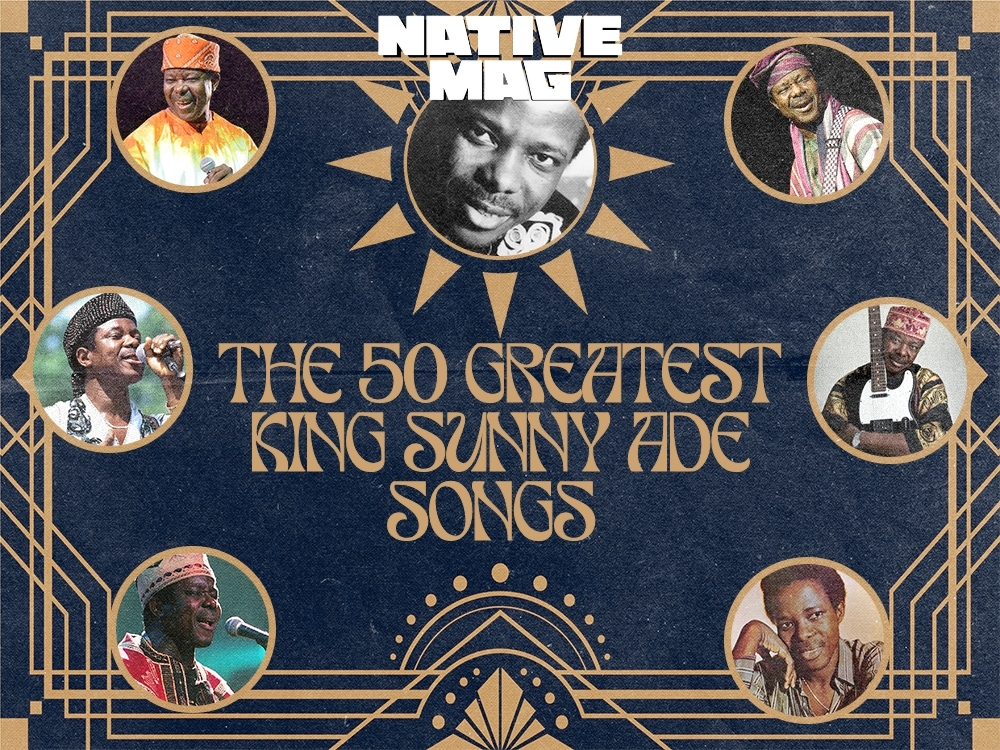
To celebrate the legend’s 79th birthday, we visit his discography to pick out the 50 greatest King Sunny Ade Songs of all time
This week, 79 years ago, Sunday Anthony Ishola Adeniyi Adegeye, popularly known as King Sunny Ade, was born in Ondo Town on the 22nd of September 1946. Spending his formative years in Osogbo, he took a keen interest in music, particularly drums, but this was frowned upon by his family. His parents, both descending from royal lineages, thought the ambition of playing drums and making music was that of subjects, not princes. Undeterred, he hid his ambition from them, playing clandestinely with several local bands.
In 1963, King Sunny Ade fled to Lagos to make his fortune, abandoning his secondary education. First, he joined Moses Olaiya and his Federal Rhythm Dandies as an apprentice Samba drummer. During his stint with the band, he bought his first guitar and taught himself how to play. Shortly after Moses Olaiya pivoted from music to theatre, King Sunny Ade formed his first band in 1966. This began Sunny’s extraordinary journey of popularising Jùjú, an indigenous variant of Palmwine music that emerged in colonial Southwestern Nigeria around the late 1920s.
By 1966, the genre was well established with pioneers like Tunde King, Akanbi Ege, Theoliphus Iwalokun, Suberu Oni, Ambrose Campbell, Ayinde Bakare, IK Dairo and Tunde Nightingale. In many quarters, Jùjú was perceived as lowbrow compared to Highlife, the preferred music of Nigeria’s emergent elite class. It was to be the life work of Sunny Ade and his contemporaries—Chief Commander Ebenezer Obey, Wale Glorious, Expensive Olubi and General Prince Adekunle—to modernise Jùjú. Sunny Ade introduced several modern musical instruments into the mix, trialed new performance modes and strategies, particularly dance choreography, evolving Jùjú into a genre that enjoyed wide appeal.
This occurred in the 1970s, coinciding with Nigeria’s economic prosperity from the oil boom. Flush with cash, neotraditional ceremonies—birthdays, naming, weddings, and funerals— popularised by settler communities in Lagos from the 1920s had become a constant source of patronage for juju bands. Sunny Ade and his band, African Beats, grew their clientele among the Yoruba elites, hobnobbing with a wide range of patrons from wealthy traders to affluent Yoruba communities in the Diaspora and Yoruba kings. In 1977, he was declared a king by his fans after emerging at the top of a poll conducted in the dailies. This was formalised by a chieftaincy title, King of All Music, bequeathed by the Alaafin of Oyo later that year.
With no fewer than hundreds of records to his name, King Sunny Ade is arguably the greatest living musician in Nigeria. He has distinguished himself as an exceptional singer, composer, and multi-instrumentalist. As a band leader, he has maintained African Beats through decades, holding his musicians to the highest standards. His performances, at concerts or parties, are delightful, packed with dance choreography, delightful solos, and soulful anthems. To celebrate the occasion of the legend’s 79th birthday, we have dived deep into his discography to celebrate the 50 greatest King Sunny Ade Songs of all time. Enjoy! – Dami Ajayi
50. “Alanu L’Oluwa” (1967)
Just at the beginning of the Biafran War in 1967, a 21-year-old Sunny Ade shared his first single, “Alanu L’Oluwa,” with the world. Heavily influenced by the leading Jùjú star of the day, Tunde Nightingale, Sunny’s salvo copied the maestro’s guitar work and nasalised tenor. This song’s theme is divine praise—a first in a career with many such thematic leanings—showing more ambition than promise from the eager upstart who would elevate the genre to global status. It sold only 13 copies. – Dami Ajayi
49. “Mori Sisi Meji” (1975)
Ita Faaji is a familiar description of spaces designed for relaxation in urban Yoruba life. Not quite a love song, Sunny Ade describes two beautiful ladies selling fish at Ita Faaji on “Mori Sisi Meji.” The song is held by his use of M’olo as a double entendre. In its contracted form, M’olo prefixes flattery in Yoruba. Deep into the song, Molo is the musical instrument lyre, a fixture of Sakara music. In this song, Molo is a signifier for old things. Sunny is certain that Juju would win the love of these beautiful ladies and upstage Sakara. – D.A.
48. “Me Le Se” (2004)
“Me Le Se” translates to “I can’t do without” in English. For King Sunny Adé, that essential thing is giving thanks to God. A constant across his career, this tendency to defer to the divine remains ever-resonant. With riveting instrumentation accompanied by harmonising backup vocalists, he strongly advocates for gratitude. – Tomide Marv
47. “Emi A Gbadura” (1977)
One of two songs recorded in London in 1977, “Emi A Gbadura” carries the cadence of a hymn rendered in Yoruba. It is also a gentle song of divine gratitude. And after each verse, the guitars and talking drum respond vibrantly, taking centre stage in an extended, joyful play. – Eniola Ayedun
46. “Oba Ta’ye Njuba” (2008)
“Oba Ta’ye Njuba,” from KSA’s late 2000s album, ‘Blessing,’ is a praise song of heartfelt thanksgiving. It is upbeat and carries the flavour of Jùjú-derived Gospel Tungba. The music video captures the ever-agile KSA, moving with youthful vigour on what appears to be an altar. – E.A.
45. “Emi Won N’Ile Yi O (Sa Jo Ma L’Owo L’Owo)” (2010)
Always the avid revisionist, King Sunny Ade found new uses for his old melodies, songs, and themes on “Emi Won n’Ile Yi O (Sa Jo Ma L’Owo L’Owo).” It opens with a voiceover of members of the African Beats band. The music itself harks back to the 1950s Jùjú Roots, which has a close affinity with Palmwine Highlife and Agidigbo melodies. – D.A.
44. “Sokoyokoto” (1987)
Between 1985 and 1988, Sunny released 15 albums on which he completely altered the sound of Jùjú, creating his signature Golden Mercury style that ‘Jealousy’ and the other LPs typified. The song was ostensibly named after a delicacy, but knowing KSA’s bawdy tendencies, you know that “Sokoyokoto” was NOT about food, abi? You’re welcome. – The Jide Taiwo
43. “Afai Bawon Ja” (1972)
An early classic, “Afai Bawon Ja” is part of a four-song medley of modern Jùjú music far removed from IK Dairo and Tunde Nightingale’s overt influences. Steeped in paranoia and an overtly conscious presence of detractors slandering, it is also a profoundly optimistic tune about triumph. – David “Elemoh” Olaoye
42. “Odun De Keresimesi” (1985)
Christmas albums are darlings of popular culture (cue in Mariah Carey). On “Odun De Keresimesi,” KSA leans into his Christian roots and delivers a guitar-driven rhythm that captures the festive spirit of Christmas. He celebrates Christ as the reason for the season, urging his listeners to be grateful for surviving the year’s trials. – D.O.
41. “Ile Labo Sinmi Oko” (1971)
King Sunny Adé was at the tail end of his second contract with African Songs Limited and playing a tour in London at the time of this recording in 1971. Homesick, patriotic, and anchored by his faith, he keeps Nigeria at the top of his mind on “Ile Labo Sinmi Oko,” drawing inspiration and title from the age-long farmer’s adage, which translates to “home is the place of rest after work.” – T.M.
40. “Challenge Cup” (1968)
Look away now, young people: there was a time when football fans didn’t care for your Barcelonas and Chelseas. Instead, Nigerians supported local clubs like Stationery Stores, I.I.C.C., and Enugu Rangers. Sunny had broken through in 1967, and when Stores won the Challenge Cup trophy in 1968, he recorded this song in their honour. It sold 500,000 copies. – T.J.T.
39. “Igbagbo Ndupe” (1977)
A proper reenactment of iconic Yoruba parties recorded in London, “Igbagbo Ndupe” features polyphonic melodies and extravagant guitar riffs. King Sunny Ade’s lyrical concerns vary constantly across the length of the song. He deftly moves from eulogising Yoruba values of religious tolerance and stoicism to offering age-long praise tributes to his numerous patrons, including a hotelier who also sells ice cream. Deep into this medley, watch out for an interlude where the talking drum leads the party, accompanied by a metronomic gong. – D.A.
38. “Kirakira” (1984)
“Kirakira” captures the everyday struggles of the common man on the road to success. With minimal lyricism and exquisite instrumentation taking the lead, it serves as a call to keep pushing forward, reminding listeners that persistence is key to actualising their dreams. – D.O.
37. “Iya O Se Paro” (1986)
“Iya O Se Paro” opens the side B of KSA’s 1986 album ‘My Dear.’ On it, he sings glowingly of mothers. The album itself signals a shift, from gentle loops and elaborate guitar work to a groovier, faster Jùjú style built on vocal harmonies and dance summons. – E.A.
36. “E Ba Mi Dupe F’Oluwa” (1987)
In the spirit of gratitude, KSA goes before his creator, inviting others to join him in thanksgiving on “E Ba Mi Dupe F’Oluwa.” He’s alive, blessings abound, and his steps are guided—all divine promises kept, and these orchestrations are beyond human reasoning per the singer. For this, KSA is appreciative and basks in the results of answered prayers while making a covenant he vows to fulfil. – T.M.
35. “Omo Tuntun” (1988)
“Omo Tuntun” sits on Side A of the ‘The Child’ album. Upbeat and celebratory, it is the sort of song you’d expect to hear at a Yoruba naming ceremony. KSA marks the joy of a new birth, congratulating both mother and father for surviving the dangers of delivery. – E.A.
34. “Orisun Iye” (1988)
Rustic and zesty, the interplay of talking drums and guitars in praise of God as the source of salvation and the infinite provider that collects tribute and gives joy that defines “Orisun Iye” was standard fare in 1980s Jùjú music. It became codified in the genre as an economic recession, and successive heavy-handed military governments meant the Church was a place of refuge for most Jùjú-loving Christians. – T.J.T.
33. “I’m Searching For My Love” (1980)
This 1980s sprawl of a love song might almost pass for an American Country song. Sung entirely in English, it involves a romantic voyage carried by an assortment of string instruments. Guitars, the occasional throbbing talking drum, but the true star of the show is the steel pedal guitar, a foreign musical instrument coopted into Jùjú by King Sunny Ade from the late ‘70s. – D.A.
32. “Baba Orun A Mbe O” (1981)
On “Baba Orun A Mbe O,” KSA seeks the face of the Lord, asking for salvation in a prayer-centred tune. He recalls his humble beginnings, pleads for divine guidance, and delivers a Jùjú anthem for Christian fellowship—it’s a soulful blend of faith, rhythm, and heartfelt supplication.- D.O.
31. “Ise Agbe” (1988)
“Ise Agbe” is a cover of the popular Yoruba rhyme composed by the prolific Chief Dayo Dedeke in 1953. This song celebrates the dignity of labour, asserting that education is incomplete without farming knowledge. Like “Clean Lagos,” “Wait for Me,” “Omo L’ododo Eye,” and “Yoyo Bitters,” KSA again uses Jùjú music to advertise products and promote a social cause. – E.A.
30. “A Gbe Kini Ohun De” (1982)
‘Ariya Special’ opens strongly with “A Gbe Kini Ohun De.” It gestures at novelty—a familiar trope in Jùjú where a bandleader, egged on by their members, insists on the newness of their approach to music. Talk is cheap, yes, but King Sunny Ade and his African Beats let their musical instruments hold their brief in a cascade of concerted celestial sounds. The effect is spacey, hypnotic, and visceral. To resist their dancing invocation would be sinful. – D.A.
29. “E Dide E Mujo” (1990)
This is an experiment and KSA’s attempt at shorter songs to capture the radio. In perfect sync with strumming guitars, vibrant key chords, and eclectic percussion, “E Dide E Mujo” draws listeners into a celebratory mood. The song title calls: “Get up and dance.” The lyrics say: “Let your feelings show, let your body move /Jùjú music is so nice and the mood is alright.” Classic party rocker. – T.M.
28. “Alase Laye Alase Lorun” (1990)
As much as Sunny was worldly and keen to enjoy all of its offerings, he also kept one eye on his Christian background. So, when he made a comeback after a period of illness, he used this song to reiterate his authority as Jùjú’s numero uno, but not before acknowledging the supremacy of God. – T.J.T
27. “Ki Isu To Diyan” (1981)
Somewhere deep into this number, it dips into a satisfying stretch of undisturbed guitar dialogue. On “Ki Isu To Diyan,” KSA reflects on the labour parents extend over a child, painting a not-so-vivid picture of familial responsibility with proverbs. – E.A.
26. “Isu Joba Lori Iyan” (1979)
Opening the ‘Golden Mercury of Africa’ LP with “Isu Joba Lori Iyan,” King Sunny Adé delivers a gentle yet firm warning. He urges his listeners to respect and bow to the powers that be. Paired with smooth, hypnotic instrumentals, this track sets a thoughtful, understated tone for the rest of the album. – D.O.
25. “Mo Ti Mo” (1983)
King Sunny Ade readdresses the existential angst that clouded his 1974 magnum opus here, ensuring an assured sense of creative direction and destiny. Insistently percussive, he returns with incantatory Yoruba aphorisms. This version on his Grammy-nominated ‘Synchro System’ album blends aspects of several songs from ‘Sunny Ade Vol. 1’ and ‘Sunny Ade Vol. 2’ into a smooth medley that underserves the expansive storytelling of the earlier version but retains the triumphant mood specific to creative breakthrough, if not superstardom. – D.A.
24. “Ekilo F’omo Ode” (1974)
On “E Kilo F’omo Ode,” KSA’s calm vocals issue a warning to an unnamed rival while three guitars trade riffs over shekere, bass, and talking drum. KSA opens by citing women’s culturally perceived limitations as a metaphor for his rival’s inferiority. – E.A.
23. “Yoruba”
This is for the kindred spirits. In a sound crafted to kickstart àríyá (merriment), the Jùjú maestro salutes his kinsmen, the Yoruba ethnic stock, and thanks them for their unwavering support, which is the compass guiding his journey. As the song reaches its close, KSA remarks that this song isn’t a farewell, but a promise that they will meet again in love and harmony, delivering with renewed purpose. – T.M.
22. “Jigi Jigi Isapa” (1998)
Although Sunny Ade introduced the Jazz drum kit into Jùjú music in the 1970s, its best feature came decades later, specifically, in the late 90s, at the Dockside Studios in Louisiana, where the energetic Grammy-nominated album, ‘Odu,’ was recorded. The drummer, Ali Mohammad, formerly of Sir Shina Peters and his International Stars band, was in fine form. He single-handedly turned the milder local version of “Jigi Jigi Isapa” into a jazzy masterpiece. It was a perfect introduction to the phenomenal record ‘Odu,’ and the drum work surpassed the onomatopoeic aspect of the song. – D.A.
21. “Omode O Mela” (1980)
Originally from his 1980 ‘G.M.A.’ album, “Omode O Mela” was brilliantly re-imagined 15 years later on the ‘E Dide (Get Up)’ album. Rich in metaphor and pithy proverbs steeped in Yoruba folklore, it feels like an elder’s counsel to a bumbling youth. – D.O.
20. “365 is My Number – Dial” (1982)
Sung entirely in English, KSA is after a love interest on “365 is My Number – Dial.” He’s lovestruck and sings to this prospective partner who’s the only woman in his life, assuring that he’ll make her place permanent if she wants. He promises commitment, although reciprocity is expected. He even calls out a few digits of his telephone number in a bid to initiate communication. Like a relationship deserves a gentle but captivating approach, KSA treats this song and message tenderly. This song has a slower pace, but it’s busy enough to swing waists and feet into controlled and graceful movements. – T.M.
19. “Ma J’aiye Oni” (1981)
Afropop is better known for its escapist ethos, for dance as an act of survival, but Sunny’s Jùjú does the same on this tune. The song starts as a hedonist creed, then lapses into poetry reminiscent of an Ifa creation myth. Watch out for the most soulful steel pedal guitar solo on this version and for the additional guitar flourishes on the version on the celebrated album, ‘Juju Music.’ – E.A.
18. “Penkele” (1983)
If the 1983 ‘Ajoo’ album or Hollywood movie “O.C. and Stiggs” didn’t draw you to this track, “Penkele,” here you go. Praise singing comes to the fore, guitars shimmer, synthesizers bolster, conga and talking drums slap, as KSA hails late Ibadan politician Adegoke Adelabu, AKA Penkelemesi. – T.M.
17. “Sunny Loni Ariya” (1986)
“Sunny Loni Ariya” crowned KSA the “King of Ariya,” somewhat like Michael Jackson’s King of Pop title. Ariya, which means joyful, lively celebration, defines Sunny Ade’s musical ethos. Made for owambe functions, this song brings to life the spirit of Yoruba faaji and communal joy. Ariya was also the name of his nightclub based in Yaba, which closed in the early 2000s. – E.A.
16. “Alhaji Rasak Akanni Okoya (Eleganza)” (1985)
Long before Raheem Okoya tried his hand at making music, musicians sang plentifully in honour of his father, Chief Razak Okoya, who reached the peak of his billion Naira empire in the mid-80s, coinciding with KSA’s golden era. More importantly, this track exemplifies Jùjú’s role in social commentary and high-society patronage. – T.J.T.
15. “Ore Meji Lo Nbe L’aiye” (1986)
For many people, the fundamental difference between KSA and Ebenezer Obey was in their approach to music. While Obey was known to be introspective, Sunny was exuberant and lively to the point of veering on carefree indulgence. “Ore Meji Lo Nbe L’aiye” was Sunny at his introspective finest, musing on friendship, loyalty, and betrayal. – T.J.T.
14. “Let Them Say” (1987)
In “Let Them Say,” King Sunny Adé delivered a message of defiance against gossip and criticism. This song uses powerful imagery of divine support to encourage listeners to stay strong and not be swayed by the noise of the world. It’s an evergreen reminder to find strength within and trust in a higher power. – T.M.
13. “Kitikiti” (1978)
Jùjú in the 1970s had a mid-tempo rollicking style, which makes the ‘Sound Vibration’ rendering of “Kiti Kiti” slightly superior to the percussion-heavy take on the much-revered international album, ‘Odu.’ Furthermore, it was also expansive in length, range, and musical accompaniment and flourishes, which allows for free-spirited creativity and wholesome storytelling. Kiti Kiti and Kira Kira are kinetic Yoruba verbs describing strife, which KSA and his African Beats do not wish on their loyal listeners. – D.A.
12. “Appreciation” (2000)
“Appreciation” appears on both the locally released ‘Kool Samba’ and internationally released ‘Seven Degrees North.’ Both albums released in the 2000s carry a contagious optimism that the song “Appreciation” embodies. It is mostly about praising the divine God; little wonder versions of these songs have been co-opted by churches in Southwest Nigeria, where dance is an act of ritual, as with traditional Yoruba religion. There is a sublime interplay of percussion and strings that accentuates melodies. – D.A.
11. “Aye Nreti Eleya” (1992)
“Aye Nreti Eleya,” means “the world awaits my disgrace.” It kicks off King Sunny Ade’s 1992 ‘Surprise’ album, a cheeky clapback to haters following his protracted illness and rumoured death after a busy decade touring and prolific album release schedule. – D.O.
10. “Oshodi-Oke” (1995)
In radio-friendly fashion, KSA assembles a large percussion section, talking drummers, and pedal steel guitars to accompany his flirtations with a love interest whom he likens to an original Land Cruiser due to her voluptuous body type. The Jùjú maestro, fully in paramour mode on “Oshodi-Oke,” gets into a one-on-one conversation with her, encouraging her to ignore the noises of naysayers and turn a deaf ear to their counsel against their relationship. KSA, always ready to stomp the yard, asks for a dance with her: “Omode yi o le pami layo, ijo ni o ba mi jo.” But it isn’t show-off time, it’s to charm her, initiate closeness, and feel each other’s passion. He directs all of her attention to himself while he gently plants his desire for intimacy at every chance he gets. – T.M.
9. “Congratulations (Happy Birthday)” (2000)
There is hardly a Yoruba birthday party where this timeless song is not played. Timed correctly, it ushers the celebrant and well-wishers to the dance floor for a birthday throwdown. KSA’s lyrics highlight the importance of birthdays and the joy of marking them, and the need to give thanks to God for the gift of life. With his signature guitar riffs delivered with warmth, the maestro opens his arms to every celebrant, offering a song that feels personal, like he is singing just for you on your special day. Sitting at the grand outro of the iconic ‘Seven Degrees North’ album, this track is the quintessential birthday anthem. – D.O.
8. “Chief Mrs Abiola Erelu-Fernandez” (1988)
Praise-singing is a cornerstone of Jùjú music—or any genre of Yoruba extraction, for that matter—and King Sunny Ade excelled at it. His tribute to Erelu Abiola Dosunmu—who at the time was once-widowed (Major Adekunle Elegbede) and once-divorced (Chief Deinde Fernandez)—was released during Sunny’s most dominant era in the mid-80s. It was after his stint with Island Records that had seen KSA include more guitars, more synths, and a global approach in making music, while still embodying the head-swelling exaltation of Jùjú music. The result is this delicious symphony in honour of one of Nigeria’s most glamorous figures ever, which extended to the 23rd Oba of Lagos, Adeyinka Oyekan II. It was music so exhilirating that her ex-husband took offence at his name being included on the record, and Sunny had to record another version without “Fernandez.” – T.J.T.
7. “Wait for Me ft Onyeka Onwenu” (1989)
In the late ‘80s, the Planned Parenthood Federation of Nigeria sponsored and distributed King Sunny Ade and the great Onyeka Onwenu’s “Wait for Me,” a campaign anthem promoting chastity and family planning to a rapidly growing population. Among the most iconic duets in Nigerian music history, “Wait for Me” reflected the then-First Lady, Mariam Babangida’s ‘four children maximum’ advisory at a time when the national average stood at six children per household. This track is remembered for the seamless blend of their voices, carried by the distinctive ‘80s retro production style, their harmonies never overshadowing the message: “If you love life, you go plan am well; if you love me you go wait for me,” they sang. Their chemistry in the accompanying music video, heightened by rumours of a romance at the time, gave the song more appeal and further amplified the national message behind it. – E.A.
6. “The Way Forward I Ft. Various Artistes” (1995)
In 1995, Nigeria was experiencing severe political turmoil. General Sanni Abacha, the military head of state, had displaced the interim government installed in the aftermath of the June 12 Elections and imprisoned Yoruba billionaire and philanthropist, Chief MKO Abiola. KSA, one of the founders of the musicians’ union, Performing Musician Association of Nigeria (PMAN), rallied his colleagues with “The Way Forward I.” It is the Nigerian equivalent of the 1985 “We Are The World” moment but they were not raising funds for a cause; they were soothing Nigerians with a song.
With delightful guitarwork and synth-laden production, groovy melodies were delivered in Yoruba, English, Pidgin English, and several indigenous languages. This 12-minute-long tune revels in positive messaging on good citizenship and community participation, eshewing hatred of all kinds. KSA showed sound leadership in initiating this project and also showed good judgment three years later when he turned down the controversial Abacha-led regime’s Two Million March concert, which, in retrospect, marked the twilight of Abacha’s dark years.
Today, Nigeria is as divided as it was in 90s. Economic strife and insecurity challenges have worsened the paranoia along ethnic lines with cyber-minions spreading hate, vitriol, and fake news. Afropop is yet to rally its troops to deliver something similar, so “The Way Forward 1” continues to be the soothing balm for those who still care for a united Nigeria for altruistic reasons. – D.A.
5. “Eri Okan” (1983)
‘Eri Okan,’ KSA’s 1983 album, features songs of prayer, existentialism, and praise singing. On the morning devotion style titular track, “Eri Okan,” KSA appeals to his inner moral compass, seeking validation in the midst of an implied audience. The thought-provoking lyrics are tempered with cascades of twangy, slightly dissonant electric guitar riffs, matching the metronomic rhythm of an easygoing loop. Many younger Nigerians likely recall this track from its use on the introduction of The Teju Babyface Show, though their parents first encountered it in the early 1980s. – E.A.
4. Easy Motion Tourist. Odu ( 1998)
“Easy Motion Tourist” is a humorous song first recorded by JO Araba and his Rhythm Blues in the ‘50s. It tells the story of a child being locked out. Beneath the humour, it co-opts this frustrating experience to illustrate life’s vicissitudes. King Sunny Adé’s version, recorded for his 1998 ‘Odu’ album, keeps this song alive in a modern Jùjú template, brimming with KSA’s inventive style: interlocking guitar riffs and tremulous talking drums. This is not a song prized for its deep, consistent themes. Instead, its charm lies in its subtle shifts. It jumps from a song of praise to a complaint, and then to a heartfelt prayer, all in a seemingly random, yet captivating flow.. – T.M.
3.“Merciful God” (2000)
A timeless gospel tune, “Merciful God” resonates with both young and old listeners. It opens with thanksgiving to the Almighty God for his mercies and protection, then blossoms into an irresistible groove that calls listeners to the dance floor. What makes it special is the harmony of the Jùjú ensemble of guitars, drums, and piano blending to create polyrhythmic melodies that are both soothing and exhilarating. It is not just a song; it is an experience, one that reminds you of a praise session in a Nigerian church where worship is layered.
That this song was named in English might give the impression that it is entirely sung in Yoruba with deep poetry and aphorisms eulogising the virtues of the divine God. Two versions of “Merciful God” exist, and both are hugely popular. The 1987 version on the eponymous album, ‘The Merciful God,’ is a fulsome medley, while the version on ‘Seven Degrees North’ released in 2000 is brisk and bright, slightly edging its earlier version. – D.O.
2. “Ja Funmi” (1982)
In Yoruba cosmology, ori is the seat of one’s destiny. Part arbiter, part guardian angel, it should not be confused with the hard exoskeleton that the Yoruba also refer to as ori. Sunny Ade mobilises Yoruba cosmology and deep Yoruba wisdom to dramatise metaphysical wars where one’s destiny is the protagonist on “Ja Funmi.” A colourful sense of hierarchies in wildlife is co-opted, where parrots, mahogany beans, and warthogs have consequential destinies. This foray into animism animates a consequential moment in KSA’s career.
He had signed with Island Records in the early 1980s, with a charge to bring Jùjú music to the global center stage. The production template that made Jamaican superstar Bob Marley was deployed to curate a reverb-loaded and dub-effect-heavy version of KSA’s Jùjú. This experiment turned KSA’s typically indulgent locally-released records into sophisticated and hypnotic dance tunes that thrilled the club scenes of Europe in the 80s. It gained KSA a cult following in the World music scene. It was not quite what Island Records projected in terms of financial gains. Still, we must agree that gambling on a lowbrow genre like Jùjú music to capture the world like the revolution-conscious reggae did is the kind of idea psychedelic drugs can suggest to woke record executives. As for the metaphysical war of destiny, King Sunny Ade won and is still winning. – D.A.
1.“Esubiri Ebo Mii” (1974)
Despair or defiance? In 1974, King Sunny Ade stood at a crossroads that could end his career. He had already defied his aristocratic family to pursue music, beaten the odds as a budding musician in the 1960s, become a superstar, and had recently sidestepped the exploitative contract with African Songs Limited (ASL) that saw him earn only 3% in royalties. In the same year, he was in court for breaching that contract, and if legend is to be believed, facing other battles of a metaphysical nature. Yet, Sunny chose defiance once again. “Esubiri Ebo Mi” was the first release on his own newly formed record label, Sunny Alade Records Ltd., and on it, he gave as good as he got: he sang of his defiance of spiritual forces and the futility of trying to hold him back. In the end, he won: ASL is a forgotten powerhouse today, but King Sunny Ade will live forever. – T.J.T.
Words by Dr. Dami Ajayi, The Jide Taiwo, Eniola Ayedun, Tomide Marv, and David Olaoye.

