
Editor’s Note
My early art history education began on Tumblr.
I remember seeing the works of Njideka Akunyili-Crosby and Toyin Ojih-Odutola, scrolling against that dark blue screen on my netbook whilst I was in boarding school in Abeokuta. For those of us who learn independently —whether from the internet or solely dependent on what life reveals to us— we learn in such a fragmented way that there are gaps in the big picture. You get one corner piece of the puzzle one day, you find random pieces that don’t always connect, but you eventually find key discoveries that create a rhythm to your research.
I got my key discovery in university at Central Saint Martins when I came across the book Postcolonial Modernism: Art in Twentieth Century Nigeria by Chika Okeke-Agulu. An entire book on a specific period of Nigerian art history? And one that was so clearly designed to look like a textbook and not a coffee table book that is rarely read cover to cover. This was the learning guide I had been waiting for and it changed the direction of my life.
I was at Central Saint Martins; I could have gotten away with building an eccentric practice solely built on my lived experiences, the concoction of artists my tutors recommended I research, and vibes. Instead, that book I discovered in the library became my anchor. It told me the story of art as a new nation emerged from colonial rule with a collection of ethnic groups who had never been one before. The modernists created visual languages built upon their disparate indigenous traditions, but also did not ignore the century of British colonial rule it had just endured, fusing indigenous ideas and Western techniques to shape a nation’s visual consciousness. That book by Chika Okeke-Agulu explicitly told me the artistic lineage I was born into and my directive was then to decide what my chapter in the sequel would be about.
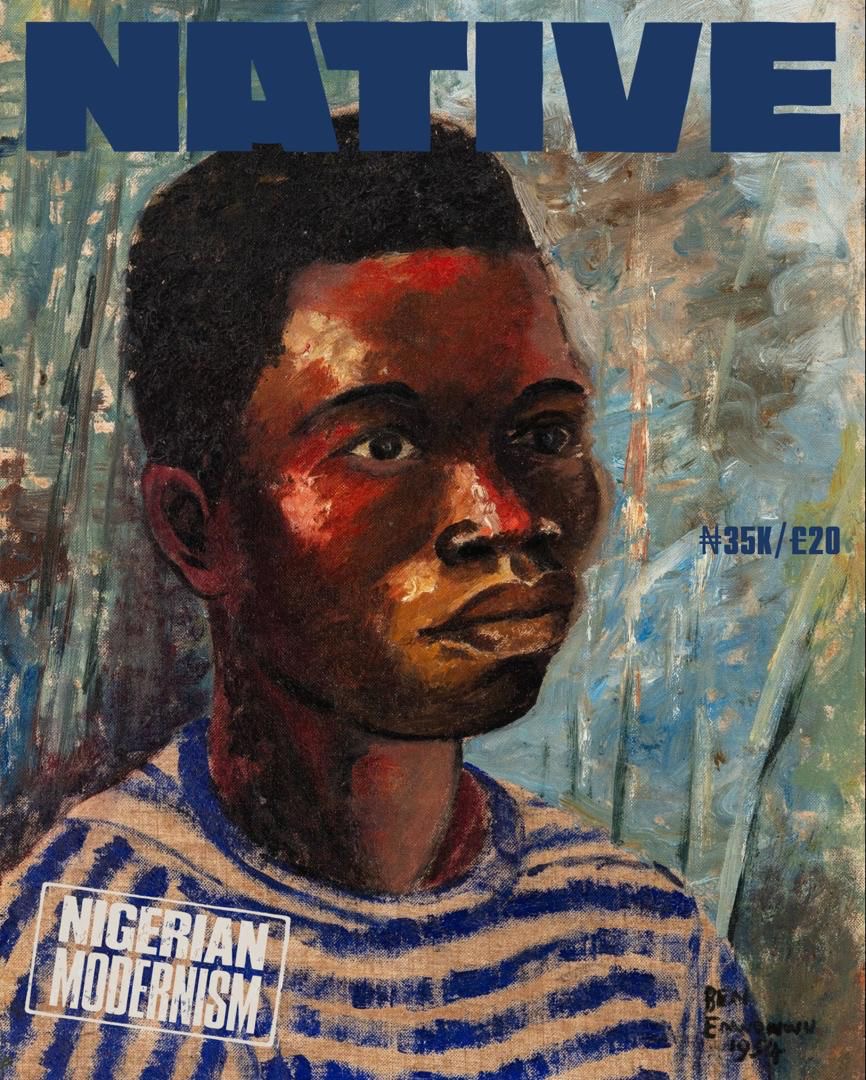
When editing these special stories, alongside Seni Saraki and Momo Hassan-Odukale, I had the student (in all forms) in mind. The one who is full of ideas that are cut off from its source. It is often when you connect innovation and context that the real magic happens. The Nigerian Modernism exhibition at the Tate Modern offers some of those puzzle pieces; I would like this issue to be offer some more in eventually revealing to you the big picture of who we are, who we were and who we are becoming.


INDIGO: AN INHERITED COLOUR
Q&A WITH OSEI BONSU
