Interview: Daramola Is Expanding His Horizons
Vying for Record of the Year at the 2026 Latin Grammys, Daramola is creating without borders.

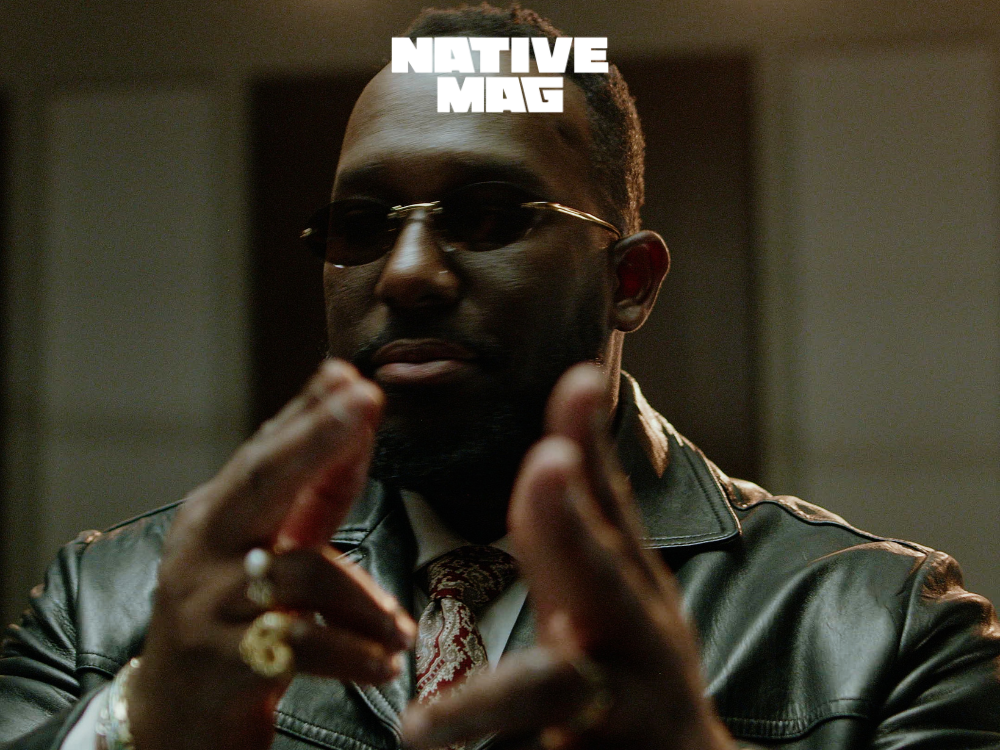
Vying for Record of the Year at the 2026 Latin Grammys, Daramola is creating without borders.
When we first met artist, songwriter, and producer Daramola, on 2017’s “Lotto”, his distinct blend of poetry, EDM, and Yoruba folk suggested a mercurial sound-bender in the making. Since then, he’s received a Grammy for his contribution to the ‘Bob Marley: One Love’ soundtrack, become a fixture in the Latin music scene, and helped rethink the musical DNA of contemporary Afrobeats.
2026 finds Daramola vying for Record of the Year at the Latin Grammys, this time nominated for his work on Elena Rose’s emotive “Alma.” “It’s an honour to be nominated,” Daramola says. “It’s a vote of confidence in what you’ve built and that, to me, is the best compliment.” Having fashioned records alongside Beele, Shakira, Alejandro Sanz and Sean Paul, Daramola carries his synergetic impulse into his upcoming producer album, ‘Le Di Sentido.’ “The name ‘Le Di Sentido’ is a perfect description for where I am mentally,” Daramola shares. “I’m making sense of everything that’s happening in my life right now. That’s manifesting itself in the sonics, sound selections, and in the collaborations.”
Some notable collaborators on the album are Anitta, Danny Ocean, Kapo, and Venezuelan band Rawayana, who appear on the lead single, “Gidi 2 Caracas (La Musica),” which offers a glimpse into the richly textured sonics to expect. “They’re really smooth guys, and when you see that in studio, you’d think they don’t care,” he says. “They don’t try; it’s just on them, and that really served the music.”
Effortlessly fusing mellow rhythms, tropical melodies, and swaying logdrums, the track embodies the spirit of ‘Le Di Sentido,’ capturing “the Nigerian experience in conversation with Latin sounds: Afrobeats meeting the Caribbean, Lagos meeting Caracas, church music meeting the dance floor.” At the core of ‘Le Di Sentido’ is the story of sound travelling, melodies coalescing, and a musical expression of Daramola’s journey as a Nigerian who finished high school in London and went back to Nigeria before finding himself at an HBCU in Alabama.
With early exposure to a range of genres, the now Miami-based artist embraces diverse ingredients from a melting pot of influences. “I’m heavy on abstract music, vocal production, synth arrangements,” he says. “In the same vein, my mom was a musician. Name every genre: Disco, Country, Juju, Highlife, and Gospel. She did it.”
Add a love for Craig David, Sufjan Stevens, Bon Iver, London Grammar and Fontaines DC to the foundational sounds of Fela Kuti, Nelly Uchendu, Oliver De Coque and Ebenezer Obey, and you get a meeting of musical worlds that has underpinned Daramola’s career. ‘Le Di Sentido’ is no exception to this alchemising, with Daramola describing it as a shared labour of love between friends across cultures. “My whole thing is ‘Let the music speak, and let it naturally evolve’,” he says. “If it travels, it travels; if it transcends, it transcends.”
Having access to the mind behind Bad Bunny’s most impactful songs over the years, Tainy, Daramola was encouraged to think of crafting a signature production style for himself. “For me, it’s like, ‘What does it mean in context’,” he says. “What is that sweet spot where it hits well but still has the sensitivities of what’s back home?” That’s a question answered on i-dle’s “Gimme Dat Love,” where Afropop grooves meet a K-pop bounce, seamlessly transferring Daramola’s familiar vibes to a new terrain.
‘Le Di Sentido’ showcases a melding of elements more broadly, with its cross-cultural exchanges taking the forefront. What drives Daramola’s communal approach is a conviction that sound belongs to the world, and a perspective that everything in the future will be a result of harmonic fusion. “I tell my kids that they’re a product of culture,” he shares. “I speak pidgin fluently, I speak Yoruba, and my Spanish is taking shape. It’s just different vocal experiences in the same house.” As a universal language, music can similarly shelter different sonic traditions under one roof. Daramola’s gift is how he allows the unique dialects within it room to be heard and space to creatively interact. “I’m a musician and I’m inspired by so many things,” he says. “I consider myself a global citizen and music is beautiful bro. Imagine trying to restrict that.”
That’s a sentiment worthy of preaching and, as a Dove Award winner for his work on Lecrae’s 2011 album ‘Rehab: The Overdose,’ Daramola keeps faith central to his artistic approach. “I’m a church boy,” he declares. “I used to stay in front of the drums every Sunday. You could call it church music or traditional music, but when you make that sweet, throw some synthesizers and mix it nice, it becomes more palatable.”
Reimagining the rhythms, harmonies and communal energy of a Nigerian church perfectly encapsulates Daramola’s ability to translate sounds across different environments. In many ways, his endeavours in the music industry bear the hallmark of a choirmaster guiding the gathering collectively in song. ‘Le Di Sentido’ does this on the cultural front, not seeking to collapse music into a singular sound, but expanding its horizons. For Daramola, there remain endless possibilities for where music can go, and his goal is to steward its direction. “There’s an art to creating and a framework for making something that lasts,” he says. “I think I found it when I had the number one record on the Latin Airplay, Latin Rhythm, and Latin Pop charts.”

