Ife Ogunjobi Is Staking His Claim with ‘Tell Them, I’m Here’
As a core member of the Mercury Prize–winning Ezra Collective, Ife Ogunjobi’s sound has travelled across global stages.

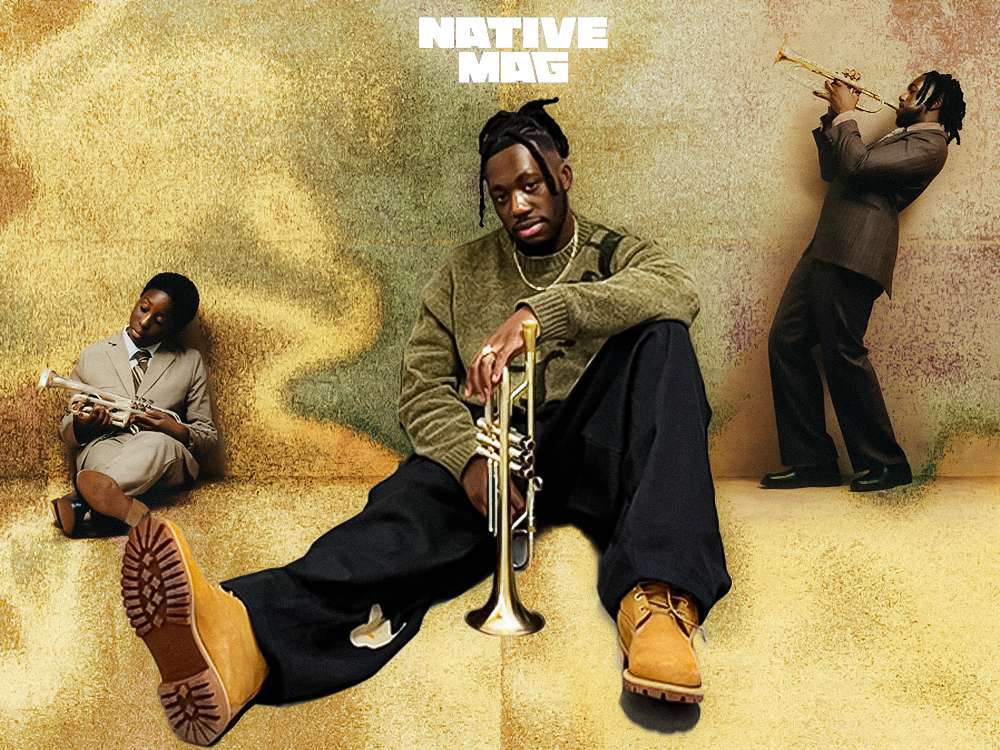
As a core member of the Mercury Prize–winning Ezra Collective, Ife Ogunjobi’s sound has travelled across global stages.
Between his 2023 debut, ‘Stay True,’ and now, Ife Ogunjobi has changed. He has grown more intent on revealing the full spectrum of his multifaceted self. Who he is now, by his own account, is someone thoroughly grounded in certainty. “There’s only one version of me,” he tells NATIVE Mag, “and that alone means I must be special in some way.”
Since that debut, Ogunjobi has moved through a period of rapid personal and creative expansion. He felt compelled to offer an update on his identity, guided by the belief that his music must faithfully reflect who he is at any given moment. Against that backdrop, his latest project, ‘Tell Them, I’m Here,’ captures his present state of mind: confident, assured, and openly optimistic about what lies ahead. The music is a conduit for the self-possession that defines him now, reaching outward towards new possibilities.
Building on this evolution, the EP projects a perspective rooted in a psychological state of aplomb that extends beyond career ambition. Ife Ogunjobi is, of course, authoritatively demanding attention upon his arrival, but he is also proposing a framework for personal autonomy. “It’s the confidence and self-belief I have in myself that I want other people to have as well,” he explains. “Even though the EP is called ‘Tell Them, I’m Here,’ I want everyone to be able to say that for themselves, in their own way. No one else can be you. You’re your own person, so step into that.” The title is an imperative sentence, striking in its decisiveness, and it is deeply satisfying that the music substantiates the claim.
A five-track release, ‘Tell Them, I’m Here‘ is a document of unrestrained melodic expression. It is buoyant and blissed-out, filled with sticky-sweet melodies that glide across subgenres, folding disparate influences from Afropop to Hip-Hop, Afro R&B, and Jazz into a cohesive whole while committing fully to genre-bending freedom.
The EP opens with the spunky, Highlife-inflected swinger “East Street Market,” a track that demonstrates the zest of the Walworth Road market. “I started with ‘East Street Market’ because a lot of projects like to ease you in with an intro before getting into it,” Ogunjobi says. “I wanted to do the opposite. I wanted to hit people straight away with what this is. As soon as you press play, you hear the drums come in. I wanted it to feel like a Nigerian hall party or like actually being in a busy market.”
It transitions seamlessly into “Cali,” where featured vocalist Samm Henshaw floats gently over a supple instrumental that gleams. “Zimbabwe,” which follows, is the EP’s most immediately adhesive moment. Rollicking and circular, it is driven by a trumpet refrain that settles into the listener’s body and refuses to leave. Ogunjobi has said that if he had to explain himself through a single song, this might be it. “Going into ‘Zimbabwe,’ I wanted to start heavy, then ease people into the vibe. If I had to explain who I am in one song, it might be this song. It’s infectious. I can listen to it all day.”
Indeed, while the prevailing mood is joyful and blithe, the EP is not emotionally monolithic, and Ogunjobi is careful not to stay in the sun for too long. He pivots to “Don’t Leave,” perhaps the most vulnerable moment on the record. On the track, the trumpet stops being a herald and starts being a confidant, moving at an unhurried, unharried pace. “It’s funny. People have said to me that once they’ve heard that song, it’s like they felt I was speaking even though I’m only playing the trumpet,” Ogunjobi shares.
None of this disrupts the EP’s coherence or its overall vivacity. There is a unifying sensibility that makes each track feel like a room in the same house, with Ogunjobi’s trumpet serving as a steady guide from one space to the next.
For an instrumentalist, this degree of emotional articulation is entirely intentional. Ogunjobi is a composer first, one who happens to play the trumpet, and uses the instrument to telegraph a complex range of feelings. Without lyrics to lean on, the burden of storytelling rests fully on melody and structure. He rejects the notion that instrumental music is subordinate to vocals. To him, the human voice can be too specific or limiting. A trumpet line, by contrast, can carry ten different meanings for ten listeners, allowing for a universality that words often constrain.
“When I start a song, it already has an emotional direction,” he says. “Then I ask myself, as an instrumentalist, what I actually want to say. I’m very intentional about that. Do I want people to feel uplifted? Reflective? Intimate? Do I want them to escape and forget their troubles? Because I don’t have lyrics, I have to be even more intentional. Everything has to come through the music itself.”
As a core member of the Mercury Prize–winning Ezra Collective, Ife Ogunjobi’s sound has travelled across global stages, forming part of the melodic backbone of a movement that has reshaped the aesthetics of 21st-century Jazz. Raised in South East London by Nigerian parents, his home was saturated with Fuji, Highlife, Afrobeat, and Jazz, where he first encountered foundational figures like Miles Davis, Fela Kuti, King Sunny Adé, and Ebenezer Obey.
While his training at the Royal Academy of Music furnished him with a formidable technical foundation, his musical instincts were forged in London’s Saturday music schools and youth centres. He recalls seeing Hugh Masekela perform at the Royal Festival Hall when he was just ten years old. That performance reoriented his sense of what was possible.
Contemporary African Jazz currently sits at the centre of global experimentation. On the continent and across its diaspora, the music is shaping the avant-garde. In South Africa, Nduduzo Makhathini frames Jazz as ritual, drawing on Zulu cosmology to guide modern improvisation. Groups like Kokoroko and SuperJazzClub channel West African lineage into groove-forward, dancefloor-ready forms. Across cities like Lagos, Paris, and London, artists like Lia Butler, Etuk Ubong, Ami Taf Ra, and Hervé Samb are building a borderless instrumental movement grounded in cultural memory and forward momentum. Ogunjobi agrees that the scene today is at a high point. “I think that Jazz and just generally the instrumental scene right now is one of its strongest,” he says. “I look at artists like Venna, who’s doing so well, and it’s very inspiring. There’s also Kokoroko; even though their music has lyrics, it is very instrumentally driven. And then artists like Masego, who sings but also plays the saxophone. There are so many pockets of people doing different things, all using instruments to tell their story as part of their craft.”
Ogunjobi’s work also intersects with Afropop’s global expansion, though it enters through a different door. He uses the trumpet to navigate the same grooves that have made West African artists global icons, adding a layer of virtuosic musicianship that feels fresh and historically literate. He remains unmoved by the industry’s bias towards vocalists. “I think the industry lost its way for a bit, treating instrumental music as a service for vocals. It doesn’t have to be that. I’ve always felt like music can speak a thousand words, even when there are no actual words.”
Looking forward, Ogunjobi is already scanning the horizon. “Even though the EP only came out, I’m already excited for what’s next and the new avenues that might open up from releasing it,” he shares. The future is an open field, and the creative restlessness that birthed ‘Tell Them, I’m Here’ is already nudging him towards new terrain, including a deeper dive into Dance music. “I want to make music you can dance to that still possesses depth,” he muses. “I want people to be in the club, dancing their problems away, while realising there’s a whole other level of nuance happening.” He isn’t sweating the journey, though. Whatever direction he takes, he remains untroubled by uncertainty. “Good music lasts,” he concludes. “It always finds its way to the surface.”
Listen to ‘Tell Them, I’m Here’ here.

