Review: ‘Black Star’ by Amaarae
In many ways, ‘BLACK STAR’ functions as a reflection of the perspective of a now actualised superstar.

In many ways, ‘BLACK STAR’ functions as a reflection of the perspective of a now actualised superstar.

When you arrive at “FREE THE YOUTH,” the closer of Ghanaian-American singer Amaarae’s third studio album, ‘BLACK STAR,’ you’re left with a buzz. The last 44 minutes have been spent immersed in a spacey and euphoric place where the glamour of dark synths swell and ebb. Throughout the album, Dance Pop sensibilities are cranked to the max to meet the sweaty desires of bodies seeking release on the dance floor.
While the ambitious “FREE THE YOUTH,” takes a peek into the future sonically, its title (derivative of the now popular Ghanaian streetwear brand) calls back to mind the no-holds-barred youth culture scene in Ghana from where Amaarae, much like the brand, first found stardom in the late 2010s. The inclusion of this track is a deliberate full-circle moment, a powerful grounding of her international success in local origins. When the last notes hit, questions linger on the mind: “What is a black star? What does this mean in the context of Amaarae’s career?”
It’s been a few years since her 2020 debut full-length album, ‘The Angel You Don’t Know,’ which produced the transcendent viral hit “Sad Girlz Luv Money” and its eventual remix featuring Kali Uchis. From TikTok feeds to dance floors across continents, the album opened a new world of possibilities. Its success, however, was merely the genesis of a broader, more ambitious journey.
In that time, Amaarae has charted on Billboard’s Hot 100, released her sophomore project, ‘Fountain Baby,’ joined Sabrina Carpenter on tour, made history as the first Ghanaian woman to perform at Coachella solo, carved an expansive fanbase, and opened for Kaytranada. She has successfully crossed over into the global sphere in a way that’s true to her eclectic nature, proving that wide appeal and authenticity are not mutually exclusive. In many ways, ‘BLACK STAR’ functions as a reflection of the perspective of a now actualised superstar.
The album arrived powered by two singles, “S.M.O.” and “Girlie-Pop!” as well as a Twitch livestream party in its honour. They offered a glimpse into the pulsating and inventive energy that was to come. It was clear that we were once again about to bear witness to Amaarae’s ability to ignite a titillating spark. If her career so far has shown anything, it’s that avant-gardism is where she shines best. In her airy sonic world, freedom, defiance, and deftly-written lust thrive. “Flip positions, switching genres/ till you make it pop,” she mulls on “Girlie-Pop!.”
Even for seasoned Amaarae listeners, ‘BLACK STAR’ might come off as overwhelming despite the warning the singer put up moments before its release. It’s audacious and exciting— two adjectives that always seem to follow any Amaarae project. Regardless, it eventually sticks. The opener “Stuck Up” wastes no time in establishing this new world. Its palette is a vibrant, carefully curated clash of genres, a defiant rejection of a single label. The heavy bass and crashing synths you hear on “Stuck Up” are not just for effect; they are the foundation of a sound ready to light up dimly-lit clubs around the globe. In the margin of the track, Amaarae expertly weaves Electro and Techno with the driving rhythms of Amapiano, Gqom, and Baile Funk.
In this new arc, self-indulgent hedonism is turned up to the max, and fun is the primary obsession. “Ketamine, coke, and molly,” she hauntingly repeats on the hook of the Bree Runway-assisted “Starkilla.” It’s not a glorification of drug use, of course; rather, she’s presenting a matter-of-fact testament of a night out marked by unbridled desire and pleasure. “I want your body black, make it sex attack/ I got some sexy ways, I move my body right,” Runway intones, creating a sense of immediacy to the song, contrasting the initial bravado with a genuine need for connection.
On “ms60”, Naomi Campbell attempts an all-encompassing definition of a black star: “They call me a bitch, a villain, a controversial diva/ No I am the Black Star.” Her understanding of being a black star does the phrase some justice. A test of stardom is being the constant subject of conversation, of which Campbell is a seasoned veteran. However, the album proves that a black star in this borderless digital age is an honest transverse product of black diasporic culture.
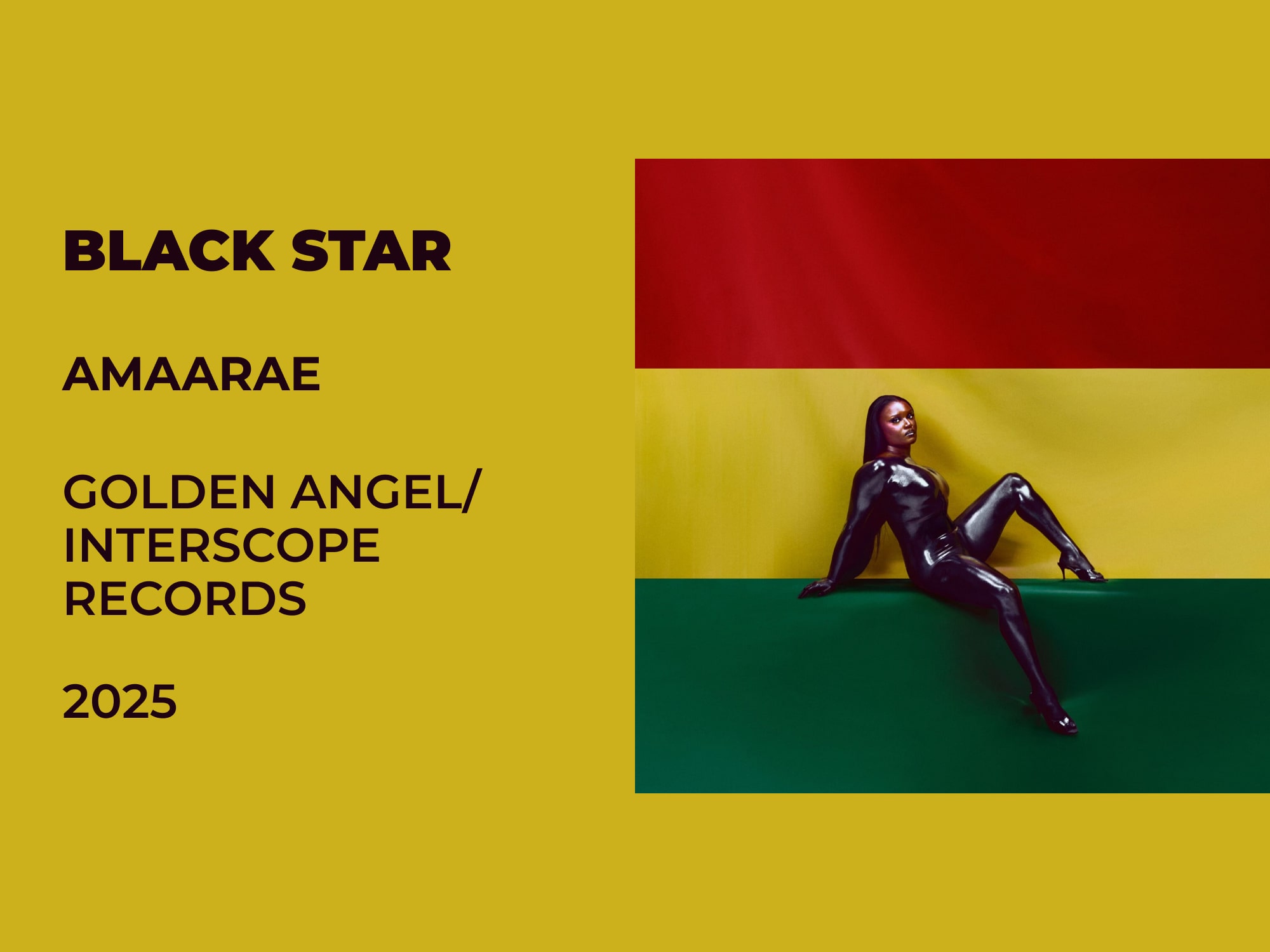
Ultimately, the Black Star of Africa, the symbol on Ghana’s national flag (and Amaarae’s cover art), represents emancipation, unity, and the guiding light of hope for the continent. What does this mean for the artist? Well, it could be a representation of where she currently finds herself in her journey. She is framing her success not just as an individual achievement, but as a victory for a new generation of Ghanaian and diasporic artists.
While some might argue that there was space for her to lean into more Pan-Africanist themes and conversation, Amaarae has never had the penchant for doing the expected. Instead, on the album, she creates sounds that are both universally danceable and distinctly diasporic. She trots the globe, tapping various dance styles from the US, Europe, Brazil, and South Africa to connect their shared Black origins. It does not stay tethered to a singular era as it ventures into different periods for inspiration.
On “Kiss Me Thru the Phone pt 2,” Amaarae is joined by fellow sample-maestro and whispery-toned singer, PinkPantheress. With unsurprisingly great chemistry, both artists take turns offering a modern spin on the lovestruck anthem by American rapper Soulja Boy over a flip of Sisqo’s “Thong Song.” “I’m not hanging up/ Could replace your love/ But I don’t want to,” they sing, yearning over their interests. Similarly, “Stuck Up” interpolates Gucci Mane’s “I Might Be” and Cher’s “Believe” finds new life on “She Is My Drug,” where Amaarae passionately asks, “Do you believe in love off the drugs?” While the sample choices may seem disparate at first glance, a late ’90s Cher hit next to a 2008 Soulja Boy track makes all the sense when viewed through the lens of Amaarae’s pursuit of connection and desire.
Though ‘BLACK STAR’ offered the promise of a major departure from its predecessor, some tracks like the wispy “B2B” and the trance-like standout, “Fineshyt” leave a familiar taste in their wake. Unlike ‘Fountain Baby, the subject matters explored on ‘BLACK STAR’ dive deeper into longing and embracing vulnerability. While Amaarae’s previous work was characterised by a carefree and detached confidence, this album reveals a softer, more introspective side.
Hedonism isn’t just about fun; it’s a way of coping, of seeking connection. The yearning and sensitivity feel like a palpable counterpoint to the album’s often hard-hitting production. “Dream Scenario,” starring the lauded Charlie Wilson, is as starry-eyed as it sounds. Amaarae breaks down her fantasies of a fashion-forward lover nestled in a Barbie dream house who’s willing to accompany her on lasting vacations to Ghana. Wilson’s addition is a masterstroke. His soulful, seasoned voice adds a layer of sincerity to Amaarae’s fantastical lyrics.
In all, ‘BLACK STAR’ is an agreeable contradiction that ordinarily shouldn’t work, but for some reason, it does, and it does so effortlessly. For this, we have Amaarae’s singular artistic vision and ability to find the emotional core of every song to thank. This is an album not just to be heard, but to be experienced thoroughly. It is clear that Amaarae now regards herself as a cultural polymath, relentlessly working her way to a resolution of her take on cross-pollinated Dance influences in each song. By the time the last notes of ‘BLACK STAR’ are sung, we have encountered an artist who has truly found her place in the cosmos—a shining, undeniable black star in her own right.
Listen to ‘BLACK STAR‘ here.

